Canon Patent For 85mm f/1.2, 100mm f/1.4, 24-70mm f/2.8, and 28-85mm f/2-2.8 Lenses for Mirrorless
Canon Patent

Another Canon patent application spotted by Hi Lows Note.

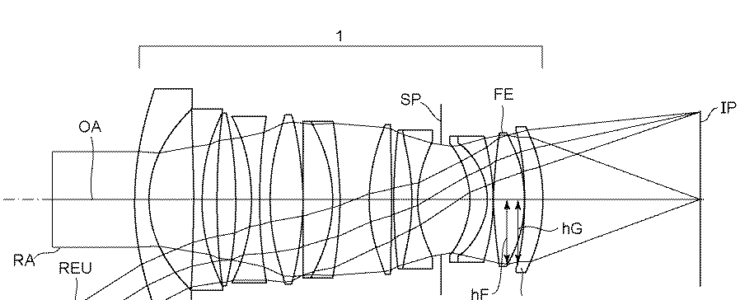
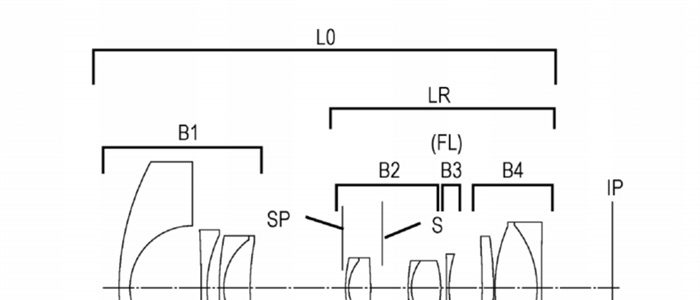
Patent application 2019-49646A and 2019-49645A describes optical formulas for 85mm f/1.2, 100mm f/1.4, 24-70mm f/2.8, and 28-85mm f/2-2.8 lenses for mirrorless cameras.

Focal length: 86.5 mm
F number: 1.24
Image height: 21.64 mm
Lens length: 135.0 mm
Back focus: 13.5 mm

Focal length: 100.0 mm
F number: 1.46
Image height: 21.64 mm
Lens length: 142.0 mm
Back focus: 14.1 mm

Zoom ratio: 2.75
Focal length: 24.71 – 45.00 – 67.90 mm
F number: 2.88
Half angle of view: 41.21- 25.68 – 17.67
Image height: 21.64 mm
Lens length: 143.89 – 161.78 – 179.68 mm
Back focus: 13.42 – 27.34 – 38.58 mm

Zoom ratio: 3.04
Focal length: 28.00 – 53.77 – 85.00 mm
F number: 2.00 – 2.60 – 2.88
Half angle of view: 37.69 – 21.92 – 14.28
Image height: 21.64 mm
Lens length: 158.50 – 176.83 – 195.16 mm
Back focus: 16.00 – 28.52 – 41.05 mm
Canon Patent For Stacked Sensor Technology

canon patent

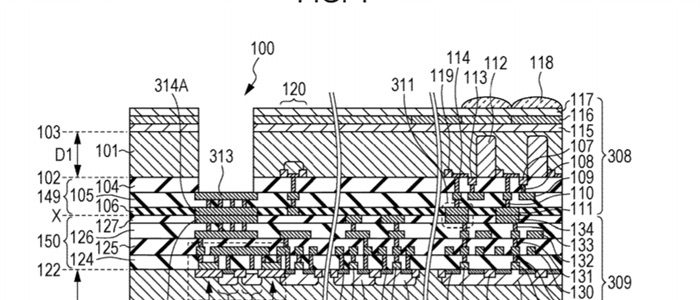
Canon patent application US20190096931 describes a stacked sensor. If you want to lear more about how a stacked sensor works, this article might help.

From the patent literature:

In CCD type and amplification-type solid-state image pickup devices used for digital still cameras, camcorders, and the like, in order to obtain high definition images, the sizes of pixels are required to be reduced. However, as the sizes of pixels are reduced more and more, a light receiving area of a photoelectric converter, in a pixel, detecting light is decreased, and the sensitivity is decreased. 

Canon Patent For 8-15mm Fisheye Lens For APS-C Mirrorless

canon patent

Canon patent application US20190094490 describes the optical formula for an 8-15mm fisheye lens. Given the back focus distance this is most likely a lens for the EOS M system.

From the patent literature:

In order for a zoom lens to have a wide angle of view and achieve high optical performance across the entire zoom range and the entire object distance range, it is important to appropriately set the elements constituting the zoom lens. For example, it is important to appropriately set the zoom type (the number of lens units and the refractive power of each lens unit), the lens configuration, and the lens unit selected for focusing, and so on. 

If these configurations are not appropriate, achieving a wide angle of view will increase the size of the whole system and also increase the variations of various aberrations caused by zooming and focusing. It will therefore be difficult to achieve high optical performance across the entire zoom range and the entire object distance range. 

For example, for a fisheye zoom lens having an imaging half angle of view of 85 degrees or more, a meniscus lens having an extremely strong negative refractive power needs to be disposed closest to the object side within the first lens unit in order to take light rays into the zoom lens from such a wide angle of view. Generally, lenses in a first lens unit not only have strong refractive powers but also have large effective diameters. Thus, when it comes to a fisheye zoom lens, its first lens unit is heavy and large as well. Then, if the entirety or part of the first lens unit (the closest lens unit to the object side) is used as a focus lens unit, quick focusing will be difficult. 

Here Is Another Canon Patent For IBIS (In Body Image Stabilisation)

canon patent

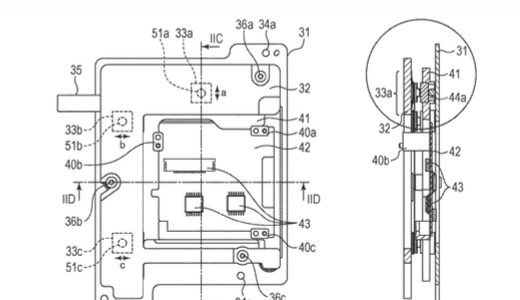
Not the first Canon patent application about IBIS (In Body Image Stabilisation).

Patent application US20190094566 describes the technology for a sensor based image stabilisation system. 

Patent application abstract:

An image stabilizing apparatus includes an optical element, a first fixing member, a movable member that holds the optical element, and is movably supported in a flat surface perpendicular to an optical axis, a ball sandwiched between the movable member and the first fixing member, a vibration wave actuator that includes a piezoelectric element and a vibrating plate, and moves the movable member, a slider that contacts the vibrating plate, and is provided in the movable member, a spring that pressurizes the vibrating plate against the slider, and a second fixing member fixed to the first fixing member so as to make the vibrating plate and the slider contact each other with a predetermined pressure.

Canon Patent For 35mm f/1.4, 85mm f/1.2 and 70-200mm f/2.8 Lenses for Full Frame Cameras

canon patent

Hi Lows Note spotted a Canon patent application (2019-45631A) describing optical formulas for a 35mm f/1.4 and 85mm f/1.2 for full frame DSLRs, and for a 70-200mm f/2.8 for full frame mirrorless cameras (the EOS R system).

Focal length: 34.31 mm
F number: 1.45
Angle of view: 32.24
Image height: 21.64 mm
Lens length: 139.98 mm
Back focus: 39.01 mm

Focal length: 85.00 mm
F number: 1.24
Angle of view: 14.28
Image height: 21.64 mm
Lens length: 123.50 mm
Back focus: 39.70 mm

Zoom ratio: 2.71
Focal length: 72.00 ~ 134.99 ~ 194.94 mm
F number: 2.91 ~ 2.91 ~ 2.98
Angle of view: 16.73 ~ 9.11 ~ 6.33
Image height: 21.64 mm
Lens length: 172.73 ~ 219.96 ~ 231.71 mm
Back focus: 14.37 ~ 18.40 ~ 28.12 mm

Canon Patent For RF 24-70mm f/2.8 and RF 28-85mm f/2.0-2.8 Lenses (EOS R System)

canon patent

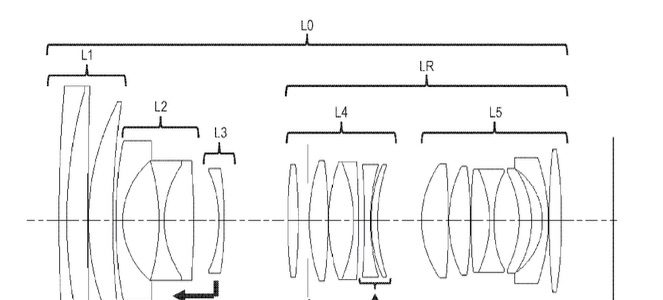
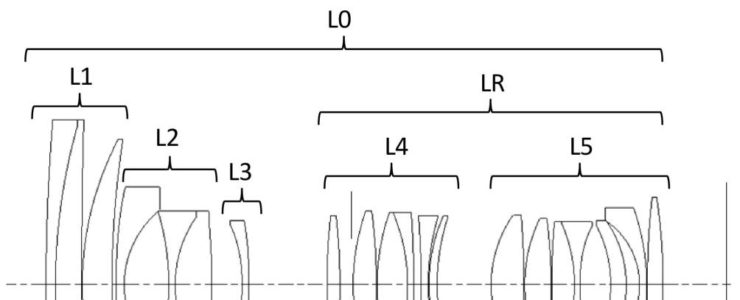
Here is another Canon patent application (2019-0079269) for two lenses for the Canon RF mount.

From the patent abstract:

[expander_maker id=”2″ more=”Click to read the article” less=”Read less”]

Provided is a zoom lens including a plurality of lens units, in which an interval between each pair of adjacent lens units is changed during zooming. The plurality of lens units consist of, in order from an object side to an image side: a first lens unit having a positive refractive power; a second lens unit having a negative refractive power; a third lens unit having a negative refractive power; and a rear lens group including at least one lens unit. An interval between the second lens unit and the third lens unit becomes larger at a telephoto end than at a wide angle end. The third lens unit is moved during focusing. Focal lengths of the second lens unit and the third lens unit, a focal length of the zoom lens at the wide angle end, and a back focus at the wide angle end are appropriately set.

More Canon patent applications are listed here. Some particularly interesting patent applications we think might get into production in the next few years are these:

[/expander_maker]