Hack: A Canon PowerShot A530 with CHDK Used to Shot (and send) Pictures from Stratosphere

There is not only Magic Lantern to get the juice out of your Canon DSLR, CHDK is a firmware extension for Canon PowerShot cameras (with many many supported PowerShots):

CHDK is a firmware enhancement that operates on a number of Canon Cameras. CHDK gets loaded into your camera’s memory upon bootup (either manually or automatically). It provides additional functionality beyond that currently provided by the native camera firmware.

To see all features click here, for an overview go here.  So, what do you need if you want to send images from the stratosphere to the ground? A lot of stuff I guess, but for the photographic part you’ll not need the high end gear you may think. Chris Stubbs is an apprentice electronic engineer who started a pretty cool project concerning high altitude balloon flights. To shot images he uses a Canon PowerShot A530 (here on eBay) with CHDK installed, and a cheap Radiometrix NTX2 FSK radio module that is so small it fits into the battery compartment.

There are a lot of technical details in Chris’ post, the project is described in every detail. Not a DIY weekend project but something you could replicate with a bit of patience and some technical skills.
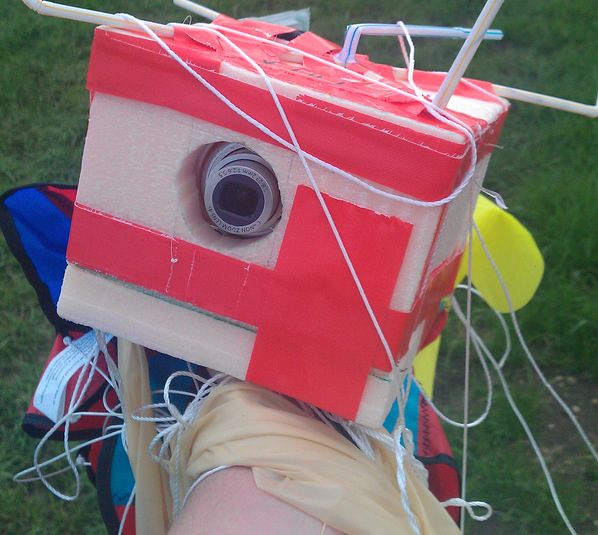

Ready to go high (image credit: Chris Stubbs)
[via hackaday]


Canon Prototype Full-Frame Sensor Captures Fireflies at Less than 0.01 Lux

Screenshot taken from the video mentioned below

Canon published a press release about a prototype 35mm sensor (announced in March 2013). This sensor is capable to capture images in extreme low light, less than 0.01 lux. To give an example the full moon provides approximately 0.3 lux, the crescent moon approximately 0.03 lux. If you follow this link there is a sample video that shows what it is about.

The press release:

TOKYO, Japan, September 12, 2013—Canon Inc. has successfully captured video footage of Yaeyama-hime fireflies flying in darkness, a feat made possible by the high-sensitivity 35 mm full-frame CMOS sensor developed by Canon for video capture that was announced in March 2013.


  • Yaeyama-hime fireflies amid jungle vegetation
    (Photomontage created from video footage)

  • 35 mm full-frame CMOS sensor for
    Full HD video capture

The high-sensitivity, low-noise video-shooting capabilities of the dedicated 35 mm full-frame CMOS sensor1for Full HD video capture were made possible not only through the integration of the high-performance sensor technologies employed in Canon’s digital SLR cameras, but also through the incorporation of new pixel and readout circuitry technologies that reduce noise.

Using a camera prototype equipped with the CMOS sensor, Canon, in cooperation with ZERO CORPORATION,2 succeeded in capturing video3 of the Yaeyama-hime fireflies that inhabit Japan’s Ishigaki Island, located off the northeastern coast of Taiwan. No artificial lighting was used during shooting, which took place after sunset amid the island’s mountains. Despite an exceptionally dark shooting environment4 of less than 0.01 lux, a level in which the naked eye would have difficulty discerning surrounding objects, the CMOS sensor was able to capture not only the color of the light emitted by the fireflies, each of which measures only a few millimeters in length, and their movements, but also the surrounding vegetation in which the species lives. Plans call for the footage to be used to benefit future research into the Yaeyama-hime firefly.

In addition to astronomical and natural observation, Canon is looking into applying this CMOS sensor to medical research purposes as well as surveillance and crime-prevention equipment. Through the further development of innovative CMOS sensors, Canon aims to expand the realm of photographic possibilities while cultivating the world of visual expression.

Rokinon 16mm T2.2 Cine Lens in Stock and Ready to Ship

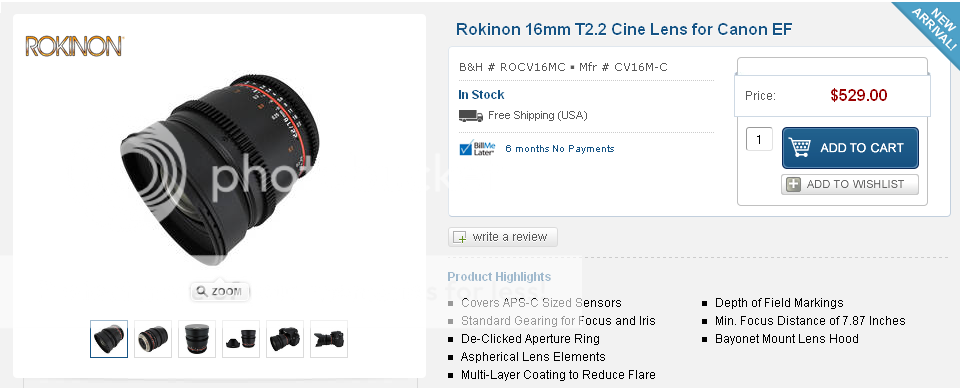
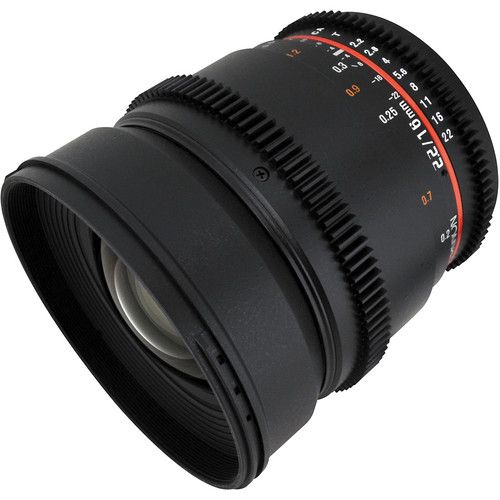
Rokinon 16mm T2.2

B&H has the Rokinon (or Samyang or Bower) 16mm T2.2 Cine Lens in stock and ready to ship for $529 (click here). Free shipping in the US, and B&H now ships worldwide too. The specs:

Focal Length 16 mm
Comparable 35mm/Full-Frame Focal Length: 25.6mm
Aperture Maximum: T2.2
Minimum: T22
Iris Blades 8
Mount Type Canon EF
Format Compatibility Covers APS-C or smaller sensors
Angle of View 79.5° (Canon APS-C)
Lens Construction 13 elements in 11 groups (1 x aspherical element, and 1 x hybrid aspherical element)
Filter Size 77 mm
Minimum Focus Distance 7.87″ (20.00 cm)
Gear Pitch 0.8
Dimensions (Diam. x L) 3.3 x 3.5″ (83.0 x 89.4 mm)
Weight 20.6 oz (583.0 g


Product description after the break or check the B&H in-depth article about the Rokinon 16mm T2.2.

Click here to open the rest of the article

A Bit of Everything

cinema5D compares the Canon EOS 7D to Alexa and Sony F65 plus tests beauty filters – planet5d

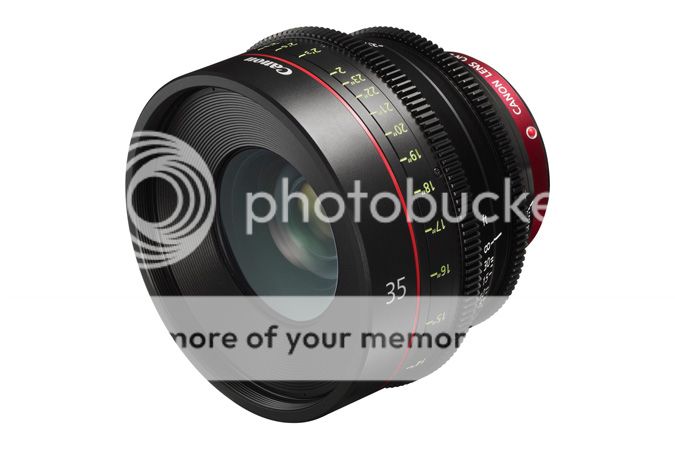
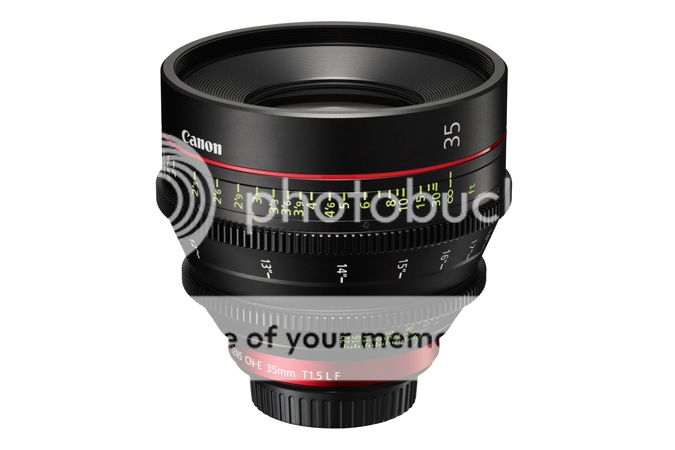
Canon Announces New CN-E35mm T1.5 L F Cine Lens (and firmware update for C500, C300, C100, XF305 and XF300)

Canon announced a new 35mm cine lens, and firmware updates for the EOS C500, , C300, C100, XF305 and XF300. The firmware for the EOS cine cams is scheduled for November 2013, for the XF305 and XF 300 it is scheduled in early 2014. Click here to learn the details of the firmware update.

Canon press release for the CN-E35mm T1.5 L F:

Canon Expands Its Cinema Prime Lens Family to Six Models with the Introduction of the New CN-E35mm T1.5 L F for Single-Sensor 35mm Cameras

Designed for Film-Style Operation, the Canon Cinema Prime Lenses Deliver Exceptional 4K / 2K / HD Imaging Performance and a Broad Range of Focal Lengths

MELVILLE, N.Y., September 4, 2013 – Canon U.S.A., Inc., a leader in digital imaging solutions, has announced today the new CN-E35mm T1.5 L F single-focal-length Cinema prime lens designed for large-format single-sensor digital cinematography cameras employing Super 35mm or full-frame 35mm imagers. Delivering outstanding optical performance in contemporary 4K / 2K / HD motion imaging, the new Canon CN-E35mm T1.5 L F prime lens is the sixth member of Canon’s line of compact, precision-matched EF-mount Cinema prime lenses, which also includes 14mm, 24mm, 50mm, 85mm and 135mm EF-mount models.

Click here to open the rest of the article