Canon EOS R6 V Officially Announced: 7K RAW, Active Cooling, No EVF – And It’s 300 Cheaper Than the R6 III
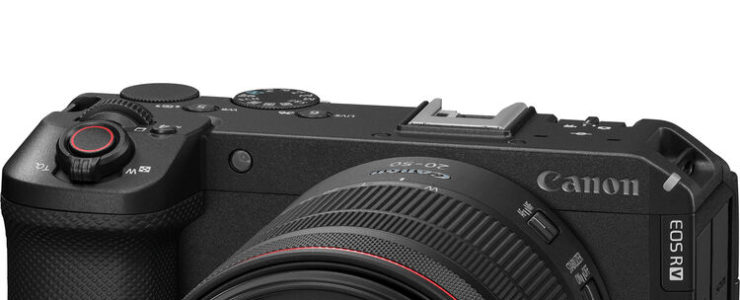
eos r6 v

Pre-orders are available at B&H Photo:

It’s official. Canon has announced the EOS R6 V, a video-first full-frame mirrorless camera that borrows the R6 Mark III’s sensor, throws in 7K RAW recording, adds a cooling fan, and removes the viewfinder. The result is something that doesn’t quite fit into any existing category – which appears to be exactly the point.

What It Is

The R6 V is the newest member of Canon’s “V-series” lineup (following the EOS R50 V and PowerShot V1), designed specifically for video creators. It uses the same 32.5MP full-frame CMOS sensor as the EOS R6 Mark III and Cinema EOS C50, paired with a DIGIC X processor. But that’s where the similarities end.

Canon stripped out the EVF and mechanical shutter entirely, added a built-in cooling fan, and built the body around video workflow: flat top plate for gimbal mounting, front-facing record button, a zoom lever around the shutter button, and dual tripod mounts (one on the bottom, one on the side grip for vertical shooting). It even has a tally lamp.

The Video Headlines

  • 7K RAW internal recording at up to 30p (Canon Cinema Raw Lite), or 7K Light RAW at up to 60p
  • Open Gate recording (3:2, 6960×4840) at up to 30p in RAW
  • Oversampled 4K from 7K at up to 60p, subsampled 4K at up to 120p
  • Full HD at up to 180p for slow motion
  • Canon Log 2 and Log 3, plus newly added HLG and PQ HDR
  • 7K ProRes RAW via HDMI to compatible Atomos recorders

Codec support includes XF-HEVC S and XF-AVC S, with 10-bit 4:2:2 options. Canon says you can record continuously for over 2 hours in demanding modes (like 4K/60 oversampled or 7K Open Gate) thanks to the active cooling fan – a significant improvement over the R6 Mark III, which would overheat after 20-30 minutes in the same modes.

The Stills Situation

Yes, it shoots stills. 32.3MP at up to 40fps with electronic shutter, with pre-continuous shooting that buffers about 20 frames before you fully press the shutter. RAW, C-RAW, JPEG, and HEIF are all supported.

The catch? There’s no mechanical shutter – just an electronic rolling shutter with a ~13.5ms readout. That means rolling shutter artifacts on fast-moving subjects, and no flash support at launch (Canon says a firmware update is coming). Also: sRGB only for stills. No Adobe RGB. Make of that what you will.

IBIS: The Surprise Inclusion

Here’s what nobody expected: the R6 V has in-body image stabilization rated at 7.5 stops (CIPA standard). That’s noteworthy because the more expensive Cinema EOS C50 – which shares the same sensor – does not have IBIS. For handheld video work, this is a big deal.

RF 20-50mm f/4L IS USM PZ: The Kit Lens

Announced alongside the R6 V is the RF 20-50mm f/4L IS USM PZ, Canon’s first L-series lens with a built-in power zoom. The 20-50mm range covers ultra-wide to standard, and the internal optical zoom design keeps the center of gravity balanced for gimbal use. You can switch between manual and power zoom from a single ring, and control zoom remotely via the Canon Camera Connect app or Bluetooth remote.

Pricing and Availability

Yes, you read that right: $2,499, which is $300 less than the EOS R6 Mark III. Canon is pricing this aggressively for the creator market. Everything ships late June 2026.

What’s Missing

No EVF. No mechanical shutter. No flash support (for now). No Adobe RGB. No shutter angle (you’d need to step up to the C50 for the Cinema EOS menu system). No bulb mode. No dual base ISO. This is not a camera for everyone, and Canon seems perfectly fine with that.

The Competition

The most direct competitor is the Nikon ZR, which also takes a full-frame sensor from an enthusiast hybrid and wraps it in a video-centric body with RAW recording. The R6 V wins on Open Gate recording, full-size HDMI, and full-size SD card slots. The ZR fights back with internal 32-bit float audio and a larger 4″ display. Sony’s ZV-E1 and FX2/FX3 are also in the conversation, though the R6 V’s 7K RAW and built-in cooling give it a clear thermal and resolution edge.


Sources: Canon USA press release
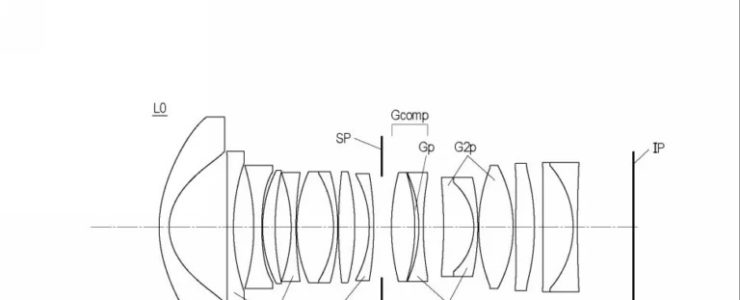
Canon Patent: Fast Wide Primes — 14mm f/1.4, 18mm f/1.4, 35mm f/1.8 Optical Systems

canon patent

Canon is apparently not done dreaming about fast wide primes. A new patent application published March 12, 2026 (JP P2026043301, filed August 28, 2024) covers a family of large-aperture wide-angle optical systems — and the specs on paper are the kind of thing that makes lens nerds sit up straight.

The stated goal? “Provide an optical system with a large aperture ratio, high optical performance, and fast focusing capability.” Bold words. Let’s look at what they’re actually proposing.

The Patent: Five Optical Systems, One Ambitious Brief

The application includes at least five worked examples spanning a broad range of focal lengths:

ExampleFocal LengthF-valueHalf-angleImage HeightTotal LengthBack Focus
Ex. 114.42mmf/1.4652.34°18.68mm118.50mm14.00mm
Ex. 220.60mmf/1.4642.54°18.90mm117.50mm18.44mm
Ex. 324.72mmf/1.4637.40°18.90mm117.50mm15.00mm
Ex. 418.45mmf/1.4645.46°18.75mm121.17mm17.78mm
Ex. 734.00mmf/1.8530.41°19.96mm98.50mm14.00mm

In plain English: Canon is exploring 14mm f/1.4, 18mm f/1.4, 20mm f/1.4, 24mm f/1.4, and 35mm f/1.8 optical designs — all with large image circles consistent with full-frame sensors.

The Back Focus Situation (Here We Go Again)

Here’s where it gets interesting — and a little speculative. The RF mount has a flange focal distance of 20mm. Several of these designs have back focus values well below that threshold: 14mm (Ex. 1), 15mm (Ex. 3), 14mm (Ex. 7), and 17.78mm (Ex. 4). Only Example 2 at 18.44mm gets close.

Short back focus in a patent design doesn’t automatically disqualify RF compatibility — there are design tricks (rear floating elements, internal focusing groups) that can shift real-world performance away from the listed patent geometry. But it does raise the familiar question that haunts Canon patent watching: are these RF, EF, or something else entirely? Canon has filed similar wide-aperture designs in the past that turned out to be for cinema lenses or specialized applications rather than consumer RF glass.

That said, the image heights (18.68–19.96mm) are solidly full-frame territory, and the total lengths (98–121mm) are reasonable for fast prime construction.

What It Could Mean for Canon Shooters

Canon’s RF wide-prime lineup still has some gaps. The RF14-35mm f/4L IS USM covers the ultra-wide zoom territory, and the RF15-35mm f/2.8L handles the faster end — but dedicated fast wide primes like a 14mm f/1.4 or 20mm f/1.4 would be genuinely new territory for RF. Sony has the FE 14mm f/1.8 G Master and the FE 20mm f/1.8 G; Nikon has the Z 20mm f/1.8 S. Canon RF shooters interested in astrophotography, architecture, or environmental portraits at wide angles have been waiting.

A 35mm f/1.8 RF, meanwhile, would slot neatly between the existing RF35mm f/1.8 Macro IS STM (budget end) and the RF35mm f/1.4 L VCM (flagship). Whether Canon actually wants to fill that middle ground is another question.

The Standard Caveats Apply

Patents are not products. Canon files dozens of optical system patents that never see production glass. This one is interesting because it covers multiple related focal lengths in a single application, which sometimes signals more serious R&D intent — but it’s still early days. Filed in August 2024, published March 2026, and almost certainly years from a camera store near you, if it ever gets there at all.

Still: a 14mm f/1.4 RF would be something. We’ll be watching.


Source: とるなら (asobinet.com) — Patent JP P2026043301, published 2026-03-12, filed 2024-08-28.

TTArtisan TILT-SHIFT 17mm F4 Lens For Canon RF Mount Announced

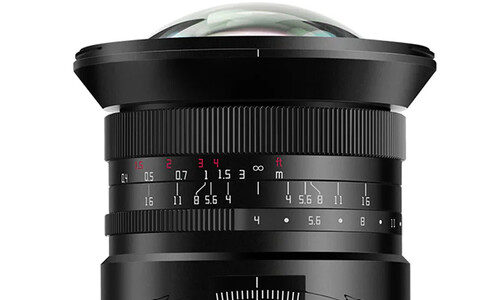
TTArtisan announced an affordable tilt-shift lens for the Canon RF mount. Please note: the image above is the lens for the Fujifilm mount.

At a glance:

  • Ultra-Wide 17mm Perspective – Perfect for Architecture & Landscape Photography
  • Tilt ±8° & Shift ±8mm – Corrects Perspective Distortion with Precision
  • 360° Rotation (15° Click Stops) – Flexible Composition at Multiple Angles
  • Ultra-Large Image Circle (Φ64mm) – larger than that of medium format lense
  • All-Metal Body with Clicked Aperture Ring – Built for Professional Durability
  • 17 Elements in 11 Groups – Sharp, Clear & Detailed Rendering
  • Closest Focus Distance: 0.3m | Manual Focus
  • Weight: Approx. 1031~1060g

The TTArtisan TILT-SHIFT 17mm F4 sells for $550 and can be preordered at B&H Photo.

Canon EOS R7 Mark II Might Be Released Before June 2026, Maybe

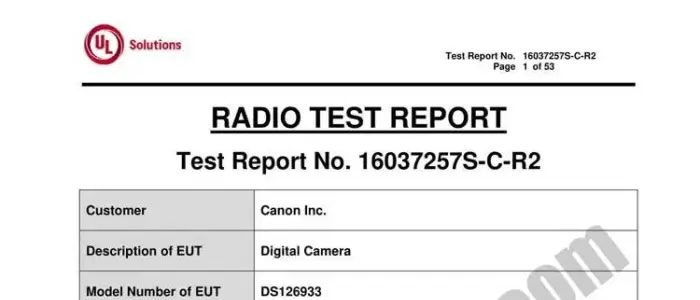
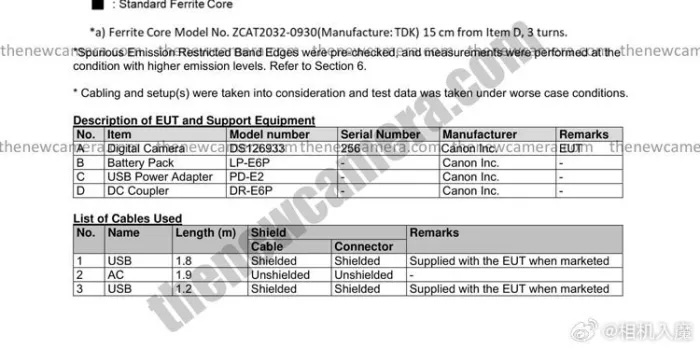
According to the FCC certification letter for Canon’s new camera announced on December 17th last year, there is reason to believe that the Canon EOS R7 Mark II will be released before June this year.

This is because the FCC certification is only confidential for 180 days. The specifications mentioned in the certification, such as the LP-E6P battery and the CFexpress+SD dual card slots, all point to the R7 Mk2.

Take it with a grain of salt.

Source: Weibo

Canon PowerShot G7 X Mark III (30th Anniversary Graphite Limited Edition)

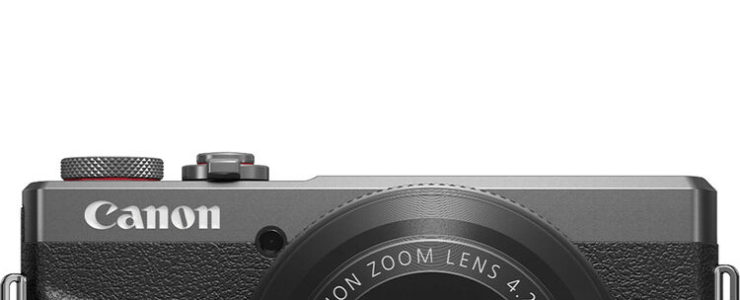
Canon announced a new PowerShot G7 X Mark III (30th Anniversary Graphite Limited Edition).

Key Features

  • 20.1MP 1″ Stacked CMOS Sensor
  • Includes Wrist Strap and SD Card
  • DIGIC 8 Image Processor
  • 4.2x Optical Zoom f/1.8-2.8 Lens
  • 24-100mm (35mm Equivalent)
  • 3.0″ 1.04m-Dot Tilting Touchscreen LCD
  • UHD 4K30p and Full HD 120p Video
  • 20-fps Shooting, 30-fps Raw Burst Mode
  • Built-In Bluetooth and Wi-Fi
  • Live Streaming & Vertical Video Support

Megadap Announces First M to RF Autofocus Adapter

This new Megadap adapter transforms M-mount manual-focus glass into a modern RF autofocus lens:

Key Features

  • True Autofocus on ANY Leica M lens – advanced motor-driven helicoid delivers fast, precise focusing
  • Full Canon Dual Pixel AF power – Eye Detection, Subject Tracking, Face Priority & AF-C all work natively
  • Quick MF/AF Switch – Macro / Infinity focus mode
  • Built for heavier lenses – rock-solid stability, no wobble even with big classics
  • Adapter stacking friendly – add EF, F, or other mounts and still get full AF
  • Electronic contacts – EXIF data + Aperture selector
  • Sleek & compact design – perfect balance on your RF body, tripod-ready