A Detailed Look On AF Microadjustement (Canon DLC Article)

af

Canon’s Digital Learning Center published a long article about auto-focus microadjustement, a useful feature you find on Canon’s higher level DSLRs, and a feature that was thankfully re-introduced to the xxD line-up with the [shoplink 14246]Canon EOS 70D[/shoplink].

From the introduction:

What does AF Microadjustment do?
It allows the user to command the camera to intentionally shift the sharpest focus either in front of or behind where it’s factory-set. The extremely precise AF system in a digital SLR is designed to read contrast at the subject, calculate how to drive the lens to focus sharply on the subject, and confirm sharp focus once the lens has stopped. With AF Microadjustment, the user is changing the data coming from the AF system, and asking it to move the lens farther in one direction or the other whenever it has to read and calculate sharp focus.

The adjustments applied using this control are based on the depth-of-field you’d have at a lens’s maximum aperture. They are not based on the lens’s focal length! When setting the Microadjustment, you’ll see a scale on the camera’s LCD monitor with up to + or – twenty steps. Each step is a very fine increment, equal to 1/8th of the depth-of-field you’d have with the current lens wide-open. And that 1/8th of the depth of field is only moving forward (toward the camera) or back (toward the background) from the sharpest plane of focus. The main thing to remember here is that these are very fine increments. Don’t expect radical shifts in focus with adjustments like plus 3 or minus 5.

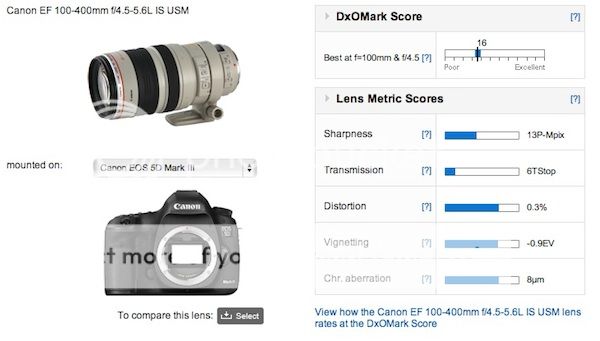
Canon EF 100-400mm f4.5-5.6L IS DxOMarked (a good all-round choice)

EF 100-400mm f4.5-5.6L IS

DxOMark felt the pulse of another well known Canon work-horse lens, the Canon EF 100-400mm f4.5-5.6L IS [shoplink 124](price & specs)[/shoplink]. They say it is “still a good all-round choice”.

  • Comparison Canon EF 100-400mm f4-5.6L IS vs. EF 70-300mm f4-5.6L IS (click here)
  • Comparison Canon EF 100-400mm f4-5.6L IS vs. Sigma 50-500mm f4-6.3 APO EX DG HSM vs. Sigma 50-500mm f4.5-6.3 APO DG OS HSM (click here)
  • Comparison Canon EF 100-400mm f4-5.6L IS vs. Canon EF 200-400mm f4L IS Extender 1.4x (click here)

In the conclusion they write:

Without doubt this lens is a popular model and it’s not difficult to see why. It has pretty good image quality throughout the range – though sharpness is confined to a relatively small area centrally at the initial aperture. Edge performance improves when stopped down but it’s not ideal where shooting in available light is usually the only option.

A new updated version is long overdue but when it arrives will likely have improved full aperture performance and a ticket to match, but for the time being this lens is competitively priced and remains a solid choice.

The Canon EF 100-400mm f4.5-5.6L IS is on sale for $1559 at major US resellers (price shows up after added to cart): [shopcountry 124].

Canon Ranks First Among Japanese Companies For Corporate Emission Performance


Canon press release:

Canon earns highest ranking among Japanese companies in 2013 Climate Counts science-based corporate emissions performance study

TOKYO, January 30, 2014—Canon Inc. announced today that, in a collaborative study on corporate emissions performance conducted by Climate Counts1 and the Center for Sustainable Organizations,2 Canon earned a fourth-place ranking, the highest of any Japanese company included in the survey.

The 2013 Climate Counts Science-Based Carbon Study analyzes the operational emissions of 100 global corporations between 2005 and 2012 to determine their performance against science-based targets. The companies included in the study spanned 10 industries, including technology, healthcare, oil & gas, and consumer goods. The study relies on a metric developed by the Center for Sustainable Organizations (CSO) called the Context-Based Carbon Metric.3 Embedded in CSO’s metric for purposes of the Climate Counts study were science-based emissions targets developed by Tellus Institute, an interdisciplinary not-for-profit research and policy organization.

The study evaluates sustainability performance not only in terms of the environment, but also from social and economic perspectives, assessing and ranking each company’s performance based on emissions per dollar of contribution to gross domestic product, as well as the amount that the company contributes to GDP.

Click here to open the rest of the article