This Image Sensor Makes It Virtually Impossible To Blow Highlights

Image Sensor

Researchers at the German Institut für Mikroelektronik Stuttgart have developed an image sensor that makes it almost impossible to blow highlights with.

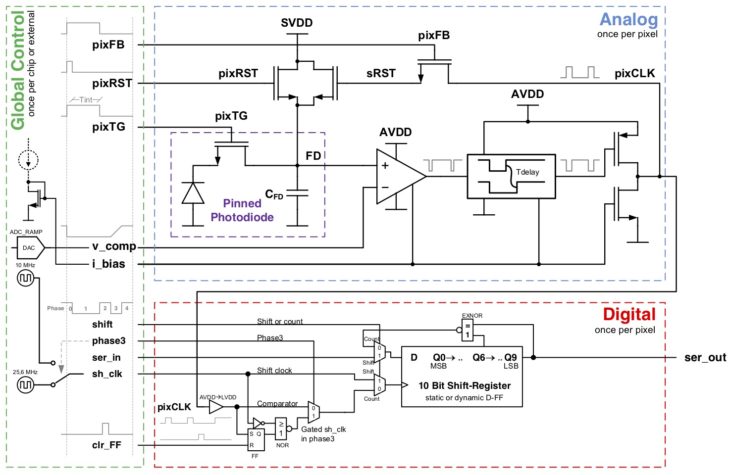
What this image sensor does, is using “self resetting pixels“, i.e. pixels that don’t clip when they get saturated but instead starts over and counts the times it has started over. From the research paper’s abstract:

Conventional CMOS image sensors with a linear transfer characteristic only have a limited dynamic range (DR) of about 60–70 dB. To extend the dynamic range considerably, the already successfully demonstrated concept of a linear self-reset pixel was employed in this work. With the self-reset concept the limit of the maximum analyzable photo generated charge (Qmax) during the exposure time is extended to a multiple of the saturation charge of the photo diode (Qsat) by asynchronous self-resets of the photo diode. Additionally, the remaining charge at the end of the exposure time is evaluated to increase the resolution of the opto-electronic conversion. Thus we achieved pixels with a DR of more than 120 dB combined with an improved low light sensitivity using a pinned photodiode.
In other words: you don’t have to worry about your exposure in order to save highlights in your image. Instead, you can set the best exposure for your subject and safely snap knowing that no highlights will be blown out.

This image sensor is a prototype and likely far from going into production. Never the less, it’s a technological innovation that sooner or later will be featured on image sensors.

The full paper “Realization and opto-electronic Characterization of linear Self-Reset Pixel Cells for a high dynamic CMOS Image Sensor” by Stefan Hirsch, Markus Strobel, Wolfram Klingler, Jan Dirk Schulze Spüntrup, Zili Yu, and Joachim N. Burghartz, is available here.

Let’s hope it’s something Canon will research too.

[via Image Sensors World]
Canon Working On Global Shutter Sensor With Dual Memory Pixels, Research Paper

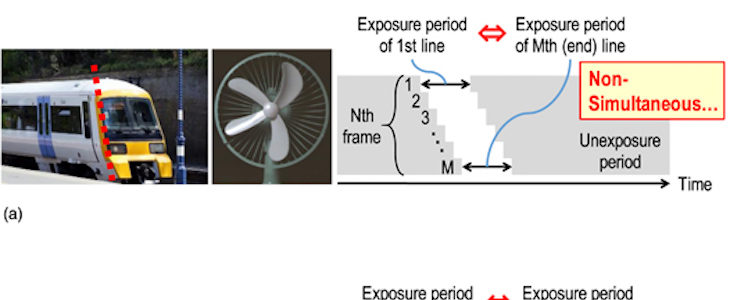
global shutter

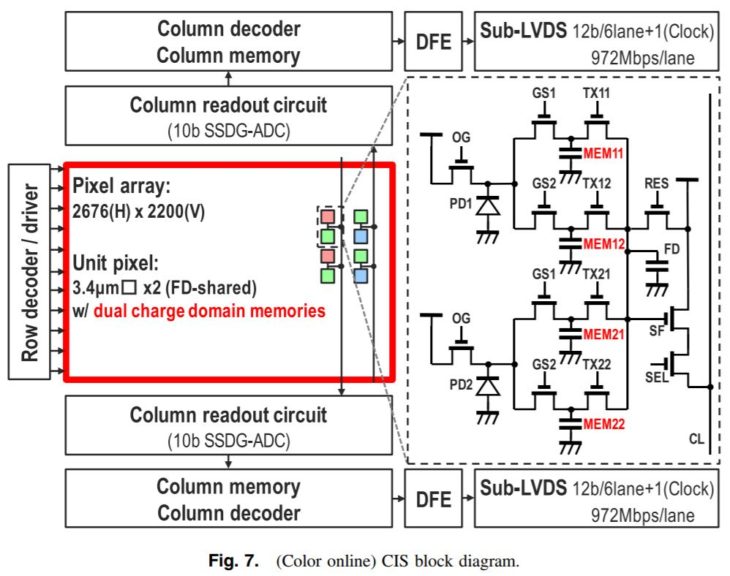
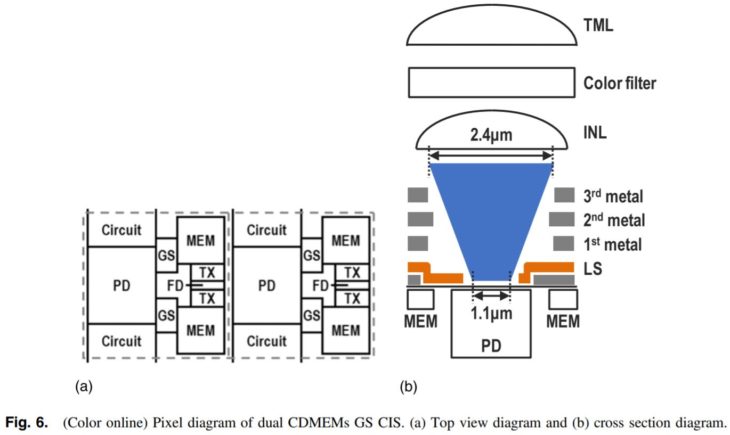
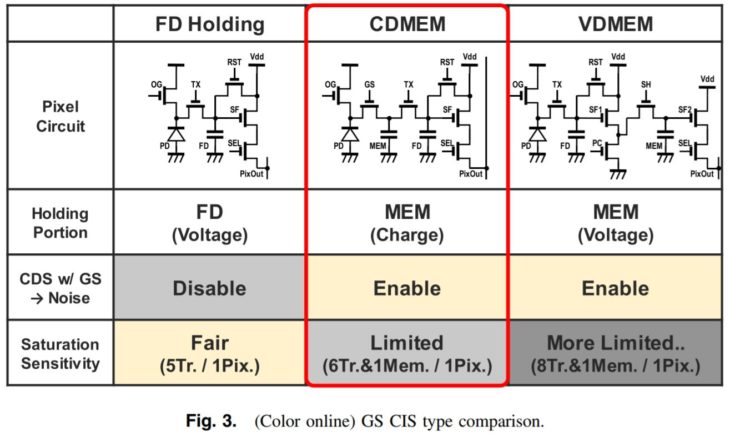
Canon published a research paper in the Japanese Journal of Applied Physics, named “A 3.4 μm pixel pitch global shutter CMOS image sensor with dual in-pixel charge domain memory” (by Masahiro Kobayashi, Hiroshi Sekine, Takafumi Miki, Takashi Muto, Toshiki Tsuboi, Yusuke Onuki, Yasushi Matsuno, Hidekazu Takahashi, Takeshi Ichikawa, and Shunpike Inoue).

From the paper’s abstract:

[expander_maker id=”2″ more=”Click to read the article” less=”Read less”]

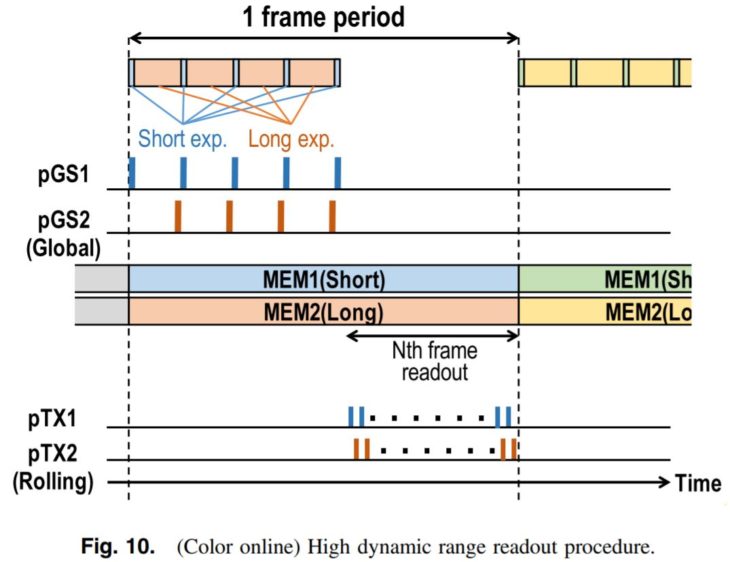
In this paper, we describe a newly developed 3.4 μm pixel pitch global shutter CMOS image sensor (CIS) with dual in-pixel charge domain memories (CDMEMs) has about 5.3 M effective pixels and achieves 19 ke− full well capacity, 30 ke−/lxcenterdots sensitivity, 2.8 e- rms temporal noise, and −83 dB parasitic light sensitivity. In particular, we describe the sensor structure for improving the sensitivity and detail of the readout procedure. Furthermore, this image sensor realizes various readout with dual CDMEMs. For example, an alternate multiple-accumulation high dynamic range readout procedure achieves 60 fps operation and over 110 dB dynamic range in one-frame operation and is suitable in particular for moving object capturing. This front-side-illuminated CIS is fabricated in a 130 nm 1P4M with light shield CMOS process.

[via Image Sensors World] [/expander_maker]

Canon research publishes paper on global shutter sensor

global shutterCanon’s research division posted a paper named “Development of Gentle Slope Light Guide Structure in a 3.4 μm Pixel Pitch Global Shutter CMOS Image Sensor with Multiple Accumulation Shutter Technology” (Hiroshi Sekine, Masahiro Kobayashi, Yusuke Onuki, Kazunari Kawabata, Toshiki Tsuboi, Yasushi Matsuno, Hidekazu Takahashi, Shunsuke Inoue, and Takeshi Ishikawa).
The paper describes a concept for a global shutter sensor. The paper’s abstract states:

CMOS image sensors (CISs) with global shutter (GS) function are strongly required in order to avoid image degradation. However, CISs with GS function have generally been inferior to the rolling shutter (RS) CIS in performance, because they have more components. This problem is remarkable in small pixel pitch. The newly developed 3.4 µm pitch GS CIS solves this problem by using multiple accumulation shutter technology and the gentle slope light guide structure. As a result, the developed GS pixel achieves 1.8 e temporal noise and 16,200 efull well capacity with charge domain memory in 120 fps operation. The sensitivity and parasitic light sensitivity are 28,000 e/lx·s and −89 dB, respectively. Moreover, the incident light angle dependence of sensitivity and parasitic light sensitivity are improved by the gentle slope light guide structure.

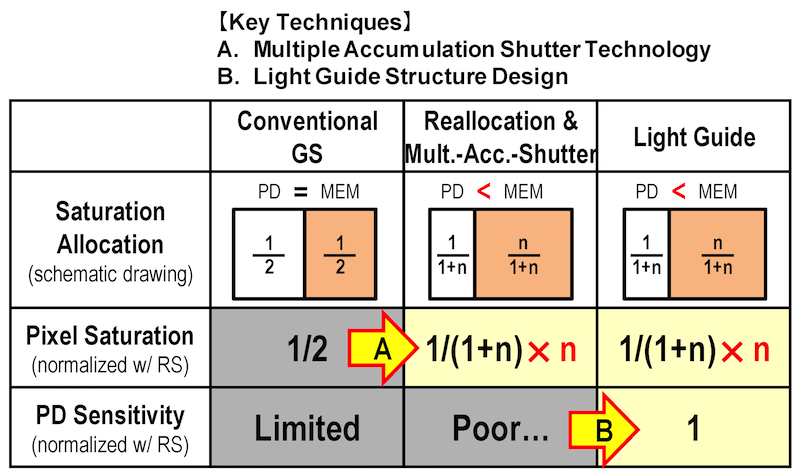
Canon’s approach to the issue is two-fold (see also the picture after the quoted text):

[…] two key techniques to realize superior optical characteristics while suppressing the reduction of saturation more than the conventional GS pixels. The first technique is the multiple accumulation shutter technology. This technique improves pixel saturation. The second technique is the light guide structure. This technique improves optical performance. As a premise of adopting these two techniques, we first explain the idea of saturation allocation that is important in these techniques.

global shutter

The research paper is publicly available here, and was spotted by Image Sensors World.