Industry News: Sony Launches RX0 II, World’s Smallest and Lightest Premium Ultra-Compact Camera

rx0 ii

The Sony RX0 II kit with the VCT-SGR1 Shooting Grip and bracket will ship in Europe in May 2019, priced at approximately €800/£730/$698. Pre-order the Sony RX0 II at B&H Photo and Adorama.

Sony press release:

Sony Launches RX0 II, the World’s Smallest and Lightest Premium Ultra-Compact Camera

  • Superb image quality delivered by 1.0-type stacked 15.3MP image sensor condensed into waterproof rugged, highly compact body
  • Featuring ZEISS® Tessar T* 24mm F4 fixed wide-angle lens
  • Movie shooting with 4K internal recording and new image stabilisation solutions
  • Advanced functionality for stills photography including up to 1/32000 sec. Anti-distortion Shutter and up to 16fps continuous shooting
  • Diverse range of shooting scenes enabled by waterproof 180 degree tiltable LCD panel and Clear Image Zoom 
  • Perfect for selfie with enhanced colour reproduction, new Soft Skin Effect mode and advanced Eye AF
  • Microphone jack and Shooting Grip (VCT-SGR1) delivers minimal and ideal Vlog shooting solution
  • Multi-camera solution that enables creative video expression from various viewpoints

Sony today introduced an exciting new addition to its highly popular compact camera line-up with the launch of the world’s smallest and lightest premium compact camera, the RX0 II(model DSC-RX0M2). Building upon the waterproof/dustproofii,shockproof, crushproof and ultra-compact qualities of the original RX0, thenew model now offers internal 4K recording, an up to 180-degree and down to 90-degree tiltable LCD screen that even works underwater,iiand new image stabilisation solutions for video recording.

At the heart of the RX0 II sits a 1.0-type stacked 15.3-megapixeli Exmor RS™ CMOS image sensor and an advanced BIONZ X™ image processing engine that offer enhanced colour reproduction including beautiful skin tones. This power packed combination have been optimised to deliver lightning fast performance and exquisite image quality for both stills and movie shooting across a wide sensitivity range of ISO 80-12800. The ZEISS® Tessar T* 24mmiii F4.0 fixed wide-angle lens has a shortened minimum focussing distance of 20cm, making it perfect for selfies or table-top photos. 

[expander_maker id=”2″ more=”Click to read the article” less=”Read less”]

A camera for all conditions

The RX0 II is truly a ‘worry-free’ camera that can be taken into places that no other camera can go. Measuring just 59mm x 40.5mm x 35mm[ and weighing just 132g, the RX0 II fitseasily into a pocket and is ready for whatever the elements can throw at it. It is waterproofii up to 10 metres deep, dustproofii, shockproofvii up to 2 metres and crushproofviii up to 200KG force. 

“The development goal of the original RX0 was to build a camera that enabled new forms of creative expression through its form factor and technical capabilities,” said Yann Salmon Legagneur, Director of Product Marketing, Digital Imaging at Sony Europe. “We have built upon this with the new RX0 II and added features and functionality that we believe make this an ideal camera for any type of travel and will perform equally well as a stills or video camera across a huge range of shooting and vlogging scenarios.”

Movies and More 

The RX0 II offers 4K 30p internal movie recordingiv with full pixel readout and no pixel binning to collect approximately 1.7 times the amount of data required for 4K video. This oversampling reduces the appearance of moiré and jaggies and delivers smooth, high quality 4K footage with exceptional detail and depth. Using the recently introduced Sony “Imaging Edge™”mobile applications, this footage can be transferred to a smartphone, edited and shared easily across social networks.

The RX0 II introduces in-body electronic stabilisation[xv] for steady footage, even when shot handheld. This can be enhanced even further when footage is exported to a smartphone or tablet running the ‘Movie Edit add-on’ application where the additional information captured during filming can be processed to produce a video with gimbal-like smoothness. An additional new feature that can be accessed via Sony ‘Movie Edit add-on’ is ‘Intelligent Framing’ where the selected subject is kept in the centre of the frame and image distortion is corrected in a final edit. Depending on where the video will be shared, the required aspect ratio can then be selected. 

Additional movie features of the RX0 II include Super Slow Motion recording at up to 1000 fps, uncompressed 4K HDMI output and simultaneous proxy movie recording. Users can utilise Picture Profile, S-Log2 and Time Code / User Bit functions to ensure a final result that exactly matches their creative vision. 

Precision Photography

The versatility of the RX0 II means thatit offers a host of stills photography features in addition to its video capabilities. It boasts an Anti-distortion Shutter of up to 1/32000 sec. and can shoot at up to 16 fpsv to capture any fleeting moment of emotion that passes across the subject’s face. In an upgrade from the original RX0, colour reproduction has been enhanced to reproduce natural and vivid colours of human skin, and the optional ‘Soft Skin Effect’ can be applied to cover minor blemishes and wrinkles.Rating and Protect functions can be applied in camera and a grouped display of continuously shot images can be viewed on the camera.

Sony’s EyeAF, that is proving hugely popular with portrait photographers across the world, has been upgraded on the RX0 II. Thespeed, accuracy and operation of the EyeAF has been improved to make it even easier to capture a stunning portrait; a simple half press of the shutter button will lock-on to the eye of the subject. The focussed eye can be selected (left / right / auto) in the menu or assigned to a custom button, allowing the user to concentrate on composition. 

The camera can be set for interval shooting, the results of which can be edited with Sony’s “Imaging Edge”desktop application ‘viewer’ into stunning time-lapse videos.

Multi-camera options

Upto 5 RX0 II camerascan be controlled wirelessly using Sony ‘Imaging Edge Mobile’ application and between 6 to 50 cameras will be able to be controlled via an access point (scheduled for Summer 2019.) The RX0 II is alsocompatible with the Camera Control Box CCB-WD1 which enables up to 100 cameras to be connected and controlled in a wired multi-camera setup. These multi-camera solutions unlock a whole new world of shooting opportunities and free video expression from any viewpoint that the user wishes to pursue.

Pricing and Availability

TheRX0 II kit with the VCT-SGR1 Shooting Grip and bracket will ship in Europe in May 2019, priced at approximately €800/£730.

For more information on the new RX0 II camera, please visit; https://www.sony.co.uk/electronics/cyber-shot-compact-cameras/dsc-rx0m2

A variety of exclusive stories, videos and exciting new content shot with the newest cameras and other Sony’sAlpha products can be found at https://www.sony.co.uk/alphauniverse. Sony’s European photography hub is available in 22 languages and details product news, competitions and an up-to-date list of Sony events in each country.

[/expander_maker]

A Visit To Sigma’s Aizuwakamatsu Factory

sigma

The folks at LensVid had the chance to visit Sigma’s Aizuwakamatsu factory in Japan.

From LensVid’s report:

SIGMA’s factory in Aizuwakamatsu is the home of 1400 employees, some parts of the factory work 24 hours non-stop and the employees work in 9-hour shifts. SIGMA’s headquarters in Kawasaki employs 200 more people, over 75% of which are engineers in different R&D departments. This follows SIGMA’s motto to keep management as lean as possible.

Arriving at the factory in Aizuwakamatsu, we were greeted by SIGMA’s Service & Support section chief, Mr. Manabu Sato, he is going to be our host in this factory tour. We started by going to one of the conference rooms for a short introduction to SIGMA’s history, put on our hats and coats and went to meet the engineers. It’s worth mentioning that in no part of our visit we were required to wear protective gear or noticed any scent of volatile materials, the factory is very well ventilated and it feels that SIGMA is working hard to make the factory as safe as possible to their employees.

Read the report at LensVid…

Here Is Another Overpriced Leica Camera You Can Buy For 5000 Bucks

leica q2

At a glance:

  • 47.3MP Full-Frame CMOS Sensor
  • Maestro II Image Processor
  • Summilux 28mm f/1.7 ASPH. Lens
  • 3.68MP OLED Electronic Viewfinder
  • 3.0″ 1.04m-Dot Touchscreen LCD
  • DCI 4K24p, UHD 4K30p, Full HD 120p Video
  • ISO 50-50000, up to 10-fps Shooting
  • 35mm, 50mm, and 75mm Crop Modes
  • Bluetooth LE and Wi-Fi
  • Weather-Sealed Construction

Ladies and gentleman, here is another overpriced piece of gear, the Leica Q2.

If you really have $5000 to waste for this toy, then you’re welcome to buy the Leica Q2 at B&H Photo and Adorama in the US, and Park Cameras in the UK. Who wouldn’t want a camera with a “Maestro” image processor and that lets you go unnoticed on the streets.

Smartphones Might Have 64MP and 108MP Sensors Soon, Credit Suisse Predicts

smartphones

A technology and market analysis paper by Credit Suisse predicts smartphones with image sensors of over 100MP to be appear soon.

Excerpt from the report:

  • Demand from Huawei (32MP CIS mass production) and Xiaomi (long-term contract) has helped Samsung to gain market share in CIS.
  • Multi-camera smartphones are expected to comprise 65–70% of all models in 2019, up from 40% in 2018. Triple-camera models are expected to account for as much as 20% of all smartphone handsets (up from 1.5% in 2018).
  • The multi-camera percentage for Samsung Mobile is expected to reach 70% in 2019 (up from 21% in 2018).
  • Demand for 5MP CIS is booming due to the trend toward multi-camera smartphones (the 5MP CIS is an essential component of triple-camera handsets).
  • The CIS technology roadmap calls for further evolution towards higher megapixels, with development expected to bring 64MP in 2H 2019 and 100MP in 2020. The trend will increase the number of lenses required (though weight is an issue), demanding higher levels of cooperation between lens, module and AP manufacturers to achieve incremental improvements in image resolution.
  • With Line 11 undergoing conversion, Samsung is planning to boost the total monthly capacity of its CIS 300mm production lines to 75,000 units by end-2019 and 85,000 units by end-2020. No decision has been taken yet on whether to convert Line 13 to CIS production, but the general plan is to continue expanding capacity steadily.
  • CIS 300mm line development is underway at SK Hynix.

[via Image Sensors World]

Industry News: Sony Develops A Stacked Global Shutter Sensor With Back-Illuminated Pixel

global shutter

Sony press release:

Sony Develops a Stacked CMOS Image Sensor Technology Using Sony’s Proprietary Global Shutter Function with Back-Illuminated Pixel Structure to Deliver Both High Imaging Performance and Miniaturization

Improves Productivity of Industrial Equipment for Smartification

Tokyo, Japan — Sony Corporation announced today that it has succeed in developing Pregius S, a stacked CMOS image sensor technology that employs Sony’s proprietary global shutter function with back-illuminated pixel structure to deliver both distortion-free, high imaging performance and miniaturization. The new sensor technology is intended for industrial equipment used in fields such as manufacturing, inspection, and logistics that require higher precision and higher processing speeds, in light of the trends in industrial advancement including factory smartification and automation.

Sony will introduce the new technology at Vision China Shanghai 2019 starting on March 20, 2019.

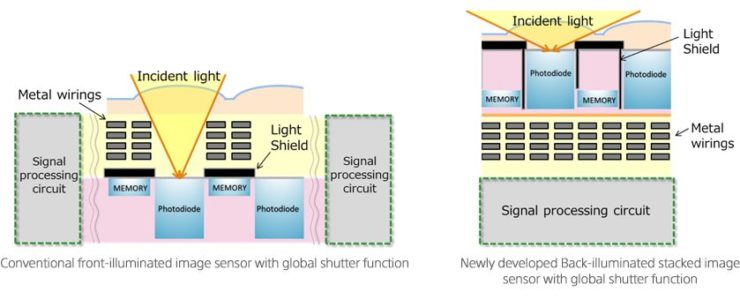
Conventional CMOS image sensors equipped with global shutter function temporarily store charge signals in the memory area located next to the photodiode to resolve image distortion (focal plane distortion) caused by the time shift due to the row-by-row readout. In front-illuminated CMOS image sensors, there is a wiring layer on the silicon substrate forming the photodiode, and with such a structure, the benefit is that it is easy to form a light shield for protecting the charge signal temporarily stored in the memory area from leaked light. For this reason, conventional CMOS image sensors with global shutter function have adopted a front-illuminated pixel structure. However, the wiring on top of the photodiode hinders the incident light, which creates an issue when attempting to miniaturize the pixels.

[expander_maker id=”2″ more=”Click to read the article” less=”Read less”]

In response to this, Sony has developed a proprietary pixel structure that achieves the global shutter function on a back-illuminated structure that has superior sensitivity characteristics, thereby resolving the issue of miniaturization. Normally, when pixels are miniaturized, the sensitivity and saturation characteristics deteriorate, but the new Sony technology enables a reduction in pixel size to 2.74 μm while maintaining performance of those characteristic, thereby achieving about 1.7 times higher resolution than conventional front-illuminated CMOS image sensors.*1 This makes it possible to measure and inspect objects in a wider area and with higher accuracy in manufacturing, inspection, logistics and other applications. Moreover, thanks to the high degree of freedom of the wiring layout of back-illuminated pixel structures, a high speed of about 2.4 times that of conventional*1 can be achieved, thereby contributing to significant productivity improvement, including shorter measurement and inspection process times. In addition, the sensor’s stacked structure makes it possible to mount various signal processing circuits, whereby it is possible to realize smart functions such as signal processing only for the necessary part of the measurement and inspection images in a smaller size compared to conventional sensors.*1 That, in turn, makes it possible to reduce the load of the subsequent processing and reduce the amount of data to be held on to, thereby contributing to the realization of highly efficient, energy-saving systems.

Going forward, Sony will work to develop products equipped with this stacked CMOS image sensor employing its proprietary global shutter function with back-illuminated pixel structure for various industrial applications and intelligent transportation systems, including development of derivatives for signal processing circuits to be mounted. Sony plans to start shipping sample units in the summer of 2019 or later.

Main Features

1) Proprietary global shutter function with back-illuminated pixel structure delivers both distortion-free high imaging performance and miniaturization

Sony developed a proprietary pixel structure that achieves a global shutter function on a back-illuminated structure that has superior sensitivity characteristics, delivering both high imaging performance and miniaturization. By miniaturizing the pixel size from the conventional*1 3.45 μm to 2.74 μm while maintaining sensitivity and saturation characteristics, Sony has achieved about 1.7 times higher resolution than the conventional front-illuminated 12 megapixels*2 CMOS image sensor,*1 thereby making it possible to perform measurement and inspection in a wider area and at a higher accuracy. Moreover, thanks to the high degree of freedom of the wiring layout of the back-illuminated pixel structure, it is possible to deliver high-speed performance of about 2.4 times that of the conventional technology*1, thereby contributing to significant productivity improvement such as shorter measurement and inspection process times.

2) Miniaturization and high functionality made possible with a stacked structure

The sensor’s stacked structure makes it possible to mount various signal processing circuits, thereby contributing to miniaturization and enhanced functions for CMOS image sensors. Incorporating the data optimization functions (smart ROI, self-trigger, compression processing, compositing, etc.) that extracts only necessary information from the image data, it is possible to reduce the load of the subsequent processing and reduce the amount of data to be held onto while achieving a smaller package compared to conventional sensors,*1 thereby contributing to the realization of highly efficient, energy-saving systems.

Going forward, Sony will leverage the technology of Pregius S to further enhance and expand functions for new industries, including development of derivatives for signal processing circuits to be mounted.

[/expander_maker]