Review: Canon RF 28-70mm f/2L (superlative image quality, Photography Blog)
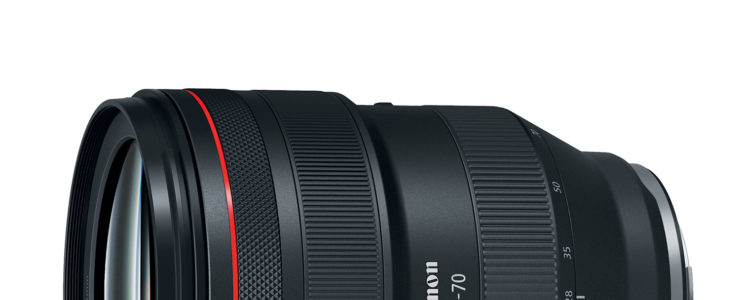
Canon RF 28-70mm f/2L review rf mount canon eos r

Photography Blog reviewed the Canon RF 28-70mm f/2L lens for the EOS R system. A lens that’s universally considered being of outstanding optical quality.

From their conclusion:

There’s no getting away from the fact that the new Canon RF 28-70mm f/2 L USM lens is very big, heavy and expensive, but there’s also no getting away from the fact that it’s extremely well-built, fast in terms of the maximum aperture, and capable of delivering superlative image quality.

We’ve seen the Canon RF 28-70mm f/2 L USM described as offering four prime lenses in one, and after using it for an extended period of time, we’d certainly agree with that assessment. Whether using it as 28mm, 35mm, 50mm or 70mm, it delivers tack-sharp images both in the centre and at the edges of the frame, with no need to stop down to get acceptable results. That means that you can shoot at f/2 at any focal length and get buttery-smooth bokeh as a result of the 9-blade aperture and that maximum aperture that is one-stop faster than most zooms of this type. Slight vignetting at wide-open apertures and a little barrel distortion at 28mm are the only real optical issues of note from what is optically an incredible lenses. Read the review…

Canon EOS R world-wide order links:

[shoplist 52287]

Canon RF mount lenses world-wide order links:

[shoplist 52325]
Canon RF 24-105mm F/4L IS Review (D. Abbott)

Canon RF 24-105mm f/4L IS Review Canon EOS R

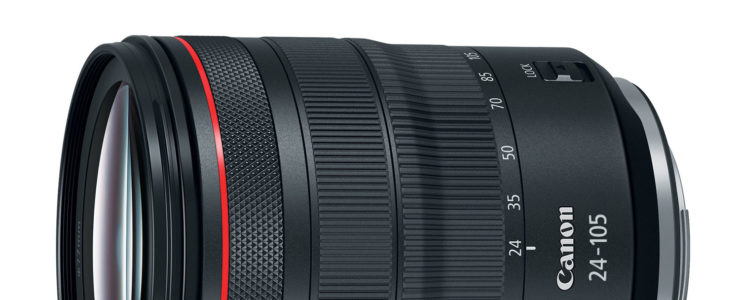
Photographer Dustin Abbott posted his final verdict on what is the kit lens for the EOS R system, the Canon RF 24-105mm F/4L IS.

From Abbott’s conclusion:

I don’t get overly excited about lenses with a maximum aperture of only F4, but there’s no question that this is a very useful lens.  You can do about 80% of your photography (or maybe 100%, depending on your needs) without the Canon RF 24-105mm F4L IS USM ever leaving your camera. 

I would recommend a good telephoto lens and perhaps a wide aperture prime lens to compliment this lens.  At the time of this review, the only camera that it can be used on is the Canon EOS R, but that will undoubtedly change as Canon introduces more cameras supporting the RF mount moving into the future.  I noted in my EOS R review that the EOS R (at present) seems to be more a delivery system for the excellent new lenses that the RF mount has unlocked.  The RF 24-105L is a great place to start in building your new lens kit, though, as it manages to avoid many of the common pitfalls from such lenses and delivers above-average image quality and truly excellent autofocus performance.

Dustin Abbott’s review comes with a huge set of sample photos and all kinds of insights. If you prefer, you can watch his review in the video below.

Abbott’s Canon EOS R review is here.

Canon EOS R world-wide order links:

[shoplist 52287]

Canon RF mount lenses world-wide order links:

[shoplist 52325]

Panasonic Lumix DC-S1 vs Canon EOS R Specification And Size Comparison

Panasonic Lumix DC-S1

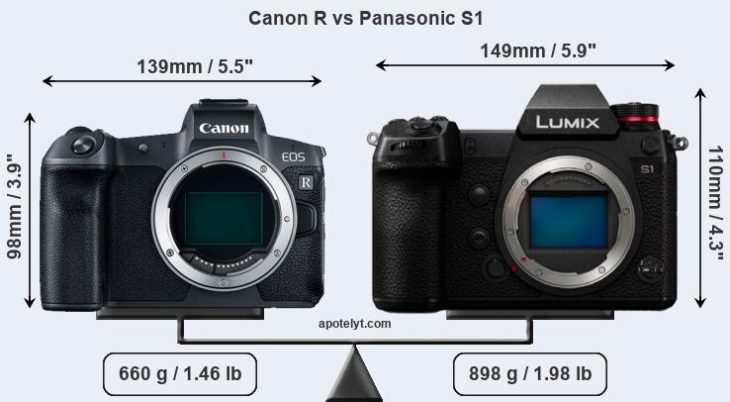
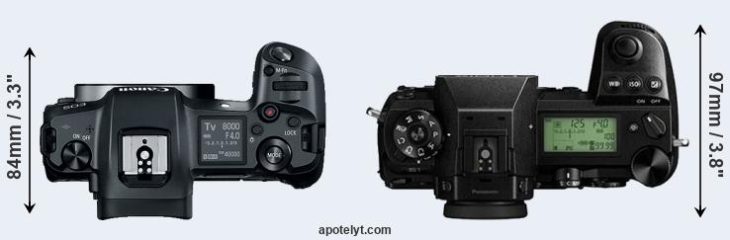
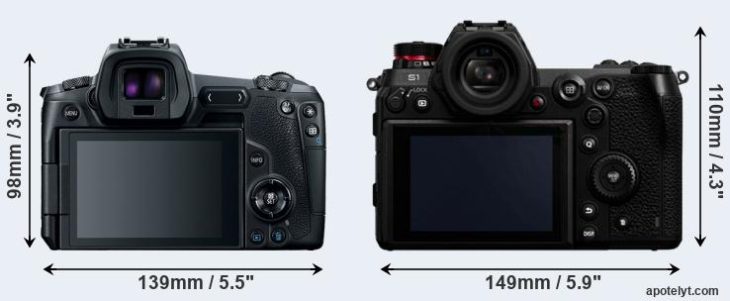
Apotelyt posted a comparison between the Canon EOS R and the new Panasonic Lumix DC-S1.

They sum up the strengths of each camera.

Review summary: Canon EOS R vs Panasonic Lumix DC-S1

So what conclusions can be drawn? Which of the two cameras – the Canon R or the Panasonic S1 – has the upper hand? Below is a summary of the relative strengths of each of the two contestants. 

Arguments in favor of the Canon EOS R: 

  • Better moiré control: Has an anti-alias filter to avoid artificial patterns to appear in images. 
  • Better video autofocus: Features on-sensor phase-detection for more confident movie autofocus. 
  • Larger screen: Has a bigger rear LCD (3.2″ vs 3.0″) for image review and settings control.
  • More selfie-friendly: Has an articulated screen that can be turned to be front-facing.
  • More compact: Is smaller (139x98mm vs 149x110mm) and thus needs less room in the bag.
  • Less heavy: Is lighter (by 238g or 27 percent) and hence easier to carry around.
  • Easier travel charging: Can be conveniently charged via its USB port.
  • Faster data transfer: Supports a more advanced USB protocol (3.1 vs 3.0).
  • More affordable: Was introduced into a lower priced segment (23 percent cheaper at launch).
  • More heavily discounted: Has been on the market for longer (launched in September 2018).

Reasons to prefer the Panasonic Lumix DC-S1: 

  • More detail: Has more megapixels (47.3 vs 30.1MP), which boosts linear resolution by 25%.
  • Maximized detail: Lacks an anti-alias filter to exploit the sensor’s full resolution potential. 
  • High quality composites: Can combine several shots after pixel-shifting its sensor. 
  • Better video: Provides higher movie framerates (4K/60p versus 4K/30p). 
  • Better sound control: Has a headphone port that enables audio monitoring while recording.
  • More detailed viewfinder: Has higher resolution electronic viewfinder (5760k vs 3690k dots).
  • Easier setting verification: Features a control panel on top to check shooting parameters.
  • Faster burst: Shoots at higher frequency (9 vs 8 flaps/sec) to capture the decisive moment.
  • Sharper images: Has stabilization technology built-in to reduce the impact of hand-shake.
  • More solid recording: Has a full-sized HDMI port for a sturdy connection to an external recorder.
  • Greater peace of mind: Features a second card slot as a backup in case of memory card failure.
  • More modern: Was introduced somewhat (4 months) more recently.
[via Apotelyt]

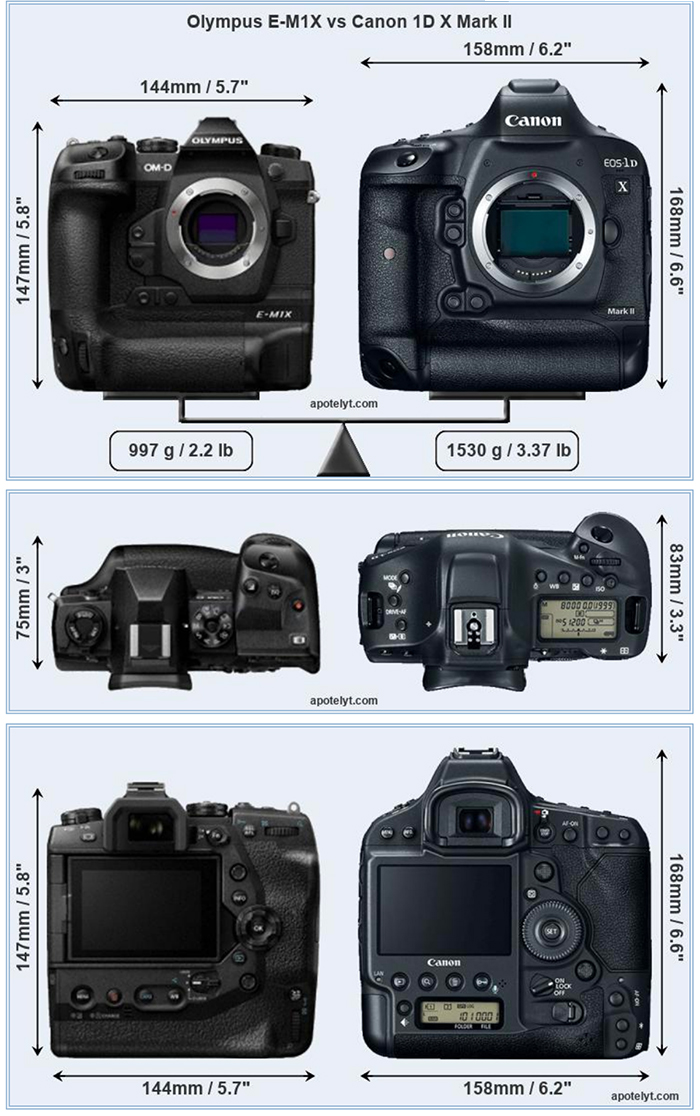
Olympus E-M1X vs Canon 1D-X Mark II Size And Specification Comparison

Olympus E-M1X

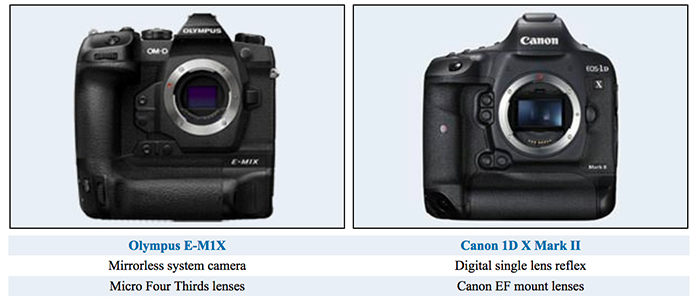
The folks at Apotelyt.com posted an interesting specs and size comparison between the Olympus E-M1X and the Canon 1D-X Mark II.

Next, they summed up the pros and cons of each camera.

Review summary: Olympus E-M1X vs Canon 1D X Mark II

So what is the bottom line? Which of the two cameras – the Olympus E-M1X or the Canon 1D X Mark II – has the upper hand? A synthesis of the relative strong points of each of the models is listed below.

Advantages of the Olympus OM-D E-M1X:

  • Maximized detail: Lacks an anti-alias filter to exploit the sensor’s full resolution potential.
  • High quality composites: Can combine several shots after pixel-shifting its sensor.
  • More framing info: Has an electronic viewfinder that displays shooting data.
  • More flexible LCD: Has swivel screen for odd-angle shots in portrait or landscape orientation.
  • More selfie-friendly: Has an articulated screen that can be turned to be front-facing.
  • Faster burst: Shoots at higher frequency (18 vs 16 flaps/sec) to capture the decisive moment.
  • Less disturbing: Has an electronic shutter option for completely silent shooting.
  • More compact: Is smaller (144x147mm vs 158x168mm) and thus needs less room in the bag.
  • Less heavy: Is lighter (by 533g or 35 percent) and hence easier to carry around.
  • Sharper images: Has hand-shake reducing image stabilization built-in.
  • More legacy lens friendly: Can take a broad range of non-native lenses via adapters.
  • Easier file upload: Has wifi built in for automatic backup or image transfer to the web.
  • Easier wireless transfer: Supports Bluetooth for image sharing without cables.
  • More affordable: Was introduced into a lower priced category (50 percent cheaper at launch).
  • More modern: Reflects 2 years and 11 months of technical progress since the 1DX Mark II launch.

Arguments in favor of the Canon EOS-1D X Mark II:

  • Better moiré control: Has an anti-alias filter to avoid artificial patterns to appear in images.
  • Better image quality: Features bigger pixels on a larger sensor for higher quality imaging.
  • Richer colors: Larger pixels generate images with better, more accurate colors.
  • More dynamic range: Capable of capturing a wider spectrum of light and dark details.
  • Better low-light sensitivity: Can be used in poorly lit environments and still produce good images.
  • Better video: Provides higher movie framerates (4K/60p versus 4K/30p).
  • Brighter framing: Features an optical viewfinder for clear, lag-free composition.
  • Easier setting verification: Features a control panel on top to check shooting parameters.
  • Larger screen: Has a bigger rear LCD (3.2″ vs 3.0″) for image review and settings control.
  • More detailed LCD: Has a higher resolution rear screen (1620k vs 1037k dots).
  • Longer lasting: Gets more shots (1210 versus 870) out of a single battery charge.
  • More heavily discounted: Has been around for much longer (launched in February 2016).
[via Apotelyt via 4/3 Rumors]

Canon RF 35mm f/1.8 STM Macro Review (IS better than Sony’s IBIS)

Canon RF 35mm f1.8 IS STM

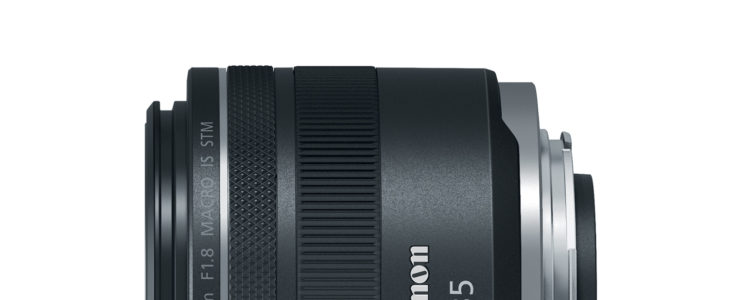
Alik Griffin reviewed the Canon RF 35mm f/1.8 IS STM Macro lens for the EOS R system.

The Canon RF 35mm f/1.8 IS STM Macro is (so far) the less expensive lens for the EOS R, it’s not “L” grade and it doesn’t sport all of Canon’s optical magic. Never the less it’s an interesting lens, especially at $500.

One interesting point of Alik’s review is the comparison with Sony’s IBIS. Alik did some extensive testing and comparison, and he found that…

[…] small shakes, from shaky hands or large vibrations are noticeably better with the IS lens compared to the Sony IBIS. Also, if you’re shooting video, IS + Digital IS is noticeably better than IBIS and the digital IS does correct the tilt take.

There are so many mostly wishful rumors about Canon delivering IBIS in a future EOS R models and Alik’s findings confirm that Canon is right when stating that their in lens image stabilisation is better than other’s IBIS. That’s not to say Canon will never sport IBIS on a camera, but for the time being it’s just a clickbait thing.

From his conclusion:

The Canon RF 35mm f1.8 is all around solid lens in terms of build and performance. There are a few flaws that are easy to work around like the vignetting at f1.8 and f2 and some noticeable barrel distortion. You can correct for all of this in-camera if you’re shooting video or JPG, but RAW shooters will have to use post corrections.
I like to shoot a lot at f2.8, which gives me great looking bokeh without the vignetting and astigmatism. I stop down to f5.6 and f8 when I want the most sharpness, and I shoot f1.8, when I need a fast shutter speed in low light or when I want very shallow depth.
Performance at f2.8 is just incredible. You don’t see any geometry yet in the bokeh at f2.8 and it cleans up all the issues in the corners and edges.

Alik tested anything you may want to measure on a lens, distortion, vignetting, flare, chromatic aberrations, you name it. A refreshing and independent review with test charts, sample images and all sort of insights.

You can follow Alik on Twitter, Facebook, Instagram, and on his site.

Canon RF 35mm f/1.8 IS STM Macro: [shoplist 53576]