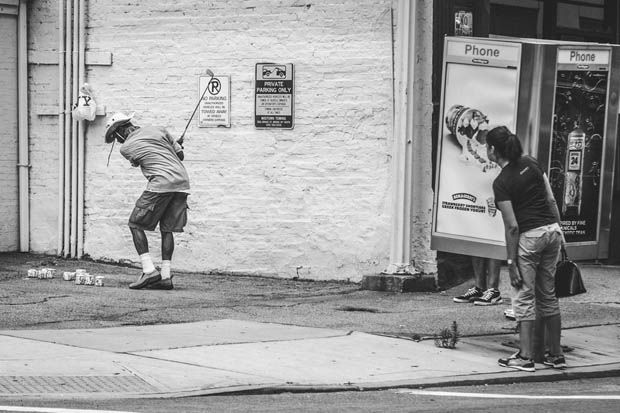
The milk carton golfer. 90mm – Image credit: Napier Lopez
Very interesting post by Napier Lopez on PetaPixel about street photography, and about telephoto lenses used for this purpose. The focal lengths that are normally recommended (and used) for street photography are roughly between 28mm and 50mm. And there is a good reason for that: focal lengths of 35-50mm are more or less equivalent to the perspective humans have, i.e. they correspond to the angle of view of our eyes. That’s why a 50mm lens is called “normal”; according to Wikipedia: normal lens is a lens that reproduces a field of view that generally looks “natural” to a human observer under normal viewing conditions. Everyone who is into street photography (I am) has his own recipe on that matter, and telephoto lenses may appear to be not the best choice for street photography. Indeed, they are a powerful tool for that purpose, yet not necessarily easy to use. I am often using telephoto lenses when I am out to shot on the streets, mainly to shot candids.
The post, in the authors words, tries to “challenge the most basic tenet most serious street photographers will tell you: that you need a wide-ish or normal lens in order to do the genre properly, and that you need to get close“. The article tackles the following points in regard to street photography and telephoto lenses:
Shooting candid: with a telephoto lens you can take pictures without getting noticed
The artistic element you may add to your pics due to the background flattening effect of telephoto lenses
Z-Axis and perspective. This one is very interesting (check the picture above) Quoting Lopez:
People generally think of telephoto lenses as capturing less space than a wide angle lens for a given framing, but this isn’t totally true. If you’re framing your subject similarly, the compositional space you lose on the 2D plane, you can essentially regain on the Z axis. Meaning, since you have to stand further from your subject for equivalent framing, you get more space in between the camera and your subject to work with, space that so often goes unused. Although photography is a 2 dimensional medium (usually), that doesn’t mean the option to express yourself through the third dimension isn’t there. It just takes a little more work.
You are not loosing the intimacy and the human element just by using a telephoto lens
An article that’s absolutely worth to be read, even if street photography is not among your main interests. You can follow Napier Lopez on 500px.
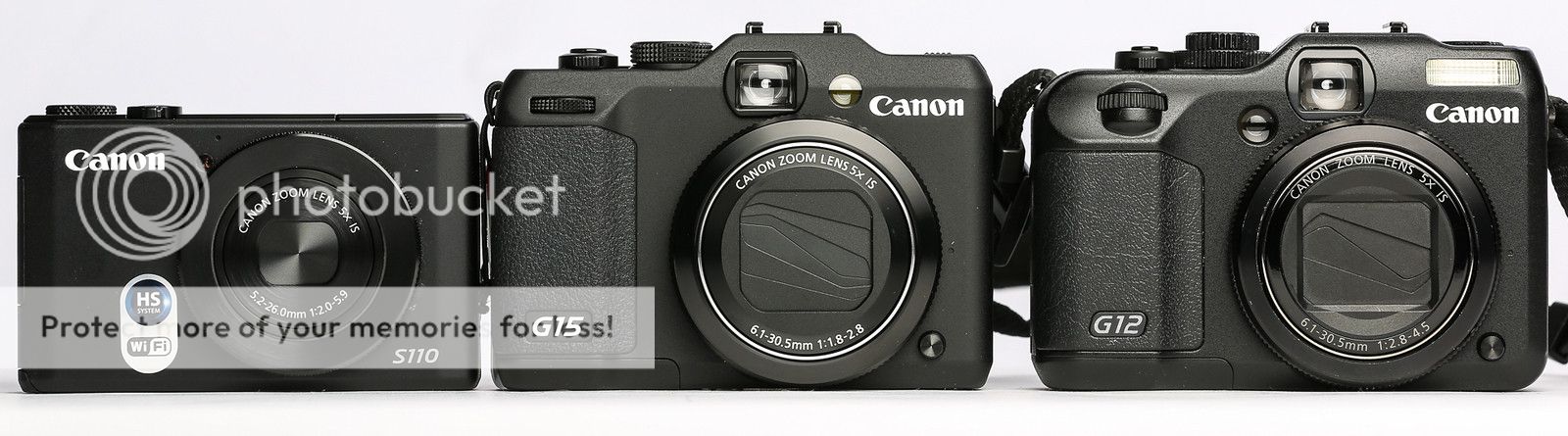
Ron Martinsen compares three Canon Powershot cameras: [shoplink 7076]PowerShot G15 ($499)[/shoplink] vs [shoplink 8373]Powershot G12 ($379)[/shoplink] vs [shoplink 8374]PowerShot S110 ($449)[/shoplink]. The last one features built-in WiFi. Some excerpts from Martinsen’s review:
Functionality-wise [he] found the G12 and G15 to be mostly the same with the biggest feature difference being the Full HD (1920×1080) support added to the G15 and the max ISO jumping from 3200 to 12,800
The big WOW feature of the s110 has to be its touch screen which really helps it to overcome its lack of buttons.
The addition of integrated Wi-Fi support on s110 was pretty exciting when I first started to review it. Once setup […] it became even more obvious how this is so much more than Eye-Fi. What you end up with is a device on your network that you can pair with your phone, printer, computer and more for an integrated wireless experience
From the conclusion:
[…] For starters, the s110 is much improved over the s95 that I reviewed back when the G12 came out. The touch screen helps it to overcome some of my past gripes, and the Wi-Fi support plus big rear display really up its value beyond just being compact. As a result, I feel a lot more comfortable recommending the s110 as a nice pocketable point and shoot.
The G15 on the other hand has made good progress getting smaller, but I honestly think it’s lost some of the things that made the G12 so great in the process. While it is smaller and lighter, I still don’t think people will consider it any more pocketable (and truth be told if you can fit a G15 in your pocket, you most likely can a G12 too – both fit in my back jeans pocket). It’s also disappointing to not see some of the s110’s features on the G15 which make it feel a bit dated by comparison.
There are also sample pics shot which each camera. More links for you to check:
Photographyblog has another batch of PowerShot G15 sample shots (studio shots inclusive) to check.
c|net has a PowerShot S110 review, they write: Nice photo quality, improved autofocus performance, and a very compact design make the Canon PowerShot S110 a solid option if you’re looking for something between a point-and-shoot and an enthusiast compact.
This website or its third-party tools use cookies, which are necessary to its functioning and required to achieve the purposes illustrated in the cookie policy. If you want to know more or withdraw your consent to all or some of the cookies, please refer to the cookie policy. By closing this banner you agree to the use of cookies.

 In Defense of Telephoto Lenses for Street Photography