Canon Develops A New CMOS Sensor With High Dynamic Range and Able To Shoot Images In Harsh Settings

ibis canon rumors canon full frame mirrorless canon PowerShot G7 X canon eos 90d coronavirus

Canon press release:

Canon Announces Development of New CMOS Sensor with High Dynamic Range and Ability to Capture Images Under Harsh Conditions

MELVILLE, NY, June 20, 2019 – The high demands of complex lighting and harsh environments require sensors capable of delivering high-dynamic range (HDR) and high-image quality in adverse temperature conditions. To answer this application need, Canon U.S.A. Inc., a leader in digital imaging solutions, is pleased to announce that its parent company Canon Inc. is pursuing development of the 3U3MRXSAAC, a 2.8-megapixel, 1/2.32-inch CMOS sensor ideal for HDR imaging.

“As Canon evolves in the sensor market, we are dedicated to utilizing our expertise to develop products built to meet current growing market trends,” said Kazuto Ogawa, president and chief operating officer, Canon U.S.A., Inc. “The 3U3MRXSAAC CMOS sensor under development reflects the continuation of our business strategy that leverages the high-quality imaging technology Canon is able to achieve.”

The 3U3MRXSAAC CMOS sensor being developed will be equipped with an HDR drive function that can achieve a wide range of 120 dB at low noise levels. This HDR function will reflect a greater ability to extract usable information even when there is a substantial difference between the lightest and darkest parts of an image. Even during normal drive operation, the sensor can achieve a dynamic range of 75 dB—greater than the sensors on many conventional digital cameras. 

Additionally, the 3U3MRXSAAC CMOS sensor will also be capable of operating in environments with extreme temperatures ranging from -40 degrees Celsius to 105 degrees Celsius. Typically, in high-temperature conditions, the increase in dark current noise (noise that occurs due to heat, even when no light reaches the sensor) can affect the quality of the image. However, the 3U3MRXSAAC CMOS sensor will be equipped with functionality that helps correct black levels (the luminance level of the darkest portion of an image) in real-time to help maintain high image quality. 

With a diagonal size of 1/2.32 inches (7.75 mm), the 3U3MRXSAAC CMOS sensor will feature approximately 2.8 million effective pixels (1936 x 1456), a pixel size of 3.2 μm x 3.2 μm and a frame rate of up to 60 fps (30 fps during HDR drive operation). The sensor will be compatible with the MIPI CSI-2 interface used by consumer-oriented cameras for a wide variety of purposes.

For more information on Canon sensors, please visit canon-cmos-sensors.com.
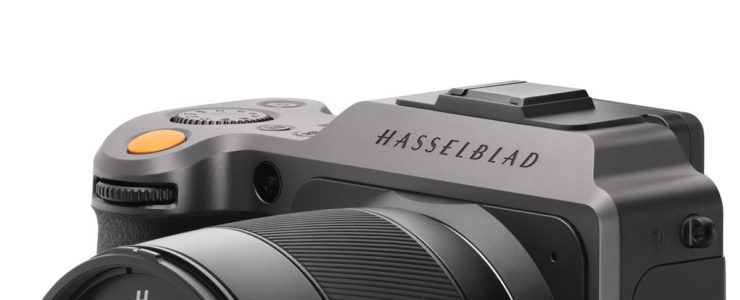
Hasselblad X1D II 50C Medium Format Mirrorless Camera Announced

Hasselblad X1D II 50C

Hasselblad X1D II 50C at a glance:

  • 50MP 43.8 x 32.9mm CMOS Sensor
  • 16-Bit Color, 14-Stop Dynamic Range
  • Hasselblad Natural Color Solution
  • 0.87x 3.69m-Dot Electronic Viewfinder
  • 3.6″ 2.36m-Dot Touchscreen LCD
  • Leaf Shutter System, 1/2000 sec Sync
  • ISO 100-25600, Up to 2.7 fps Shooting
  • Dual SD UHS-II Memory Card Slots
  • Built-In Wi-Fi, USB 3.0 Type-C

Hasselblad announced the Hasselblad X1D II 50C Medium Format Mirrorless Camera. Pre-orders are open at $5,750 at B&H Photo and Adorama.

Press text:

X1D II 50C
COMPACT. POWERFUL. ENHANCED.

Based on the iconic, award-winning design of the first generation, the enhanced X1D II 50C is a compact, powerful mirrorless medium format camera with an excellent 50MP CMOS sensor packed into a lightweight, portable build. With outstanding colour definition, 14 stops of dynamic range, and Hasselblad Natural Colour Solution technology integrated into the camera’s system, the X1D II 50C delivers superb, true-to-life tones that match what the human eye sees. The X1D II 50C’s upgraded electronic platform includes a brilliant 3.6-inch 2.36-million-dot touch display and an enhanced OLED electronic viewfinder (EVF) with 3.69-million dots and a high magnification of 0.87x, both featuring a higher resolution, a faster live view refresh rate, and an even quicker and intuitive user interface control. Shutter lag and black out time between frames have been reduced in addition to a startup time cut almost in half from the first generation.

Built-in Wi-Fi and USB-C connection enable a portable medium format workflow with Phocus Mobile 2, allowing the photographer to transfer RAW and full quality JPEG files directly from the X1D II 50C and edit RAW images on their iPad Pro. Dual SD card slots, now supporting the faster UHS-II standard, ensure optimal storage space or the option to back up images to a second card when shooting. With access to the full line of XCD Lenses in addition to HC/HCD Lenses, V System Lenses, and XPan Lenses via the XH Adapter, XV Adapter and XPan Adapter, respectively, the X1D II 50C boasts a varied lens line up of high-class medium format optics for endless creative possibilities. The X1D II 50C lets the photographer bring the beauty of medium format outside of the studio, capturing the world around them with Hasselblad’s renowned, stunning image quality.

In the Box
Camera body, Battery, Battery charger, USB 3 cable, Camera front protective cover, Shoulder strap, Quick Start Guide

Specifications
50 MP Medium Format Mirrorless Digital camera with Autofocus, Auto exposure, interchangeable lenses. Dimensions of complete camera w/ XCD 45 mm lens: 148 x 97 x 125 mm [W x H x D].
Camera Body only: 148 x 97 x 70mm
Weight 1230 g (Complete camera with XCD 45 mm lens, Li-ion battery and 2 SD cards)
650g (Camera Body)

Compatibility
X System accessories and adapters. XCD lens range

Estimated time of delivery:
July 2019

This Quick Access Camera Bag With Lifetime Warranty Raised $250.000 In One Day (on Kickstarter)

The DUO Daypack is a dawn-to-dusk daypack and camera bag for commuters, creators, photographers, and travelers looking to elevate the way they carry their daily gear. The project raised $250.000 in one day on Kickstarter. You can back the DUO Daypack camera bag project here.

More about the DUO Daypack can be seen here.

More noteworthy Kickstarter projects:

  1. Kamlan 50mm f/1.1 lens for $199
  2. Peak Design super light travel tripod

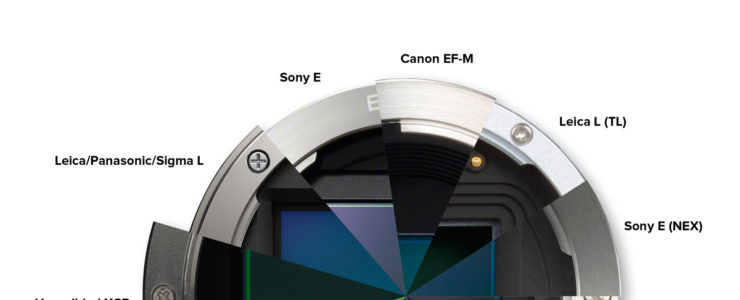
What Is Value Angle And Why Does Fujifilm Think Canon Has The Edge With The EOS M System

value angle

Ever heard about the value angle?

Without diving into too much engineering stuff, the value angle is a computed parameter that has a strong influence on the design of a camera mount and hence of the whole system. But there is more. It also gives a glance about what can be made lens design wise and how far optical engineers can push the design. In one word: it expresses the potentiality of a camera system.

The idea behind it is that a larger value is generally speaking more advantageous and that it allows the design of lenses that provide a particularly high image quality. Oh, and it’s a concept invented by Fujifilm.

The formula for calculating the value angle is: 

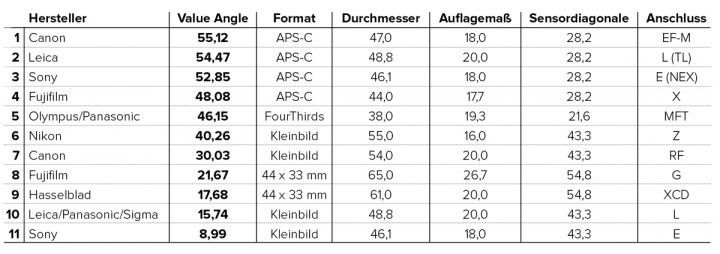
ValueAngle = 2 × arctan ((2 × flange distance) / (mount diameter – sensor diagonal)) 

In a recent Fujifilm summit, the company introduced the concept of value angle to discuss the X System. And it turns out Canon has a real winner here with the EOS M system. If you have a look at the table below, you’ll see Canon’s EOS M mount ranks first when it comes to this very parameter, i.e. it has the most flexible lens mount (please note: “Kleinbild” means “full frame”).

value angle

If you want to learn more about, German site Profifoto has good introduction (Original | machine translated).

Canon EOS M mirrorless system: [shoplist 6091]

Canon’s APS-C Mirrorless Cameras Still Top Ranked In Japan

mirrorless

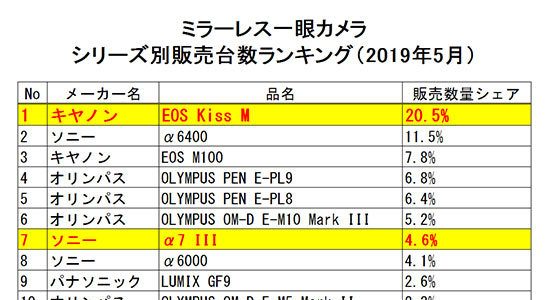
The Canon EOS M50 and EOS M100 are best sellers in Japan, especially the former.

No surprise that latest BCNRetail data for May 2019 confirm once more that Canon is doing very good in the APS-C mirrorless market, and not just in Japan.

The EOS M50 has a market share of 20.5% (most sold), the Sony a6400 has 11.5% (second most sold), and the EOS M100 has 7.8% (third ranked).