Canon EOS C300 Gets Dual Pixel CMOS Auto-Focus Upgrade
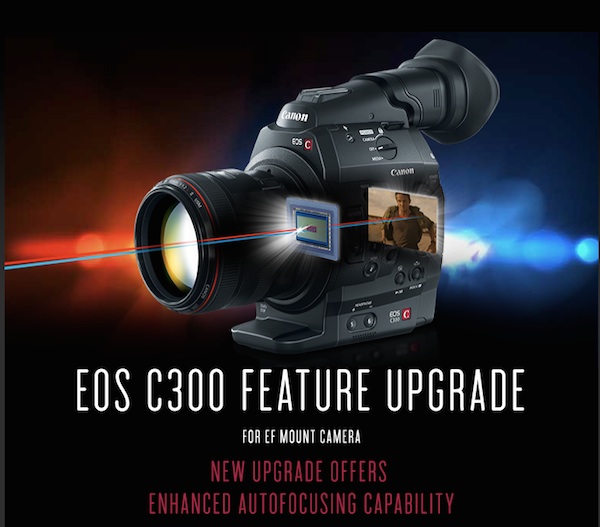
Dual Pixel CMOS Auto-Focus

The amazing Dual Pixel CMOS Auto-Focus technology Canon first implemented on the EOS 70D is now available on the Canon EOS C300.

Canon press release:

Available soon from Canon will be an accredited Canon service center installed feature upgrade for the EOS C300 Digital Video Camera that will offer an autofocus mode to help ensure sharp focus and smooth focus transitions. The upgrade provides a new Continuous AF (Autofocus) Function for all Canon EF autofocus Lenses, using Dual Pixel CMOS AF technology. A new AF Lock setting also lets you change the image framing while holding the desired focus. These critical focusing capabilities are designed to help reduce out of focus video while providing for smooth focus transitions and assist users when operating with small crews.

The accredited Canon service center installed feature upgrade for the EOS C300 camera is targeted at users who regularly shoot with smaller crews, who shoot moving subjects, or who want smoother, more natural-looking autofocus. Specific markets include documentary filmmakers, electronic news gathering, sports productions, weddings and similar special events, nature and wildlife, and many others.

To use and enjoy this milestone technology by Canon you don’t have to break your bank and get a $14,000 C300, it’s already available on the prosumer-oriented [shoplink 14246]Canon EOS 70D[/shoplink]. I am using the EOS 70D everyday while on the road in India (together with the awesome [shoplink 14551]Sigma 18-35mm f/1.8 DC HSM[/shoplink]). I am working on a review while abroad, first samples shot with the EOS 70D and the Sigma 18-35mm f/1.8 can be seen here.
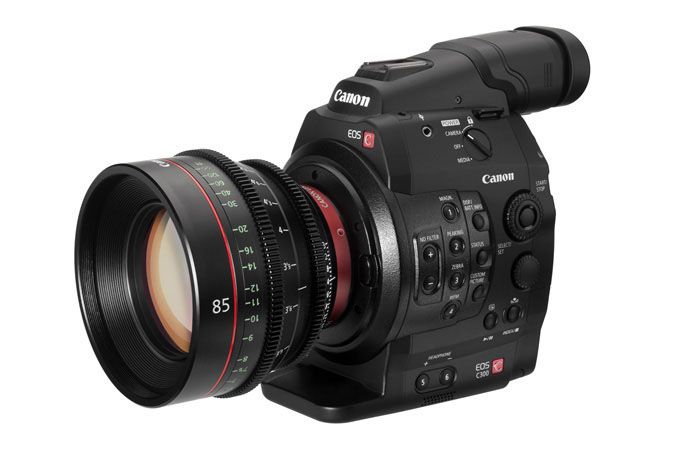

Dual Pixel CMOS Auto-Focus
Canon EOS C300

(Update #3) Are Sony, Olympus and Panasonic Cheating Their Customers (crop factor with ISO & aperture)?

update #3: be sure to read Tony Northrup’s comments and answers in the comment section of this post.

update #2: I think Tony Northrup is wrong, Have a look here to grasp the whole story.

update: have a look at mirrorlessrumors.com to get an alternative view of the issue. Says Ale from MR:

There are a couple of logical errors made by Tony Northrup.

First: No one cheats. All company aperture lens info are correct! The Panasonic 12-35mm f/2.8 has a f/2.8 aperture and not a f/5.6 aperture. You don’t have to make the equivalence he says has to be done! Use the Sony A7r and Sony A6000 for the same shoot. To get same result the camera automatically sets on both the same ISO and same lens aperture despite the different sensor size. Just to say that the aperture remains CONSTANT and is not relative! There is no equivalence to make on that!

Please read this why you cannot apply the aperture equivalence you mention on no other than the “depth of field” and “field of view” only:
http://admiringlight.com/blog/full-frame-equivalence-and-why-it-doesnt-matter/

The focal length and aperture remain constant!!!!

Second: He says Olympus, Panasonic and Sony do cheat. Nope. All companies use the same kind of measuring aperture for all lens formats (medium format, MFT format, APS-C and so on).

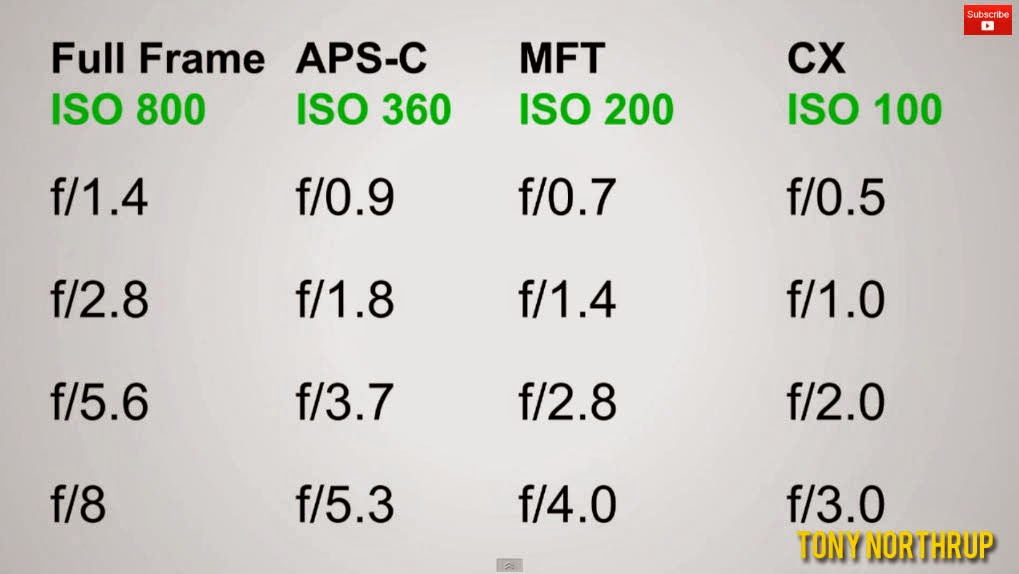
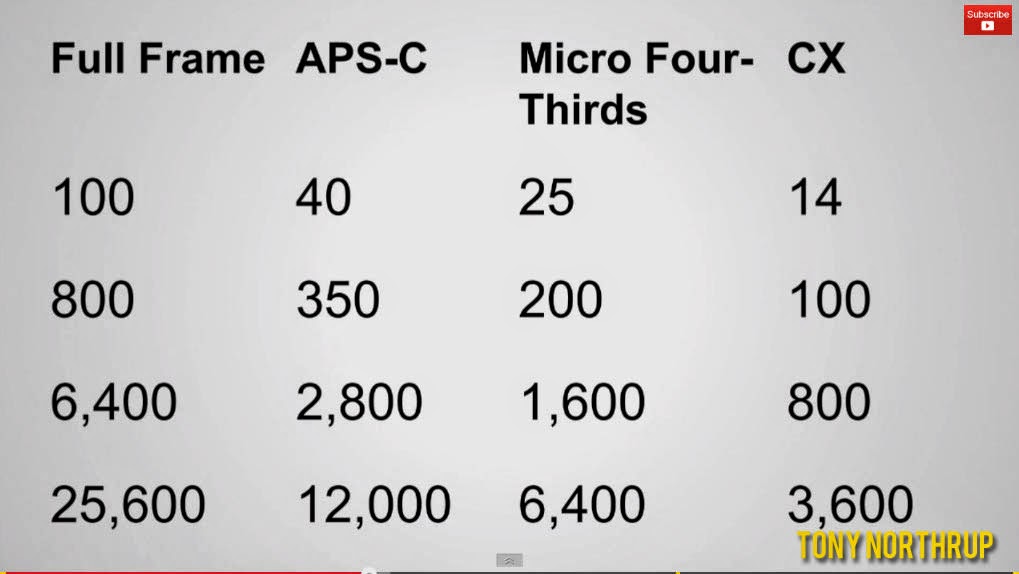
This 37 minutes video by Tony Northrup is rather technical and complex, but it is a must see if you want to understand the tricks some camera manufacturer are using to mislead their customers. According to Tony Northrup only Canon, Nikon and Fuji are stating the truth with their crop sensor specifications.

Says Tony Northrup:

Please spread the word to end the cheating: Why you need to apply crop factor to both your ISO and aperture, and how Sony, Olympus, & Panasonic use crop factor to mislead buyers

The folks at iso1200 made a table of contents of the video:

0:00 – Introduction
1:28 – Focal Length & Crop Factor
3:35 – ISO & Crop Factor(2)
15:00 – Aperture & Crop Factor
21:18 – Panasonic misleading consumers
27:10 – Sony misleading consumers
29:53 – Olympus misleading consumers
30:50 – Panasonic misleading consumers (again)
32:01 – Fuji misleading consumers
33:18 – The Good Guys: Canon, Nikon, Fuji, Sigma, Metabones, Voigtlander, and You
36:51 – Summary

[via iso1200]
That’s what it is about Panasonic’s f/2.8 lens
crop factor
Real aperture comparison chart
crop factor
Real ISO comparison chart


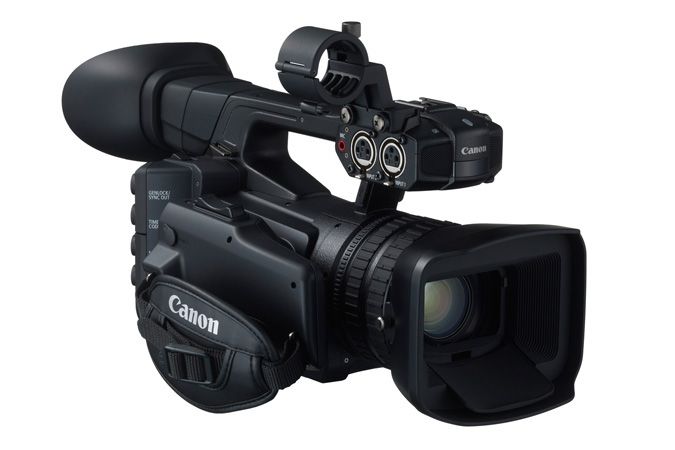
Features and benefits of the XF200 and XF205 Professional Camcorders (CPN Article)

XF205
Canon XF205

Canon Professional Network posted an article about the recently announced XF200 and XF205 run-and-gun camcorder.

From the introduction:

With today’s large sensor camera systems such as the Canon EOS 70D, 5D Mark III, 1D C and the EOS C100, C300 & C500, it would almost seem like small sensor-based camcorders are irrelevant in today’s production environments. As someone who has a long history with small sensor-based camera systems and still uses them on projects that I produce today, that couldn’t be further from the truth. There are, in fact, many situations where small sensor camcorders are actually better suited for the job at hand and are not only used daily in many facets of television and web-based video production, but also are preferred.

In this article, I will discuss some of these applications and how the CanonXF205 & XF200 represent the next generation of Canon’s small sensor-based camcorder systems that target productions where these cameras excel. I will also focus on some of the key features of the camera, such as its rotating hand grip, Wide DR Gamma, enhanced image stabilization, infrared recording and Wi-Fi features, which, together, make for a unique small sensor-based camcorder that can be used in a wide variety of today’s productions.

Read the article at CPN –>