Canon Patent: In Camera RAW Processing With Arbitrary LUTs
canon patent

A somewhat different Canon patent application. RAW processing with arbitrary LUTs. LUTs (Look Up Table) allow to apply specific color rendition parameters, for instance. If I got this patent right, it will allow to apply LUTs to the in camera RAW processing pipeline.

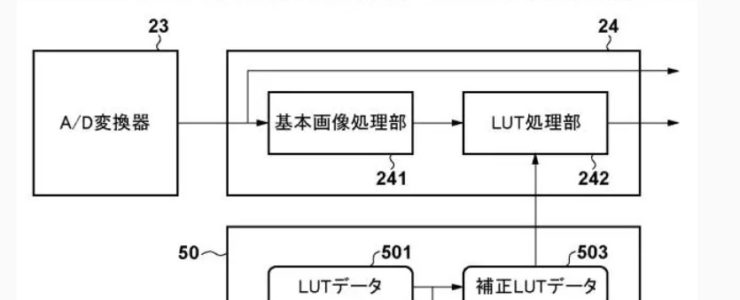
Canon patent application 2023121533 (Japan, published 8/31/2023) discusses technology and methods to integrate LUTs to the in camera RAW processing. From the patent literature:

An object of the present invention is to obtain an image having a degree of applicability desired by a user while using a lookup table desired by the user.

Description of the Related Art

A lookup table (hereinafter referred to as LUT) is generally used as means for correcting the color and contrast of an image. In many imaging devices, an LUT built in the imaging device can be applied to an image, or an LUT created by an external application can be loaded into the imaging device and applied to the image.

In addition, LUTs for converting to cinematic images, LUTs for special effects, etc. are often provided on the Web regardless of whether they are paid or not. can be applied.

However, LUTs provided on the Web, etc. are LUTs for converting into images that the creator considers good, and not everyone finds the images good. Some people may want to weaken the effect and apply it. In that case, it is necessary to first shoot an image without applying the LUT, and then combine the image as shot in post-production with the image to which the LUT is applied. It takes a lot of effort.

In the conventional example described above, the correction table changes depending on the determined scene. Even if it differs from the user’s preference, the user cannot change it according to his/her preference. Therefore, it is conceivable that the user adjusts the degree of application of the LUT before applying it to the image. However, when recording image data that has not been subjected to image processing, such as RAW moving image recording, naturally the LUT is not applied. Therefore, in order to reproduce the same image as the image viewed at the time of photographing at the time of post-editing, it is necessary to perform the same processing on a PC or the like using the LUT used and information on the degree of application, which takes time and effort.

In order to solve this problem, for example, the imaging apparatus of the present invention has the following configuration. That is, an image pickup apparatus having image pickup means and capable of connecting to a predetermined storage medium, an acquisition means for acquiring a first lookup table for image conversion from the storage medium, and Setting means for setting the degree of application of the first lookup table; and generating means for generating a second lookup table from the first lookup table based on the degree of application set by the setting means. and converting the image data obtained by the imaging means using the second lookup table generated by the generating means.

More Canon patents are listed here.

[via asobinet]
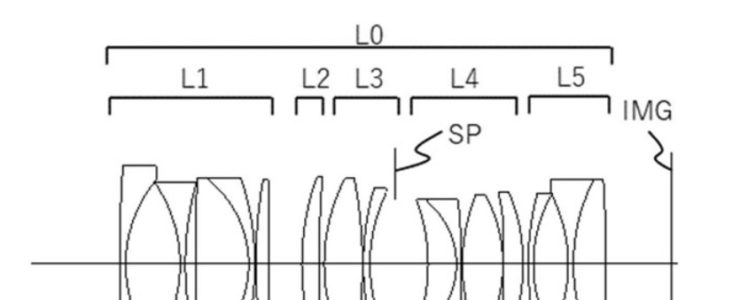
Canon Patent: 24mm F1.4, 35mm F1.4 And 50mm F1.4

canon patent

And yet another Canon patent application. Fast primes for the RF mount.

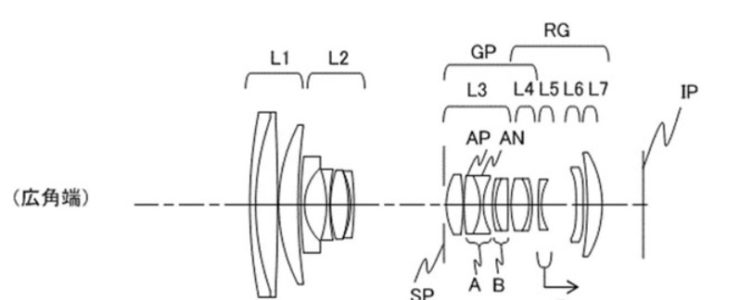
Canon patent application 2022024113 (japan, published 8/30/2023) discusses optical formulas for three fast prime lenses:

  • 24mm F1.4
  • 35mm F1.4
  • 50mm F1.4

From the patent literature:

Optical system and imaging device

A compact optical system capable of high-speed focusing with a wide angle of view and a large aperture ratio is provided.

Description of the Related Art

Imaging devices using solid-state imaging devices such as CCD sensors and CMOS sensors are required to have optical systems that have a wide angle of view, a large aperture ratio, a small size, and high optical performance. There is also a demand for high-speed autofocus in the optical system.

An optical system with a wide angle of view and a large aperture ratio has the problem that it is difficult to correct various aberrations. In particular, if the weight of the focus lens group is reduced in order to perform high-speed focusing (autofocus), it becomes difficult to suppress aberration fluctuations in focusing from an object at infinity to a close object.

According to the present invention, it is possible to provide a compact optical system capable of high-speed focusing while having a wide angle of view and a large aperture ratio.

Example 1 (24mm F1.4)

  • Focal length 24.36
  • F value 1.44
  • Half angle of view 41.61
  • Image height 21.64
  • Lens length 106.56
  • Back focus 12.72

Example 2 (35mm F1.4)

  • Focal length 34.09
  • F value 1.45
  • Half angle of view 32.40
  • Image height 21.64
  • Lens length 113.84
  • Back focus 13.67

Example 3 (50mm F1.4)

  • Focal length 48.50
  • F value 1.45
  • Half angle of view 24.04
  • Image height 21.64
  • Lens length 108.70
  • Back focus 11.47

More Canon patents are listed here.

[via Digicame Info]

Canon Patent: 10-20mm F2-2.8 And 10-30mm F2-2.8 Lenses

canon patent

A new Canon patent application was spotted. Two wide angle zoom lenses.

Canon patent application 2023120768 (Japan, published 8/30/2023) discusses optical formulas for two relatively fast wide angle zoom lenses:

  • 10-20mm f2-2.8
  • 10-30mm f2-2.8

From the patent literature:

A zoom lens that is advantageous in terms of wide angle of view, small size, high optical performance, and the like is provided.

Description of the Related Art

Zoom lenses used in imaging devices such as surveillance cameras, digital still cameras, video cameras, and broadcasting cameras are desired to have a wider angle of view and a smaller size. Patent Documents 1 and 2 disclose a negative lead type zoom lens as a compact zoom lens with a wide angle of view.

The above zoom lens is also required to have high optical performance corresponding to high image quality such as 8K image quality.

An object of the present invention is, for example, to provide a zoom lens that is advantageous in terms of wide angle of view, small size, and high optical performance.

Example 1

  • Focal length: 10.41-20.81
  • F-value: 2.05-2.84
  • Half angle of view: 59.1-29.7

Example 2

  • Focal length: 10.79-28.04
  • F-value: 2.00-3.17
  • Half angle of view: 58.9-22.3

More Canon patents are listed here.

[via asobinet]
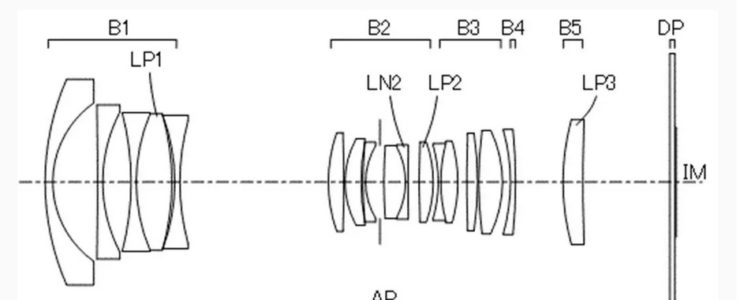
Canon Patent: RF 100-300mm F2.8 Telephoto Zoom Lens

canon patent

Here is a new Canon patent application, yet for another RF mount lens. A rather interesting one, although it refers to ab already released lens: the Canon RF 100-300mm f/2.8L IS USM.

Canon patent application 2023117937 (Japan, published 8/24/2023) discusses optical formulas for a fast telephoto zoom lens, a telephoto zoom that keeps f/2.8 over the zoom range.

Excerpt from the patent literature:

A zoom lens, an imaging device having the same, and an imaging system.

An object of the present invention is to provide a lightweight zoom lens that has high optical performance over the entire zoom range and all object distances.

Description of the Related Art

In recent years, zoom lenses used in image pickup apparatuses are required to have high optical performance at all object distances from infinity to the shortest distance, and to be quiet during focusing. In order to meet these demands, a zoom lens has been proposed that performs focusing by moving two lens groups along different trajectories (see Patent Documents 1 and 2).

In a large-aperture telephoto zoom lens with a long focal length and a small F-number, if the focus group is arranged near the diaphragm or closer to the object side than the diaphragm, the lens diameter of the focus group increases, making it difficult to reduce the weight . As a result, the load on the actuator for driving the focus group increases, making it difficult to perform quiet and high-speed focusing. In order to reduce the weight of the focus group, it is important to appropriately set the arrangement of the focus group and the refractive power of the front and rear lens groups.

SUMMARY OF THE INVENTION

It is an object of the present invention to provide a lightweight zoom lens that has high optical performance over the entire zoom range and object distance.

Example 1

  • Focal length: 103.00-292.00
  • F-value: 2.89-2.91
  • Half angle of view: 11.86-4.24
  • Image height: 21.64
  • Overall length: 334.46
  • Back focus: 32.73

Example 2

  • Focal length: 120.00-294.00
  • F-value: 2.91
  • Half angle of view: 10.22-4.21
  • Image height: 21.64
  • Total length: 350.00
  • Back focus: 37.47

As I said at the beginning, the Canon patent application refers to an already released lens. More Canon patent applications are listed here.

[via asobinet]

Canon Patent: Smaller Form Factor For Built-in Teleconverter

canon patent

Here is a new Canon patent application. I rather interesting one.

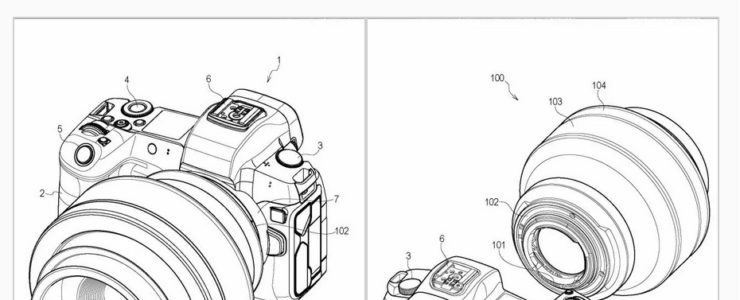
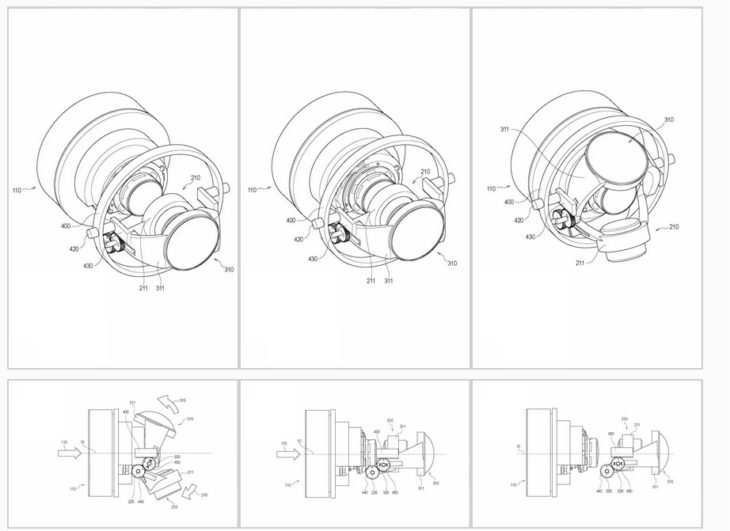
Canon patent application 2023118490 (Japan, published 8.25.2023) discusses methods and technology for a built-in teleconverter with a smaller form factor, i.e. the miniaturization of the teleconverter.

From the patent literature:

A large space is required for inserting or retracting a conversion lens inside an optical device, making it difficult to miniaturize the optical device.

Description of the Related Art

In optical equipment such as digital cameras, video cameras, and interchangeable lenses, it is known that the focal length range can be changed by inserting a conversion lens into the optical path.

Patent Document 1 discloses a technique for moving a conversion lens built into a camera body between an insertion position inserted into an optical path and a retracted position retracted out of the optical path. The built-in conversion lens described here is retracted in the space between the prism that guides the subject image to the finder and the strobe that is stored above the lens barrel.

However, the built-in conversion lens described in Patent Document 1 is moved to the retracted position using a dedicated actuator. Therefore, a space for arranging the actuator inside the lens is required, and it is difficult to suppress the enlargement of the lens.

Accordingly, the present invention provides an optical apparatus that has a built-in conversion lens so that a space for inserting or withdrawing the built-in conversion lens can be secured while suppressing an increase in the size of the lens. for the purpose.

More Canon patents are listed here.

[via asobinet]
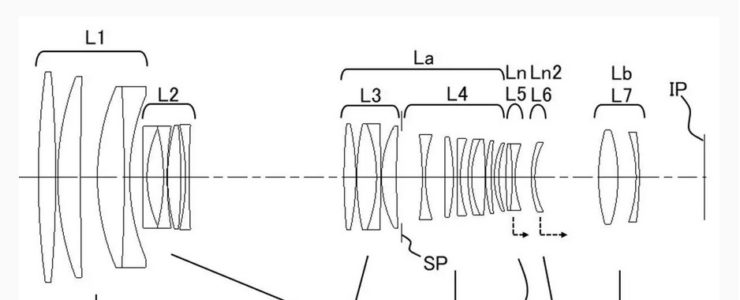
Canon Patent: 15-70mm F2.8-4 IS, 15-70mm F4 IS And 15-85mm F2.8-5.6 IS for APS-C

Canon patent

A new Canon patent application for three lenses for the RF mount and cameras with APS-C imaging sensor.

Canon patent application 2022013994 (Japan, published 8/14/2023) discusses optical formulas for three RF-mount lenses for APS-C imaging sensors:

  • 15-70mm F2.8-4 IS
  • 15-70mm F4 IS
  • 15-85mm F2.8-5.6 IS

From the patent literature:

A compact zoom lens with a wide angle of view is provided that is robust against manufacturing errors and yet provides high optical performance.

Description of the Related Art

In recent years, there has been a strong demand for a lens system used in an imaging apparatus to have high optical performance while the entire lens system is compact. In order to achieve good optical performance while miniaturizing the entire lens system, it is important to appropriately set the refractive power and configuration of each lens group, and the conditions for moving each lens group during zooming. In particular, when miniaturizing the lens system of a camera with a large image sensor, high refractive index glass materials are often used, and it is required to suppress chromatic aberration while ensuring robustness against decentration of the lens.

SUMMARY OF THE INVENTION

It is an object of the present invention to provide a compact zoom lens or the like with a wide angle of view that provides high optical performance while being robust against manufacturing errors. In the zoom lens of each embodiment, any one of the lens groups as a whole or a part thereof is moved so as to include a component in the direction perpendicular to the optical axis as an anti-vibration group, or in an in-plane direction including the optical axis. It is also possible to employ a configuration in which vibration isolation is performed by rotationally moving (oscillating). In particular, it is preferable to use the cemented lens B as the anti-vibration group.

Example 1 (15-70mm F4, for APS-C)

  • Zoom ratio 4.40
  • Focal length 15.45 36.03 67.94
  • F value 4.12 4.12 4.12
  • Half angle of view 41.27 19.59 10.60 Image
  • height 12.66 13.66 13.66
  • Total lens length 100.14 108.00 120.23
  • Back focus 10.46 10.79 12.37

Example 2 (15-70mm F2.8-4, for APS-C)

  • Zoom ratio 4.40
  • Focal length 15.45 36.49 68.04
  • F number 2.88 3.86 4.12
  • Half angle of view 41.38 19.53 10.61 Image
  • height 12.66 13.66 13.66
  • Lens length 100.32 11 0.44 118.71
  • Back focus 10.62 11.68 15.59

Example 3 (15-85mm F2.8-5.6, for APS-C)

  • Zoom ratio 5.42
  • Focal length 15.45 36.29 83.77
  • F value 2.88 4.00 5.80
  • Half angle of view 41.36 19.65 8.71
  • Image height 12.66 13.66 13.66
  • Total lens length 101.54 1 16.35 133.85
  • Back focus 12.12 12.61 16.91

More Canon patents are listed here.

[via digicame info]