The EOS R8 Mark II is real, a 300-600mm may be weeks away, and the…
The Best Black Friday Deal Is the One You Skip
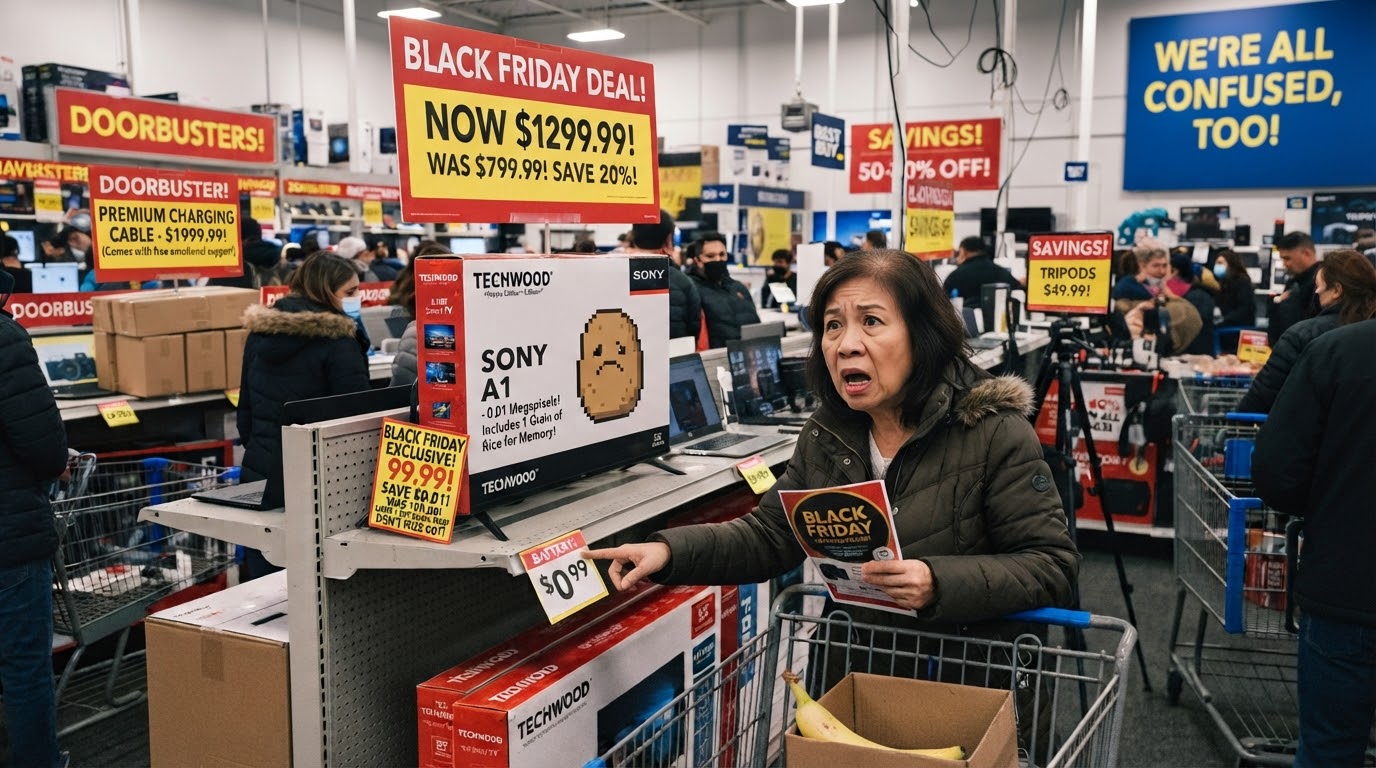
Why the camera in your bag beats the one in your shopping cart. Only 1 in 5 Black Friday deals is real. Here’s what the data says, and a better way to spend this weekend. However, if you really want to surf for deals, I won’t mind.
It’s Thursday night, and Black Friday starts tomorrow. Your inbox has been filling up for a week: “Up to 40% off!” “Lowest price of the year!” “Ends at midnight!” In another tab there’s a shopping cart with a new camera body in it, and you’ve started telling yourself something every photographer has told themselves at least once: this is the one that will finally make my photos better.
Before you click “buy,” here’s something worth knowing. When the consumer group Which? tracked more than 250,000 daily prices at eight major retailers, it found that only about one in five Black Friday deals was actually the lowest price of the year. Most of the rest could be bought for the same price or less at other times.
In this post I’ll look at how much of the Black Friday discount is real and the tricks retailers use to make deals look bigger. Then I’ll argue that the camera already in your bag can do more than you think, suggest a better way to spend this weekend, and give you a quick checklist in case you still want to buy something. The best Black Friday deal might be the one where you don’t spend anything at all.
Let’s start with the numbers.
1. The Black Friday Discount Often Isn’t There
The biggest study yet: only one in five deals is real
Every November, Which? checks whether the previous year’s Black Friday deals were actually deals. Its 2026 report is its largest so far. Researchers took 756 home, tech and health products from the Black Friday sales pages of eight major UK retailers: Amazon, AO, Argos, Boots, Currys, John Lewis, Richer Sounds and Very. Then they tracked more than 250,000 daily prices, from six months before the sale to six months after.
Only 22% of the offers hit their lowest price during the four-week Black Friday period. Another 44% only matched a price that had been available at another point in the year. Nearly four in five “deals” could be bought for the same price or less some other time.
Which? retail editor Reena Sewraz didn’t claim there are no bargains. She said they “might be hard to find,” and that “more often than not” shoppers can still get the same deal or a better one towards Christmas and beyond.
This isn’t a one-off
Which? has been finding the same pattern for years. Its analysis of Black Friday 2020 looked at 201 deals from six retailers, and 184 of them (92%) were the same price or cheaper in the six months before the sale. Only one of the 201 products was at its cheapest on Black Friday alone. Things looked no better after the sale: within the following six months, 98.5% of the products were the same price or cheaper at some point.
One example stands out. A Zanussi washing machine “discounted” to £309 at John Lewis had been cheaper on 88 different days before Black Friday. Five months earlier, it had sold for £249.
European regulators found the same thing
In 2022, the European Commission and 13 national consumer authorities monitored 16,000 products on 176 websites for a month around Black Friday. About half the products carried a discount announcement. Roughly one in four of those announcements broke EU law, and violations turned up on at least 43% of the websites checked.
The most recent sweep, published in March 2026, covered 314 online traders in 23 EU countries plus Iceland and Norway. Authorities found that 30% referenced their discounts incorrectly. Under EU law the “was” price must be the lowest price the shop charged in the previous 30 days. It can’t be whatever number makes the discount look biggest.
American trackers agree
- WalletHub compares Black Friday ad prices with the same items’ earlier prices on Amazon. Its 2026 analysis found that 38% of items offer no savings compared with their pre-Black Friday prices, up from 36% in 2025. Consumer electronics averaged a 22% discount; computers and phones averaged just 17%.
- Groundwork Collaborative, a progressive think tank, examined 351 products that Amazon featured on its own Black Friday and Cyber Monday deal pages in 2024 and 2025. It found that 29.1% were priced the same or higher than their lowest price in the previous 30 days. Over 90 days, that rose to 57.3%. To be fair, Amazon strongly disputes this. It calls the report “deeply flawed and false” and says its own analysis found 98% of those products were at or below their 30-day price.
- Visualping monitored more than 2,600 products during the 2025 holiday season. It found that roughly a third of Black Friday and Cyber Monday deals had been available for less earlier in the season.
One caveat: none of these studies looked at cameras specifically. They cover consumer electronics, appliances and general goods. Still, they all point the same way, and camera gear is sold by many of the same retailers using the same pricing systems.
If so many deals aren’t what they seem, the next question is how retailers make them look so convincing.
2. How Retailers Make a Deal Look Bigger
Knowing the tricks is the best defence. These five come up again and again in the research.
Trick 1: Raise the price, then “cut” it
Decodo, a web data company, tracks more than a million prices at 37 US retailers, collecting them six times a day. Between early September and late October 2026, it found that 1 in 8 products got more expensive. The typical rise was 23%, and the average was 33%. Electronics saw the most markups: 1 in 3 electronics products now costs more than it did in early September.
Last year’s data shows how this plays out. Products that had a pre-sale price rise were twice as likely to go on sale. Their deals looked like 28% off, but compared with the September price, shoppers saved only 12%.
One example: a Ryobi 18V tool kit cost $79 in September 2025, climbed to more than $200, and was then “slashed” 51% to $99 on Black Friday. That’s an impressive headline discount for a price still about 25% higher than in September.
Trick 2: Pick a convenient “was” price
The European Commission published a real case from its 2022 sweep. A product had been selling for €27.99. In early November its price went back up to €39.99 and stayed there for about three weeks. On Black Friday it dropped to €23.99 and was advertised as “40% off €39.99.”
Under EU rules, the reference price should have been the lowest price in the previous 30 days, which was €27.99. The honest discount was 14%. Same product, same price, but the ad made the discount look almost three times bigger.
Trick 3: The RRP nobody actually charges
Watch for “RRP” (recommended retail price). It’s the price the manufacturer suggests, and the shop doesn’t have to have ever charged it. In one investigation, Which? found Amazon selling a Samsung heat pump tumble dryer for £629.99 on Black Friday against an RRP of £789.99. That looks like a £160 saving. But Amazon hadn’t sold it for £789.99 at any point in the previous 12 months; the highest price it had charged was £719.
Shoppers often misread these labels. In a Which? survey, only 55% knew what RRP means, and 18% wrongly thought the retailer must have sold the item at that price before. When shown a “was/now” price, 31% assumed the “was” price applied just before the sale. In some deals Which? checked, the “was” price dated back as far as 11 months.
Trick 4: Black Friday “specials” and padded bundles
Some Black Friday products are made specifically for the sale. Consumer Reports and Wirecutter have warned about “derivative” models, mostly TVs and monitors. Sometimes they just get a new model number; sometimes they get cheaper parts or fewer features. Because the exact model isn’t sold anywhere else, you can’t compare prices easily, and price-match guarantees (which usually cover only identical models) don’t apply.
The camera world has its own version: the bundle. A body comes “packed with extras”: a generic bag, a slow memory card, a cheap UV filter, a flimsy tripod. Add up what those extras really cost, and whether you’d ever use them, and the “free £150 of accessories” often turns out to be a few pounds’ worth of things that will end up in a drawer. Before you get excited about a bundle, price the body on its own.
Trick 5: Fake urgency
Countdown timers, “only 2 left,” and “deal ends at midnight” all exist to stop you thinking. The EU’s 2026 sweep found that 18% of traders used pressure-selling techniques like these, and authorities judged more than half of those cases misleading; for example, claiming a product was running out when it wasn’t.
To be fair: some deals are real
None of this means every deal is fake. Which? found that 22% of deals really were the lowest price of the year, and some retailer price guarantees held up in its testing. In a separate study of more than 430 products, Decodo found that most reached their lowest price of the season on Black Friday itself. Its advice is simple: if the Black Friday price beats both the September price and last Black Friday’s price, it’s a real saving. The point is to check before you trust the label.
Even a real saving raises a bigger question, though: do you actually need the thing you’re saving on?
3. The Camera You Have Is the Best Camera Right Now
Gear Acquisition Syndrome
Photographers have a name for the feeling that the next camera or lens will finally unlock better photos: Gear Acquisition Syndrome, or GAS. DPReview has written that while GAS isn’t unique to photography, the hobby is “particularly fertile ground for the collective delusion” that better gear will lead to better photographs.
GAS never ends, because there’s always a newer model. The camera in your cart today will be “last generation” within a couple of years, and the same itch will come back. Black Friday makes it worse: it takes a vague wish and adds a deadline.
What a new camera won’t fix
Be honest about what’s actually holding your photos back. For most of us, it’s things that have nothing to do with the sensor:
- Composition. Where you stand, what you leave out, and how the frame is balanced.
- Light. The same scene at noon and at golden hour can look like two different places.
- Timing. Waiting for the person to step into the light, or the bird to turn its head.
- Seeing. Noticing a photo in the first place.
- Subject choice. Having something worth saying, and a reason to point the camera at it.
- Editing. Knowing when to stop, and developing a consistent look.
A new body improves none of these. A sharp photo of a dull scene is still dull.
Your “old” camera is better than you think
A camera from five or ten years ago is still very capable. A 24-megapixel file is large enough to print at around 20 by 13 inches at photo quality, which is bigger than most of us will ever print. Most of the limits people blame on older gear can be worked around with technique:
- Not enough resolution? Shoot a stitched panorama and get more pixels than most new bodies offer.
- Too much noise at high ISO? Use a tripod, a lower ISO and a slower shutter speed, or find better light.
- Limited dynamic range? Bracket your exposures and blend them, or shoot when the light is softer.
- Slow autofocus? Pre-focus, anticipate movement, and use back-button focus.
Every one of these workarounds also makes you a better photographer. A new camera just removes the problem, and the lesson with it.
The science of working with less
There’s research behind the idea that limits can help creativity. In a 2016 paper in the Journal of Consumer Research, “Creating When You Have Less: The Impact of Resource Scarcity on Product Use Creativity,” Ravi Mehta and Meng Zhu found that making people think about scarcity led them to use products in more novel ways. The researchers argue that scarcity activates a “constraint mindset” that pushes people away from the default way of using things.
The studies were lab experiments with everyday objects, not cameras, so it’s worth not overstating them. But they fit what many photographers already know: one lens, one camera and no option to upgrade force you to solve problems creatively.
The honest exception
Sometimes you really do need new gear. If your camera is broken, or it truly can’t do the job (you’ve taken up wildlife and need a long telephoto lens, or you’ve started shooting paid events and need two card slots), buy what you need. That’s a need, not a deal. Just make sure the sale isn’t what created the need.
So if the cart isn’t the answer, what should you do with this weekend instead?
4. Spend This Weekend on Skills Instead
If the urge to shop is really an urge to get better, there are ways to do that without spending money.
Finally learn your camera
Most of us use a fraction of what our cameras can do. Spend an evening with the manual (it’s probably a free PDF) and work through it with the camera in your hands. Focus on:
- Custom buttons and dials. Put the settings you change most often where your thumb already sits.
- Custom modes (C1, C2 and so on). Save one setup for landscapes and one for moving subjects so you can switch in a second.
- Autofocus modes and areas. Learn when to use single versus continuous AF, and which focus area suits which subject.
- Metering and the histogram. Learn to read the histogram so you stop trusting the rear screen, which lies, especially in bright sunlight.
An hour of this often feels like getting a new camera, because in practice you’ve upgraded how you use it.
Take the Black Friday Challenge
Here’s a challenge for the weekend: one camera, one lens, 36 frames. If you only have a zoom, tape it at one focal length. Treat it like a roll of film. No machine-gunning and no “I’ll fix it later.” Every frame has to be deliberate.
Limiting yourself to 36 frames makes you slow down, think about composition before pressing the shutter, and value each shot. On Monday, pick your best three. You’ll likely learn more from those 36 frames than from a month of shooting freely.
More exercises for the long weekend
- Three times of day. Photograph the same subject at dawn, midday and dusk. Compare them, and you’ll see how much light shapes a photo.
- A week in manual mode. Set aperture, shutter speed and ISO yourself for every shot. It’s frustrating at first, and then it suddenly clicks.
- Recreate a photo you admire. Work out the lens, light and position behind an image you love. The gap between your version and theirs shows you exactly what to learn next.
- Ten photos within 100 steps of your front door. A good test of how well you see ordinary things.
Small spends that teach more than a new body
If you want to spend something, there are better options than a new camera:
- A print of your best photo. Seeing your work large and on paper shows you its strengths and flaws in a way a screen never does.
- A photo book of your year. It forces you to edit and choose, which is a skill in itself.
- A workshop or photo walk with someone better than you.
- A professional sensor clean for the camera you already own.
- A second-hand book on composition or light. It costs a few pounds and lasts a lifetime.
An optional experiment
Work out what the camera in your cart would have cost, and move that amount into a savings account. A year from now, see what it could pay for: a trip somewhere worth photographing, a proper workshop, or a lens you’ve proven you need. Experiences and skills tend to improve your photos far more than a new body does.
Still convinced you need to buy something? That’s fine. Just do it properly.
5. If You Still Want to Buy, Use This Checklist
This isn’t a lecture. If you’ve thought it through and still want something, here’s how to make sure the deal is real.
Step 1: The “need” test
Ask yourself: Which specific shot have I missed at least three times because of my gear? Name it. “Birds in flight that my autofocus can’t track” is a real answer. “I just feel like it’s time” isn’t. If you can’t name the shot, wait.
Step 2: Check the price history
Don’t trust the “was” price; check what the item has actually sold for. Price trackers like Keepa and CamelCamelCamel (Amazon only), comparison sites like PriceRunner and PriceSpy in the UK, and Google Shopping’s price history all show how a price has moved over months.
Then apply Decodo’s rule: the Black Friday price should beat both the September price and last Black Friday’s price. If it doesn’t, you’re looking at a reset price, not a saving.
Step 3: Check at least three stores
This one is simple and it works. Deal.ai compared 24,394 identical products at 16 major US retailers. On average, the price at one store picked at random was 15.6% above the lowest listed price. Checking three stores cut that gap to 3.7%. About one in three products at Walmart and Amazon, and half at Target, were listed for less at another big retailer at the same moment. On a camera body, that gap can run to hundreds.
Step 4: Remember that waiting is allowed
The deadline is mostly marketing. Which?’s 2020 data found that 98.5% of Black Friday products were the same price or cheaper at some point in the six months after. In Decodo’s tracking of more than 430 products, about one in four got cheaper after Black Friday ended. Camera gear also tends to drop in price when its replacement launches. If you can wait, you usually lose nothing.
Step 5: Consider used or refurbished
Cameras and lenses are built to last, and the used market is full of well-kept gear from people whose GAS moved on to something else. Buying used or manufacturer-refurbished often saves a large share of the new price, keeps working equipment out of landfill, and usually costs you little in image quality. Buy from dealers who offer a warranty and a returns window.
And if you work through all five steps and decide to wait, you’ve just found the best deal of the weekend.
Conclusion: Close the Tab, Open the Shutter
Black Friday depends on one idea: that the price in front of you is a chance you’ll never get again. The data says otherwise. Which? found that only 22% of last year’s Black Friday deals were really the lowest price of the year. European regulators found that 30% of the online traders they checked showed their discounts incorrectly. And when prices quietly rise in September, a deal that looks like 28% off can turn out to save you only 12%. Real bargains do exist, but you only find them by checking, not by trusting the label.
The bigger point isn’t about price, though. A real discount on a camera you don’t need is still money spent on the wrong problem. A new body won’t give you composition, light, timing or the ability to see a photo before you take it. Those come from using the camera you already own until you know it well, and from limits that force you to think instead of upgrade.
So here’s my challenge for this weekend:
- Tonight: charge your battery, format your card and pick one lens.
- Saturday and Sunday: take the Black Friday Challenge. One camera, one lens, 36 deliberate frames.
- Monday: choose your best three and share them in the comments below. I’d love to see what your “outdated” gear can do.
- If you really need something: add it to a price tracker and buy when the price history says so, not when a countdown timer does.
One last thought. Picture the photographs you love most, your own or anyone else’s. You probably can’t remember which camera took most of them, and you certainly don’t know what it cost. Nobody looking at a great photograph asks whether the camera was bought at full price.
The deals in your inbox end at midnight. The light on Saturday morning doesn’t. A year from now, which will you remember: what you saved, or what you shot?
Related Posts