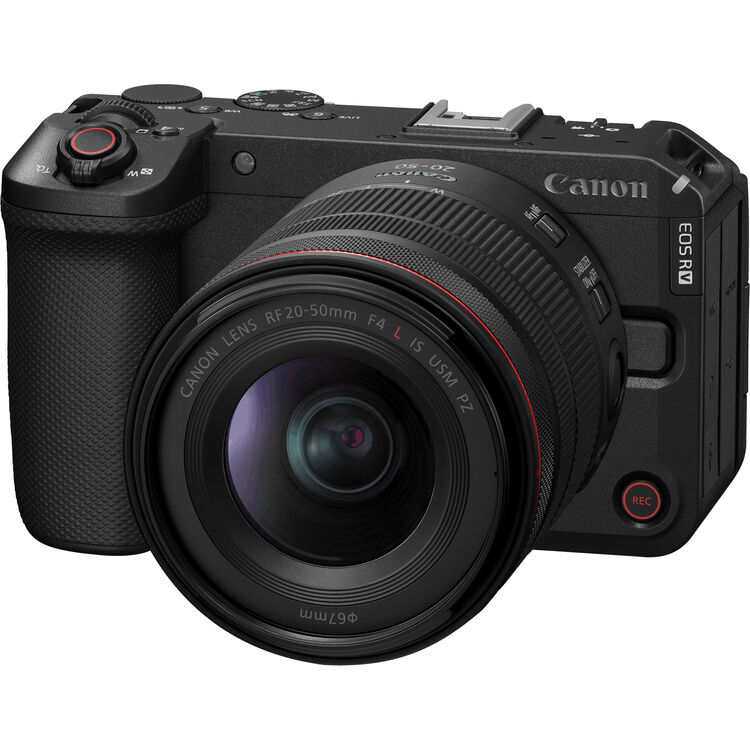
Pre-orders are available at B&H Photo: Canon EOS R6 V RF 20-50mm F4 L IS…
Canon Patent: Fast Wide Primes — 14mm f/1.4, 18mm f/1.4, 35mm f/1.8 Optical Systems
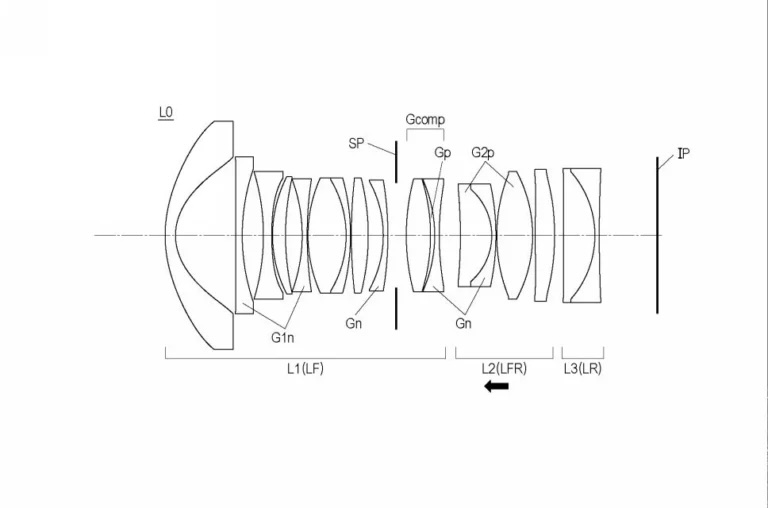
Canon is apparently not done dreaming about fast wide primes. A new patent application published March 12, 2026 (JP P2026043301, filed August 28, 2024) covers a family of large-aperture wide-angle optical systems — and the specs on paper are the kind of thing that makes lens nerds sit up straight.
The stated goal? “Provide an optical system with a large aperture ratio, high optical performance, and fast focusing capability.” Bold words. Let’s look at what they’re actually proposing.
The Patent: Five Optical Systems, One Ambitious Brief
The application includes at least five worked examples spanning a broad range of focal lengths:
| Example | Focal Length | F-value | Half-angle | Image Height | Total Length | Back Focus |
|---|---|---|---|---|---|---|
| Ex. 1 | 14.42mm | f/1.46 | 52.34° | 18.68mm | 118.50mm | 14.00mm |
| Ex. 2 | 20.60mm | f/1.46 | 42.54° | 18.90mm | 117.50mm | 18.44mm |
| Ex. 3 | 24.72mm | f/1.46 | 37.40° | 18.90mm | 117.50mm | 15.00mm |
| Ex. 4 | 18.45mm | f/1.46 | 45.46° | 18.75mm | 121.17mm | 17.78mm |
| Ex. 7 | 34.00mm | f/1.85 | 30.41° | 19.96mm | 98.50mm | 14.00mm |
In plain English: Canon is exploring 14mm f/1.4, 18mm f/1.4, 20mm f/1.4, 24mm f/1.4, and 35mm f/1.8 optical designs — all with large image circles consistent with full-frame sensors.
The Back Focus Situation (Here We Go Again)
Here’s where it gets interesting — and a little speculative. The RF mount has a flange focal distance of 20mm. Several of these designs have back focus values well below that threshold: 14mm (Ex. 1), 15mm (Ex. 3), 14mm (Ex. 7), and 17.78mm (Ex. 4). Only Example 2 at 18.44mm gets close.
Short back focus in a patent design doesn’t automatically disqualify RF compatibility — there are design tricks (rear floating elements, internal focusing groups) that can shift real-world performance away from the listed patent geometry. But it does raise the familiar question that haunts Canon patent watching: are these RF, EF, or something else entirely? Canon has filed similar wide-aperture designs in the past that turned out to be for cinema lenses or specialized applications rather than consumer RF glass.
That said, the image heights (18.68–19.96mm) are solidly full-frame territory, and the total lengths (98–121mm) are reasonable for fast prime construction.
What It Could Mean for Canon Shooters
Canon’s RF wide-prime lineup still has some gaps. The RF14-35mm f/4L IS USM covers the ultra-wide zoom territory, and the RF15-35mm f/2.8L handles the faster end — but dedicated fast wide primes like a 14mm f/1.4 or 20mm f/1.4 would be genuinely new territory for RF. Sony has the FE 14mm f/1.8 G Master and the FE 20mm f/1.8 G; Nikon has the Z 20mm f/1.8 S. Canon RF shooters interested in astrophotography, architecture, or environmental portraits at wide angles have been waiting.
A 35mm f/1.8 RF, meanwhile, would slot neatly between the existing RF35mm f/1.8 Macro IS STM (budget end) and the RF35mm f/1.4 L VCM (flagship). Whether Canon actually wants to fill that middle ground is another question.
The Standard Caveats Apply
Patents are not products. Canon files dozens of optical system patents that never see production glass. This one is interesting because it covers multiple related focal lengths in a single application, which sometimes signals more serious R&D intent — but it’s still early days. Filed in August 2024, published March 2026, and almost certainly years from a camera store near you, if it ever gets there at all.
Still: a 14mm f/1.4 RF would be something. We’ll be watching.
Source: とるなら (asobinet.com) — Patent JP P2026043301, published 2026-03-12, filed 2024-08-28.
Related Posts