
Canon Financial Results Q2 2019 – The Times They Are A Changing
Canon Financial Results

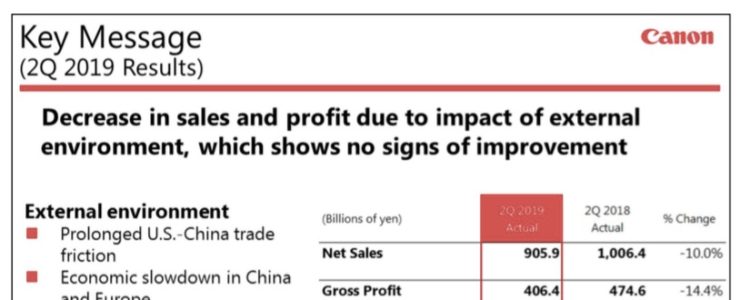
As anticipated, Canon had to adjust the expected sales figures for Q2 2019. And the published Canon financial results confirm it.

Canon’s sales figures for Q2 2019 aren’t exactly exciting with huge losses compared to Q2 2018 (see image on top). In Canon’s own words:

We still do not see any signs of improvement in the business environment that surrounds us. In fact, since our last earnings announcement, the situation surrounding U.S.-China trade friction has become more and more chaotic and economic slowdown in China and Europe has worsened. Furthermore, in the industrial equipment market, the recovery of customer capital investment has been pushed out further due to sluggish smartphone demand and continuing decline in memory prices.

About the imaging systems:

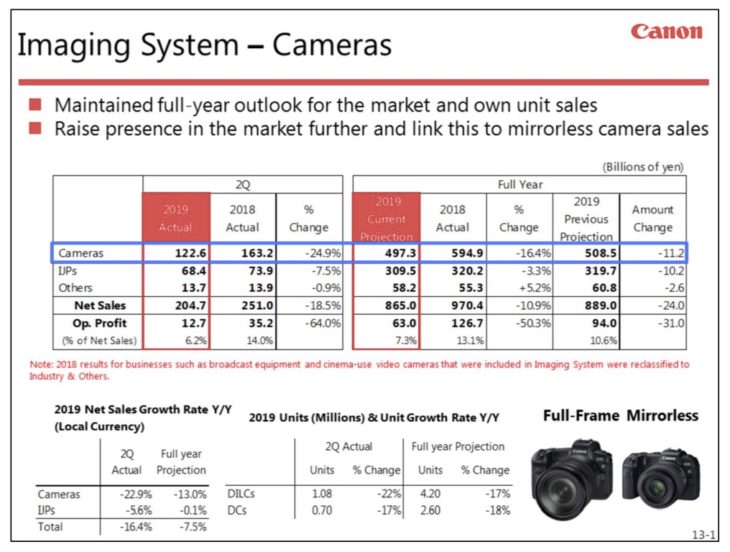
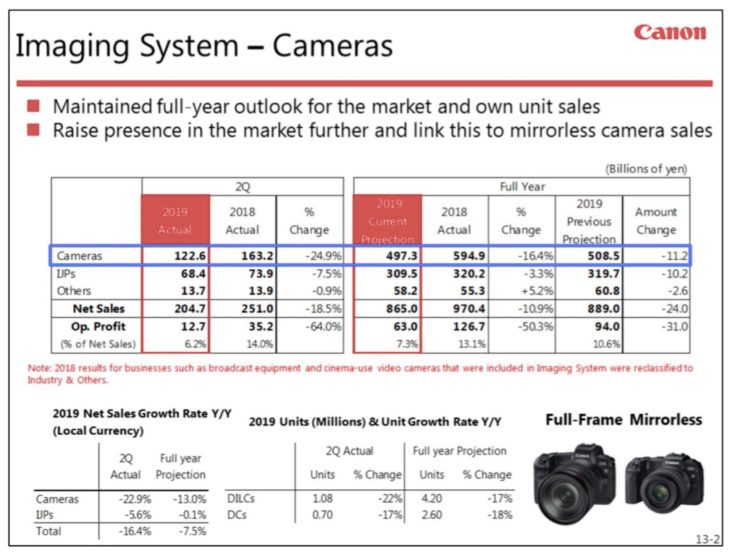
As for Imaging System, although we saw unit sales of mirrorless cameras grow at a higher rate than the market, sales and profit for the entire business unit declined, due to the impact of DSLR market contraction, particularly for entry-class models. Although the level of profit was low compared with the same period last year, by promoting the optimization of production and sales organizations in line with market changes, profitability did pick up from its bottom in the previous quarter.
The EOS M50 and the new EOS R line can not save the plummeting camera market.

More about Canon’s camera systems:

Looking at interchangeable-lens cameras, in addition to market contraction centered on entry-class DSLRs, in 2018 we launched three new products that led to a high level of sales in the second quarter of last year. As a result, unit sales for the second quarter this year were down 22% to 1.08 million.

Against this backdrop, we successively launched strategic full-frame models into the mirrorless camera market from the second half of last year. The introduction of a high-end model, further heightened our presence in the market and at the same time had a positive impact on overall sales of our mirrorless cameras.

On the other hand, in the full-frame category of the market where price competition is increasing, as a result of prioritizing profitability, unit sales were below our target. However, for interchangeable-lens cameras overall, our unit sales were in line with our plan. As a result, we retained our full-year projection for unit sales. In terms of revenue, we did lower our projection to reflect a change in product mix to our plan. However, in the second half of the year we will stimulate sales through the launch of new lenses.

Specifically, we will enhance our lineup launching 5 new lenses for mirrorless cameras. Through kit sales that leverage our broad range of mirrorless camera lenses and by bundling cameras with accessories like our lens adapter that makes it possible to use our existing rich lens lineup we will promote further expansion of mirrorless camera sales.
In addition, we will further strengthen our efforts to generate user interest in our mirrorless cameras. As a large percentage of high-end models purchases involve the customer actually handling the model and trying it out before buying, in major cities in Japan and other markets, we will create even more touch points for users, proactively expanding opportunities to actually experience our products.

Additionally, for professional photographers, we will foster trust in our products, offering, among others, enhanced support at international sports events.

Through these measures, we will further raise our presence in the market for high-end models, which will also have a rippling effect on more volume oriented cameras and subsequently link this to a further boost in sales.

As for compact cameras, sales were in line with our plan. As such, we maintain our full-year unit sales projection. Through the launch of new products, we will raise the proportion of sales attributable to premium G series models and link this to improved profitability.

All published information for Canon’s Q2 2019 financial results are here.

Luminar 4 With AI Sky Replacement Technology Announced, Preorder Now And Save

Luminar 4 sky replacement

Skylum announced Luminar 4 with Sky Replacement technology. Laminar 4 will be released in Fall 2019. If you preorder now you can save.

You can save on two Luminar 4 bundles:

Press release:

Sky’s the limit: Luminar 4 introduces the first automatic Sky Replacement technology

Utilizing the proprietary technology based on machine learning, Luminar 4 will be the first photo editor to have a fully automated Sky Replacement tool to save the artists hours of editing.

BELLEVUE, WA – July 23, 2019 — Today, Skylum announces the upcoming release of Luminar 4, set to ship this fall. Skylum continues to push innovations forward through machine learning tools. In addition to the new AI Sky Replacement tool, Luminar users can expect to see more machine learning present in Luminar 4. With its easy-to-use interface and sensible workflows, Luminar 4 is a great choice for creatives looking to move their photography forward.

“With Luminar 4 we continue to empower everyone who loves photography to make incredible images faster and easier,” said Alex Tsepko, CEO of Skylum. “No one needs a “simply another photo editor” these days. That’s why with every Luminar update we bring photographers something truly meaningful, something that will really level up their creative skills.

In Luminar 2018, Skylum introduced the AI Sky Enhancer filter, helping to add depth and color back into flat or blown-out skies. Earlier this year, Skylum added the Accent AI 2.0 filter to Luminar 3, a powerful content aware filter powered by machine learning to automatically enhance images. Now, with Luminar 4, AI Sky Replacement offers the first automatic tool for replacing skies. Machine learning tools like these are the foundation of the Luminar platform, helping to save photographers hours of manual labor so they can achieve their creative dreams.

Why AI Sky Replacement?
Sky replacement methods have become popular in recent years with landscape photographers, in order for them to truly showcase their creative vision. Up until now, photographers have spent minutes or even hours manually replacing skies, through tools like Smart Selection, Luminosity Masking, Overlaying, Layers, Masking, Smart Brush, Color Range and more. And even with all those tools, it was hard to get a perfect sky.

While development of AI Sky Replacement has been equally challenging, Skylum’s machine learning technology means that photographers can apply a realistic sky to their photograph in mere seconds, freeing up time to be more creative.

Click here to open the rest of the article

Aurora Aperture Introduces Revolutionary Filter System For Mirrorless Mount Adapters

Aurora Aperture

Press release:

AURORA APERTURE INTRODUCES A REVOLUTIONARY FILTER SYSTEM: ADAPTER MOUNT FORMAT FILTERS FOR MIRRORLESS MOUNT ADAPTERS

Irvine, California, July 15th, 2019 – Aurora Aperture Inc. today has introduced a revolutionary filter system, the Aurora Aperture Adapter Mount Format (AMF) filter for mirrorless mount adapters. 

The AMF filters drop into mirrorless camera mount adapters such as the Canon Mount Adapter EF-EOS R, the Nikon FTZ, the Sigma MC-11 for Sony E, and the Sigma MC-21 for the L mount.

“In 2017 we introduced a rear mount filter system for the Canon EF 11-24mm F4L USM: The Aurora CR format, an industry-first rear mount glass filter,” said Jeff Chen, founder and CEO of Aurora Aperture Inc. “The Aurora Aperture CR format filters solves the problem of needing a huge filter adapter and massive filters for lenses that have protruding front elements. Due to the recent pivot of mirrorless camera development and releases from Canon, Nikon, Panasonic, Sony, and others: We’ve invented the Adapter Mount Format for the mirrorless mount adapters which enables mirrorless camera users to use a single set of filters for all their DSLR lenses regardless of the filter thread size.”

One Mount One Filter

Designed in California, the Aurora Aperture AMF drop-in filters offer many advantages over traditional front–mounted lens filters. Since a drop-in filter goes inside a mount adapter, users only need one set of filters per adapter instead of specific thread sizes for each lens. It not only saves users from having to buy multiple sets of filters or large diameter filters – but it also means awkward to use step-up rings are no longer necessary.

The drop-in filters are very compact and lightweight, meaning that they’re easily carried. They cost much less than traditional front mount filters, especially in comparison to large filter thread sizes.

Any DSLR lens that can be mounted on the four supported mirrorless mount adapters can be used with these drop-in filters, whether the lens has a front filter thread or not. This is especially beneficial for ultra wide-angle lenses without a front filter thread which would otherwise require massive filters on a bulky adapter.

Click here to open the rest of the article

Camera Blind Test – Which Image Do You Prefer, Can You Spot The Camera?

camera predictions 2021 canon rumors canon full frame mirrorless camera

Mattias Burling posted a short video with a challenge. In his own words:

This is a blind test comparing videos from a couple of different cameras, lenses and filters. List your top three favorites in the comment sections and I will present the results as well as the gear used in part two […]

Are you ready? Then watch the video below:

The results can be seen in the next video (below):