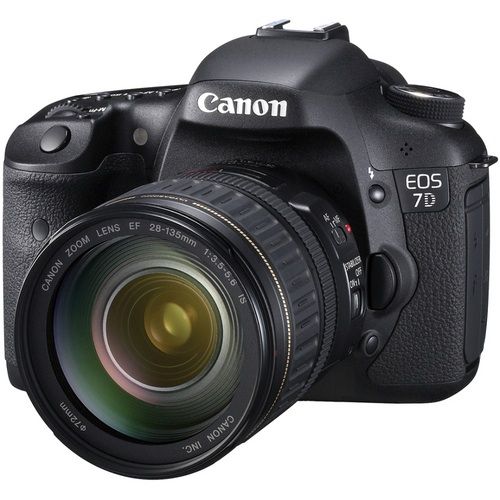
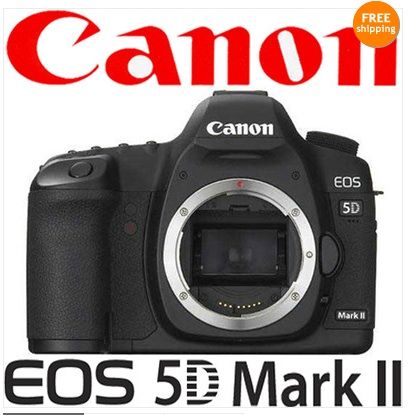
You can get an additional 15% discount for Canon DSLR cameras using the coupon code SLRF15 at the Canon Store. That means an EOS 7 D (click here) will cost $1,155, the EOS 5D Mark II (click here) is $1,495, the EOS 60D with EF-S 18-135mm IS Lens (click here) is $883, and so on and so forth (click here to see all refurbished DSLR cameras).
18.0-megapixel CMOS Sensor and Dual DIGIC 4 Image Processors for high image quality and speed
Body only; lenses sold separately
Advanced HD movie mode with manual exposure control and selectable frame rates
Intelligent Viewfinder with 100 percent field of view; 19-point, all cross-type AF system equipped with dual diagonal cross-type sensors
Capture images to CF Card Type I and II, UDMA-compliant CF cards (not included)
UPDATE: prices are slightly higher now, around $1,324.
These are incredibly cool deals on eBay for the Canon EOS 7D body, and they come with free shipping if you live in the USA. The items are all brand new (not refurbished), boxed ecc, and are below $1,300, that’s around $300 less than normal price. Needless to say that I am only listing top rated, serious sellers. I found three that are really worth a look at. All have approx. 100 items in stock (even if they state “more than 10” – I checked it with the sellers), all are US based. And here are the great EOS 7D deals:
electronicsvalley for $1,293.82 ([shoplink 3842 ebay]click here to check the deal[/shoplink])
800photovideo for $1,293.86 ([shoplink 3843 ebay]click here to check the deal[/shoplink]
bigvalueinc for $1,293.93 ([shoplink 3844 ebay]click here to check the deal[/shoplink]
For sample pics, technical specifications and product description click here.
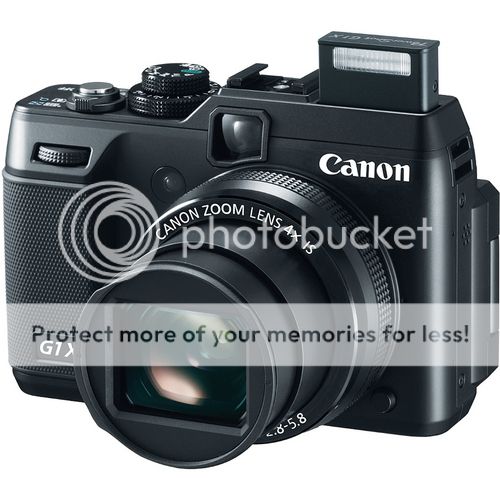
I found an interesting post on dpinterface with an in-depth image comparison between [shoplink 1785]Canon’s G1 X[/shoplink] and [shoplink 337]EOS 7D[/shoplink] – two players in different leagues. Lets first see the basic tech specs for both cams:
[shoplink 337]EOS 7D[/shoplink]
18.0 Megapixels
3.0″ LCD
HD Video Recording
Selectable Video Exposure + Frame Rates
Dust & Weather Resistant
100% Viewfinder
Self Cleaning Sensor
High Sensitivity (ISO 12800)
8fps Burst Mode
[shoplink 1785]Powershot G1 X[/shoplink]
14.3Mp 1.5″ CMOS Sensor
3.0″ Vari-Angle LCD Screen
28mm Wide Lens with 4x Optical Zoom
DIGIC 5 Image Processor
Hybrid Image Stabilizer
Optical Viewfinder
12,800 ISO
1080p Full HD Video
High Dynamic Range Scene Mode
Manual & Numerous Other Shooting Modes
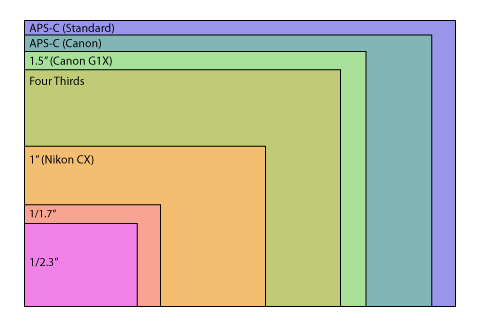
The next chart illustrates the respective sensor sizes:
Credits: DPreview
Definitely gear aimed at different using-scenarios. Another thing to keep in mind is the difference in aspect ratio of the sensors (G1X 4:3, 7D 3:2). The lens used on the [shoplink 337]EOS 7D[/shoplink] was the Canon EF 24-70 mm f2.8L USM. So we have a 14MP sensor against a 18MP one, which is also 27% larger than the one mounted on the [shoplink 1785]Powershot G1 X[/shoplink]. The comparison in summa:
Dynamic range: very close
Detail level: 7D clear winner (no wonder: bigger sensor, higher resolution, and – to some matter – an L lens)
High ISO noise: not really comparable since on the 7D noise reduction was disabled, which is not possible on the G1 X (NR set to standard). However, high ISO noise is very good on the G1 X. Would have been better to do this comparison using RAW files.
The conclusion:
The Canon PowerShot G1X actually produces image quality that is very close to that of the Canon EOS 7D; not identical but very similar. The Canon G1X produces photos with, overall, better out-of-the-camera sharpness but less color saturation and slightly less detail, though the difference isn’t really obvious unless you inspect really fine detail as shown in the examples above. Even that can be overcome by shooting in RAW or tweaking the camera’s settings to increase saturation and sharpness.
The PowerShot G1X definitely outperforms other prosumer models and compact cameras of its class thanks to its premium larger-than-average image sensor. If you want a relatively compact (though the camera will not fit in your pants pocket at all!) camera that delivers digital SLR or ILC level image quality without the hassle of something the size of an actual SLR, consider taking a look at the Canon PowerShot G1X.
Hold one, there is more. The same guys did also a comparison between the video modes of the [shoplink 1785]Powershot G1 X[/shoplink] and the [shoplink 337]EOS 7D[/shoplink]. The Powershot G1 X comes with 1080 full HD, stereo recording, 24 fps (720p standard HD and VGA give you 30 fps). The EOS 7D comes with 1080 full HD, mono recording, 24 or 30 fps at 1080p. Ok, let’s go with the videos, first the one shot with the Powershot G1X.
Next, the video made with the EOS 7D (1080p at 30fps).
All in all, the Powershot G1 X doesn’t stay that much behind the EOS 7D. Read the post here.
Finally, we have the usual services for you.
If you want to see some Powershot G1 X samples click here, for EOS 7D samples click here. This is an automatic service retrieving the latest pics uploaded to Flickr.
EOS 7D price check (click on the shop name): [shopcountry 337]
Powershot G1 X price check (click on the shop name): [shopcountry 1785]
The next two boxes are based on our eBay live-ticker with selected deals. Check them to see if you find what you are looking for.
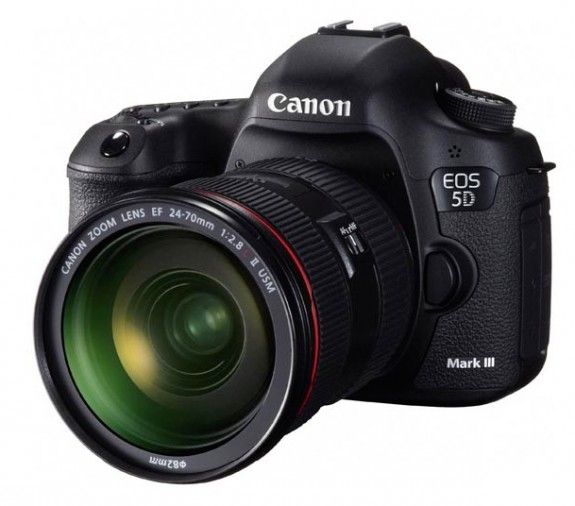
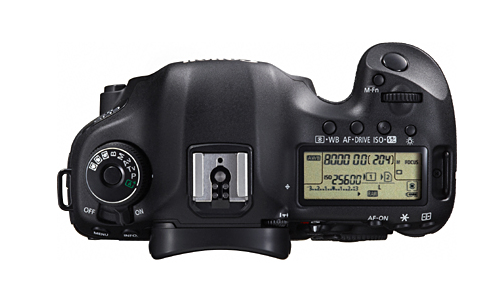
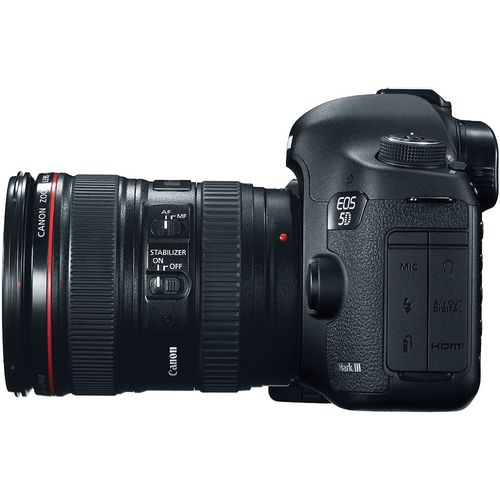
Let’s start with a problem some users have with Canon’s DPP software. People reports that DPP is generating extremely soft jpgs from the [shoplink 2431]5d Mark III[/shoplink] RAW files. Two possible solution for the problem:
go to DPP’s “preferences”, then “general setting” tab, and the change “viewing and saving RAW images” to “high speed” (default is “high quality”). When using “high speed” the noise reduction palette is not used no moiré correction is applied.
use a third party RAW converter, namely: Adobe Camera Raw 6.7rc. Using ACR you first generate DNGs and the can use this DNG wherever you want (remember that LightRoom 4 does not natively support the 5D Mark III)
Ok, that should help to see all the super sharpness of the [shoplink 2431]5d Mark III[/shoplink] images.
Next, let us talk about reviews. There is a bunch out there that are helpful and worth to be read if you want to learn more about the [shoplink 2431]5d Mark III[/shoplink], or need to take a decision if to buy it or not.
Le me start with a detailed hands-on review by lightingmods. Read part 1 and don’t miss part 2 of this review. The latter comes with useful samples, and other informations you may be interested in.
Engadget has a pre-production 5D3 for two weeks (those lucky guys…) and made a serious field test with the cam.
They start the review:
Shoot in the dark. That’s essentially what you can do with the Canon 5D Mark III — with a top sensitivity of ISO 102,400, what was once unfathomable could soon become an acceptable standard. While point-and-shoot manufacturers are adding WiFi and GPS, and tweaking algorithms in an effort to boost sensitivity beyond the 6400 mark, Canon and Nikon are making clear cases for a DSLR upgrade, by drastically improving image quality. The 5D Mark II had an excellent three-year run, but with its 22.3-megapixel sensor, 1.04M-dot 3.2-inch LCD, improved autofocus and high-performance video capabilities, Canon’s latest full-frame DSLR is an entirely different beast, and a very compelling successor.
Sounds good to me. But let us see the single points they are discussing:
Silent shooting – You made it past the break! As a gesture of our appreciation, we’re going to let you in on a little Mark III secret — in fact, if that high-ISO shooting wasn’t in the picture, this could very well have been our favorite new feature.
ISO 25,600 and beyond – Yes, you know the Mark III can capture usable images at ISO 25,600 — the top sensitivity available on the 5D Mark II — but there’s a noticeable improvement with this year’s model, even with our pre-production sample
Image quality – As you’ve probably already gathered, we’re very impressed with the Mark III’s performance, both while capturing images and when it came time to review them after a shoot. So much so, that we wouldn’t hesitate to declare that image quality is absolutely spectacular.
Focusing – You can’t really prioritize features when it comes to a professional camera — everything needs to work, very well, and focusing performance is right up there with image quality in our book. When every shot counts, having a flawless focusing system is key, and thanks to the 61-point High Density Reticular Autofocus on board (the same system you’ll find on the 1D X), we felt quite fulfilled in this department as well.
Video – Like its predecessor, the 5D Mark III is an incredibly capable video shooter
Battery life – Battery life shouldn’t be an issue on any recent DSLR. Period. This is also the case with the 5D Mark III — you’re likely to fill your memory card long before you exhaust the battery
And finally they conclude:
We honestly haven’t been this in love with a camera since we reviewed the Sony NEX-7. And while there’s little to compare from a price and design perspective, we’re seriously questioning that affair, and completely ready to sacrifice the compact design in favor of this incredibly capable do-everything shooter. At $3,499 for the body only, Canon priced this latest 5D higher than its predecessor, which rang in at $2,699 at launch. Still, if you’ve been considering a [shoplink 2431]5d Mark III[/shoplink] purchase, don’t hesitate — it’s worth the investment, we promise. And if you’ve already placed your order or have one in the mail, get ready to have your world turned upside-down — this thing is simply amazing, in every way.
The review (click here) is filled with sample pics (lots shot in low light) that can also be downloaded (original files). Two videos are provided. The first one a sample video shot with the [shoplink 2431]5d Mark III[/shoplink].
The other one compares the design of the [shoplink 2431]5d Mark III[/shoplink] and 5D Mark II
The photographyblog has a LOT of sample images to show, also samples that cover the whole ISO range. They also provided a sample video shot at the highest quality setting of 1920×1080 and at 25 frames per second. You can see the movie clicking here.
Samples, samples, samples, who doesn’t want to see as much of possible of them? :-) We do. DPreview gives us the gift of a selection of real world samples images. They also updated the 5D Mark III preview page with new information about the cam. More samples taken with a final production Canon EOS 5D Mark III using a selection of lenses can be seen at cameralabs. The whole set (original size!) can be seen and downloaded from their Flickr page. More pixel-peeping exercises can be performed using the samples at dsrl4real. Or, for the lazy ones among us, by watching the following video:
If you are still stuck in comparison chaos then the following links should be useful for you:
Nikon D800 vs [shoplink 2431]5d Mark III[/shoplink] vs 5D Mark II vs Nikon D700 at lensrentals (what a battle! :-)). It’s mainly on resolution issues and gets somewhat technical yet being understandable also for non-engineers (click here to read)
[shoplink 2431]5d Mark III[/shoplink] vs 5D Mark II vs Nikon D700 ISO comparisons at dcfever(Google translated). This is a true pixel-peeping thing and wont disappoint those who want to get all the subtile differences among these cameras.
More about the [shoplink 2431]5d Mark III[/shoplink] vs Nikon D800 issue can be read at nofilmschool.
National Geographic Photographer Ira Block got a [shoplink 2431]5d Mark III[/shoplink] and shares his thoughts about Canon’s new FF cam (samples included). Next, it’s photographer Philip Bloom who shares thoughts and pictures of his first 48 hours with a [shoplink 2431]5d Mark III[/shoplink] with us. This are pics shot by a professional photographer, some are simply beautiful.
Ok, that’s all for today. Hope it makes a pleasant sunday reading for all of you. To see the latest [shoplink 2431]5d Mark III[/shoplink] pictures uploaded to Flickr click here. For more information, including order and pre-order options click here. EOS 5D Mark III price check: [shopcountry 2431]
And since we are all eager to find good deals, have a look at our eBay live-ticker for possible 5D Mark II deals:
World-wide EOS 5D Mark III price check:[shoplist 2431]
[via DP, engadget, NC]
[shariff]
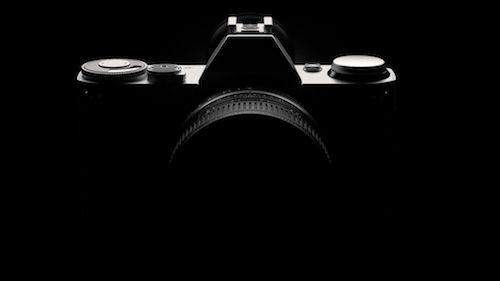
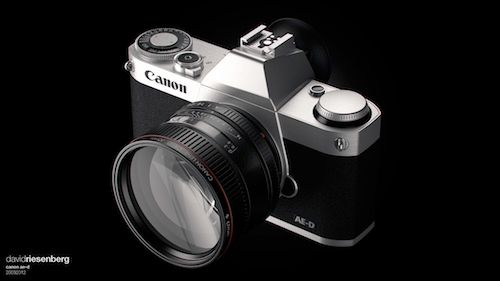
For the time being Canon is the only major brand that still did not jump on the mirrorless bandwagon (at least not for a ILC – Interchangeable Lens Camera). The closest thing to a mirrorless camera that Canon made is the [shoplink 1785]G1 X[/shoplink]. Even Nikon did its thing with the Nikon V1. While we are all eagerly waiting for Canon to announce a true mirrorless system camera (and I am almost sure we will see something in September at Photokina 2012), David Riesenberg, a designer, has come up with an interesting mock-up made using CAD-software. D. Riesenberg called its concept AE-D, clearly having in mind Canon’s AE cams of the seventies. In his own words:
Like many others, I too have been waiting for quite a while for Canon to release its mirrorless system. There are speculations and indications that they may very well do so this year, but I personally grew a bit restless. Because of this, I decided to put to paper, or rather to CAD and rendering software, my vision of such camera. After about a month of learning, debating, modeling and rendering, the Canon AE-D came to life.
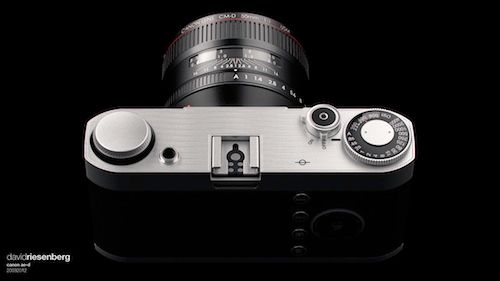
As you can see in the following pictures, the concept has a old-fashioned looking design that is somewhat resembling the Olympus E-M5 (it seems that retro-style aesthetics paired with up to date technology is the big thing for a lot of people).
Credits: David Riesenberg
David Riesenberg’s thoughts on his concept:
The design is inspired by the classic AE and AE-P which are two of my favorite Canon cameras ever. Simple, iconic, timeless. I couldn’t think of a better basis for a modern mirrorless system.
Some of the main features and the reasoning behind them are:
Full Frame – Might as well be the pinnacle of 35mm. Especially if a new lens mount is required. Future proof.
18.1MP sensor from the 1DX – This camera will not rob sales from the 1DX on form factor alone so it makes sense to use an existing sensor instead of a new one. Plus, it will make an excellent pair to someone with an 1DX.
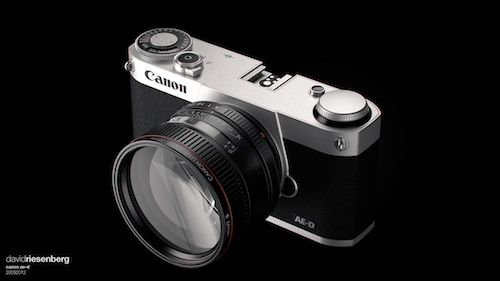
The next picture shows the same concept without the viewfinder.
Credits: David Riesenberg
D. Riesenberg about the EVF:
Viewfinder – Design wise, I knew from the start that I wanted to incorporate the prism hump of the AE cameras. It is a prominent feature that without it, the context of the design gets somewhat lost. At the same time, it is obviously not a technical requirement in mirrorless cameras so making it detachable while housing the EVF felt like the the optimal combination of form and function. After all, if this is a camera for photographers, a viewfinder, even if electronic, is a must.
There are some considerations to make. Besides competing with the Nikon V1, a Canon mirrorless camera sporting a full-frame sensor would compete with the Leica M9 (which, besides being a $7000 toy, for the time being is the smallest mirrorless full-frame system camera you can get). The other big competitor would be the Fujifilm X Pro1, especially because the interesting price tag and its well known IQ (using an APS-C sensor).
We can only hope that Canon got the message :-). In the meantime you can have a look at the [shoplink 1785]G1 X[/shoplink], the closest thing resembling a ILC (Interchangeable Lens Camera) Canon has made so far. Or you can have a look to the latest images shot with a [shoplink 1785]G1 X[/shoplink] that have been uploaded to Flickr (click here). Canon G1 X price check [shopcountry 1785].
Check the following boxes (our eBay live-ticker) for possible deals regarding the cameras mentioned in this post.
This website or its third-party tools use cookies, which are necessary to its functioning and required to achieve the purposes illustrated in the cookie policy. If you want to know more or withdraw your consent to all or some of the cookies, please refer to the cookie policy. By closing this banner you agree to the use of cookies.