

DxO Nik Collection 8 Released, New Powerful Features And Better Integration
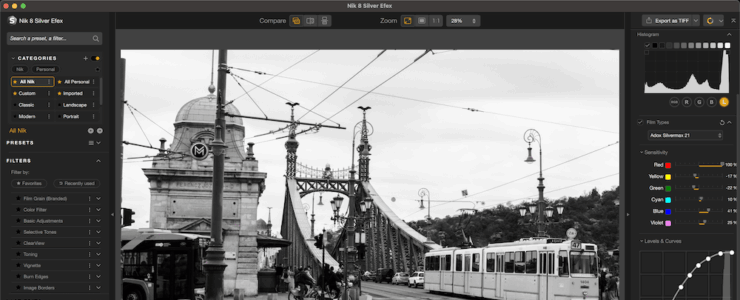
A new version of Nik Collection has been released. A 30‑day trial is available.
Nik Collection 8 expands Photoshop’s photo‑editing potential across all seven plugins thanks to new integration and powerful features
Version 8 unlocks the full power of Photoshop masks, and upgrades make Nik Color Efex better than ever. Plus, Nik Silver Efex has been rethought to ensure effortless black‑and‑white images.
Paris (France): DxO today unveils Nik Collection 8, the latest version of its celebrated creative plugin suite for photographers. This new release brings a completely redesigned Photoshop panel, powerful new masking functionality, and significant improvements to Silver Efex and Color Efex, delivering a more dynamic editing experience.
“With Nik Collection 8, we wanted to enhance both creativity and efficiency,” said Boris Oliviero, Product Director. “We’ve re‑imagined the Photoshop workflow, making it easier than ever to apply powerful effects, refine local adjustments, and move seamlessly between plugins.”
POWERFUL NEW MASK OPTIONS
Photographers can now import masks directly from Photoshop into any Nik Collection plugin, making full use of Photoshop’s powerful selection tools. A new feature in the Local Adjustments panel also lets users transfer masks effortlessly between plugins. And when ready, photographers can send masks created in Nik Collection straight back to Photoshop for further refinement.
With Nik Collection 8, your masks remain accessible at every step of the workflow, whether they originate from Photoshop or a Nik Collection plugin.
A SMARTER, MORE FLEXIBLE RETURN TO PHOTOSHOP
Bringing edits back into Photoshop is now more intuitive. Users can choose to:
- convert edits into a Smart Object for non‑destructive editing;
- apply changes to the current layer or create a new one;
- generate a new layer with a mask, providing additional flexibility.
SEND EDITS AS LAYERS TO PHOTOSHOP
Photographers can now send their Nik Collection edits directly to Photoshop as a new Photoshop layer while continuing to work inside Nik Collection. This allows users to test multiple ideas for an image without breaking their creative flow, and have all of their edits immediately at hand once back inside Photoshop.
BRAND‑NEW PHOTOSHOP PANEL FOR MAXIMUM EFFICIENCY
Nik Collection 8 introduces a fully customizable and dockable Photoshop panel, replacing the traditional Nik Palette. This new design allows photographers to save screen space by choosing which plugins to display, and launch any plugin with a single click for a more fluid workflow. Plus, all of the essential controls for managing layers and masks are immediately accessible.
MAJOR UPGRADES TO NIK SILVER EFEX
Nik Silver Efex, the industry’s leading black‑and‑white editing tool, gets significant usability and feature boosts:
- Color Reference Image: view the original color image while working in black and white.
- Streamlined interface: matches Nik Color Efex and Nik Analog Efex, keeping filters on the left until used.
- Better logic when applying presets: only relevant filters appear on the right when a preset is selected.
- New Local Adjustments: ClearView and Selective Tones can now be applied locally.
- New Filter Looks: every filter now includes pre‑defined options for quick application.
NEW COLOR MASKS BRING PRECISION EDITS TO NIK COLOR EFEX
Targeting local adjustments just became more powerful as the suite now lets photographers select a range of colors for changes. Click on the desired color, tweak the handles as required, and start making adjustments.
QUICK EXPORT UPGRADED FOR A FASTER WORKFLOW
It’s now quicker to switch to TIFF format when using the Quick Export button, and export options are instantly accessible so users can tweak the configuration directly without navigating a menu.
PRICE AND AVAILABILITY
Nik Collection 8 is available today from the DxO website (shop.dxo.com) for macOS and Windows:
- New license: 159,99 $/€ – 145,99 £
- Upgrade from Nik Collection 6 or 7: 89,99 $/€ – 79,99 £
Canon Patent Reveals Compact Wide-Angle Prime Lens Designs with Built-In ND Filter and Shutter
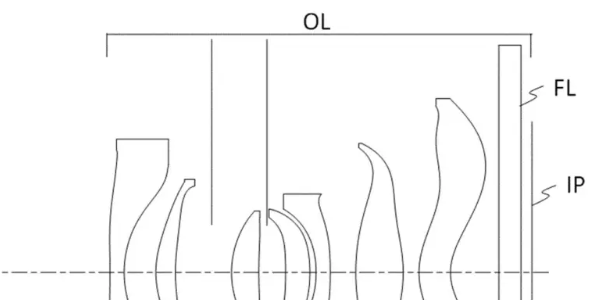
On May 2, 2025, Canon published a new patent application that outlines multiple wide-angle prime lens designs, seemingly developed for sensors around 1.4 inches in size. The application suggests a focus on compactness, with provisions for integrating an ND filter, iris diaphragm, and shutter – a configuration particularly suitable for video-oriented imaging devices.
Patent Overview
- Publication Number: P2025070387
- Publication Date: May 2, 2025
- Title: Optical System and Imaging Device
- Application Date: October 20, 2023
- Applicant: Canon Inc.
- Applicant ID: 000001007
The patent describes a small, lightweight wide-angle optical system that arranges key optical elements – such as the iris diaphragm, neutral density (ND) filter, and shutter – in optimal internal positions.
Background
Modern imaging devices, including digital cameras, smartphones, vehicle cameras, and security systems, require compact lenses that maintain high image quality across wide angles of view. Smartphone cameras, in particular, rely heavily on fixed-aperture prime lenses made with plastic-molded aspherical elements. These lenses are also expected to house an ND filter, iris, and shutter, all while maintaining a short overall length, especially important for video applications.
Previous designs (e.g., Patent Document 1) struggled to accommodate these components without increasing the lens diameter. Positioning the ND filter and shutter too close to the aperture limited internal space, while placing them farther away resulted in a bulkier external design.
Canon’s latest approach attempts to solve this by efficiently integrating all components in a compact form factor.
Design Notes
The optical systems described here appear to support an ultra-wide angle of view, roughly equivalent to 20–24mm in full-frame terms. While the image height seems modest for a 1.4-inch sensor like that used in the PowerShot V1, this is likely intentional – reserving part of the sensor area for electronic image stabilization.
Interestingly, only Example 3 assumes a different sensor size.
The PowerShot V1, for context, features an 8.2–25.6mm f/2.8–4.5 zoom lens, which encompasses the optical system type discussed in this patent – though it’s physically much larger. If Canon applies this new design to the V series, we might not see a huge leap in performance. Still, there’s hope for a truly compact model with a non-protruding lens, which would be a welcome development for vloggers and mobile content creators.
Example 1
- Focal length: 9.47
- F-number: 2.88
- Half angle of view: 47.57
- Image height: 10.36
- Overall length: 27.22
- Back focal length: 7.41
Example 2
- Focal length: 11.68
- F-number: 2.88
- Half angle of view: 41.11
- Image height: 10.19
- Overall length: 27.14
- Back focal length: 7.56
Example 3
- Focal length: 6.75
- F-number: 1.85
- Half angle of view: 46.56
- Image height: 7.13
- Overall length: 18.77
- Back focal length: 3.35
Example 4
- Focal length: 8.41
- F-number: 2.88
- Half angle of view: 50.47
- Image height: 10.19
- Overall length: 29.95
- Back Focus: 7.16
[via asobinet]
Canon Patent Application Highlights New Compact Zoom Lens Designs
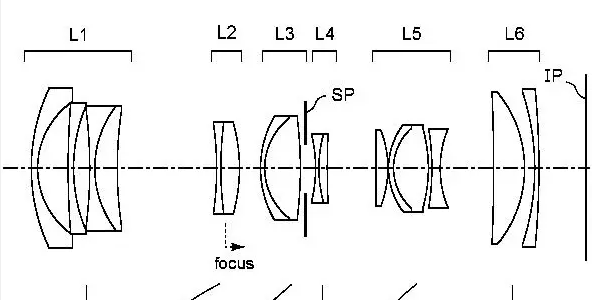
A new Canon patent application, published on April 28, 2025, outlines several interesting optical system designs. Among them are full-frame-compatible zoom lenses believed to target configurations like a 20–40mm f/2.8 and 20–50mm f/4, as well as an APS-C format lens such as a 12–35mm f/2.5–3.5.
Although it’s uncertain whether these specific designs will reach commercial production, Canon’s track record suggests it’s a real possibility. These lenses might be part of a broader initiative to develop zoom lenses optimized for video applications.
Patent Overview
- Publication Number: JP2025-68535 (P2025-68535A)
- Publication Date: April 28, 2025
- Title: Zoom Lens and Imaging Device Having the Same
- Filing Date: October 16, 2023
- Applicant: Canon Inc.
- Applicant ID: 000001007
The patent describes a compact zoom lens that offers high optical performance.
Background
Zoom lenses used in image capture devices often become bulky when the mass, number, or movement range of lens groups increases during zooming. Previous designs, such as the one cited in Patent Document 1, fall short in correcting optical aberrations effectively throughout the zoom range. This has created a demand for compact, high-performance zoom lenses.
Summary of the Invention
The aim of this invention is to provide a small-form-factor zoom lens with excellent optical quality.
Several of the optical systems in this application suggest designs intended for inner zoom-type lenses, including both full-frame and APS-C models. Some may be considering a powered zoom mechanism with an integrated motor drive, similar to Canon’s RF-S 14–30mm f/4–6.3 IS STM PZ, which appears in related patent filings that assume the use of electric zoom functionality.
The examples include lenses with constant apertures of f/2.8 and f/4, offering user-friendly optics. The focal lengths lean toward the wide-angle end, aligning with the growing demand for video-capable lenses. While the aperture varies only in the APS-C design – reaching a bright f/2.35 on the wide end – all examples are noted for their relatively long lengths. However, their inner zoom construction ensures the center of gravity remains stable during use, which is especially beneficial for video work.
Example 1
- Focal length: 20.61-38.72
- F-number: 2.90
- Half angle of view: 43.64-29.19
- Image height: 19.65-21.64
- Total length: 130.70
- Back focus: 31.45-40.28
Example 2
- Focal length: 20.61-48.39
- F-number: 4.10
- Half angle of view: 43.69-24.09
- Image height: 19.69-21.64
- Overall length: 133.51
- Back Focus: 12.18
Example 3
- Focal length: 15.47-28.82
- F-number: 4.10
- Half angle of view: 52.36-36.90
- Image height: 20.06-21.64
- Overall length: 97.47
- Back Focus: 11.75
Example 4
- Focal length: 12.37-33.97
- F-number: 2.35-3.60
- Half angle of view: 44.47-21.96
- Image height: 12.14-13.70
- Overall length: 113.77
- Back Focus: 11.50
[via asobinet]
Latest Canon Rumors Roundup (R6 III, R7 II, R10 II, lenses)

Below is a roundup of the most credible Canon rumors that surfaced in the last two weeks. I’ve grouped the rumors by product family so you can see how they fit together and – just as important – where the rumors are still murky.
1. Full-frame bodies: a “moving target” launch calendar
EOS R6 Mark III
The most-quoted leak is that Canon quietly pushed a May product event to “later in the year”, stalling the long-anticipated R6 III as well as several lenses. Behind the scenes, sources cite two factors: a 7-8 % price hike for North-America, and fears that new U.S. tariffs could whipsaw production costs. Specification whispers haven’t changed – 24-30 MP new-gen sensor, 6 K (possibly 8 K) capture, better thermal management, and an EVF upgrade – but commentators now peg the body for late Q4 2025 or even early 2026.
2. APS-C bodies: “Baby R5” hype and cascading delays
EOS R7 Mark II
It might come with a stacked 40 MP APS-C sensor, 8 K/60p video, and be the first Canon mirrorless body that might ditch the mechanical shutter entirely. The new chassis is said to be physically larger so it can share the R5 II’s cooling grip and larger battery. If those specs stick, the R7 II would leapfrog Fujifilm’s X-T5 on resolution while matching its 8 K headline. But the same sources warn that the R7 II is tied to the R6 III event window, so the practical ship date could slide in lockstep.
EOS R10 Mark II
Insiders mention the entry-level R10 II as “collateral damage” of Canon’s reshuffled roadmap. Expected upgrades – oversampled 4 K/60 p, livestream-friendly USB, and a flippy screen – are intact, but no firm timing survived the schedule reshuffle.
3. Lens buzz: two threads worth watching
(a) The long super-telephoto zoom
What about a RF 300-600 mm f/5.6 L IS USM as the “new big white zoom”? With a design that would slot between the RF 100-500 mm and the long-rumored but heavier (and pricier) RF 200-500 mm f/4. The leak stressed a constant-aperture 5.6 design to keep weight and cost under control, plus an internal zoom to maintain balance on monopods.
(b) A pair of ultra-fast f/1.2 L primes
It is rumored that two new f/1.2 L primes for stills shooters are “imminent.” No focal lengths were named, but insiders speculate on a revamped RF 50 mm f/1.2 L (lighter, possibly with VCM focusing) plus a long-awaited RF 35 mm f/1.2 L. Conversation on X during the past ten days shows the story still has legs, with commenters noting the absence of patents for an updated RF 85 mm f/1.2, suggesting Canon may refresh the 50 mm first.
4. RF-S glass: small hints, no hard leaks
Forum chatter continues about four unnamed RF-S lenses scheduled for 2025, but no real specs leaked in the last 14 days. The consensus – based on older road-map slides – is two constant-aperture zooms and at least one compact prime, likely timed to ship with the delayed R7 II and R10 II bodies. Until Canon reschedules its APS-C announcements, that thread remains speculation.
5. Market context: why every rumor now carries an asterisk
Canon’s own financial guidance called for a global price adjustment in April, and North-American retailers have already updated price lists. Add the looming U.S./China tariff hikes and component shortages, and it’s easy to see why every body-launch date leaked this month came with a hedged “late 2025 or 2026” qualifier. Analysts also warn that Canon is spacing releases to avoid cannibalizing R5 II and R1 sales in a year when margins are razor thin.
6. What feels firm – and what still feels fuzzy
| Category | Likelihood (next 9 months) | Key unknowns |
|---|---|---|
| R6 Mark III | Medium – delayed but highly developed | Final sensor resolution; CP+ 2026 vs. Q4 2025 launch |
| R7 Mark II | Medium-low – tied to R6 III timeline | Will Canon really go stacked 40 MP APS-C? |
| R10 Mark II | Low – entry bodies slip first | Whether Canon keeps mechanical shutter to cut costs |
| RF 300-600 mm f/5.6 L | Medium – optical patents exist | Internal zoom vs. external zoom; target price |
| New f/1.2 L primes | Medium-high – multiple sources, long overdue | Exact focal lengths; whether VCM focus rings return |
Bottom line
Over the last two weeks Canon rumors have shifted from “what’s next?” to “when is next?”. Hard specs on the R7 II fan the flames of an APS-C renaissance, but tariff jitters and component inflation have turned May’s expected launch cycle into a waiting game. On the lens side, a constant-5.6 mega-zoom and refreshed f/1.2 primes look the most solid, yet even these are hostage to Canon’s revised calendar. If you need new gear for summer 2025, the safest bet is still the already-shipping R5 II or existing RF glass. If you can wait, the next nine months should be telling – just keep in mind that every credible leak now carries an economic caveat as big as the cameras themselves.
[via CR]
Canon Rumor: EOS R7 Mark II, 40MP Sensor, 8K Video, Major Design Tweaks, Late 2025
Here is a new Canon rumor, it’s about the EOS R7 Mark II, and I recommend you take it with a healthy dose of doubt.
The Canon EOS R7 Mark II is rumored to make its debut in the second half of 2025, likely in Q3 or Q4. As with all early leaks, exact release dates are hard to pin down, but it is said that multiple sources suggest the announcement is already in Canon’s pipeline. The upcoming model appears to be a significant step up from the original EOS R7, with rumors pointing to a more premium direction.
According to the mentioned sources, the EOS R7 Mark II will feature a higher-resolution APS-C sensor, reportedly around 40 megapixels, and will offer 8K video recording. That’s a hefty resolution bump and positions the camera to compete directly with Fujifilm’s high-res APS-C models. Despite the larger sensor output, the body is expected to stay lightweight, though slightly bigger in size, with ergonomics more akin to the EOS R5 Mark II. This change would be a welcome improvement for users who found the original R7’s layout less than ideal.
Another notable rumor is the possibility of the camera relying entirely on an electronic shutter, eliminating the mechanical shutter altogether. This could improve durability and reduce manufacturing costs, but it would demand extremely fast sensor readout speeds – something that hasn’t been confirmed. Some speculate this shutterless approach may instead be reserved for a different model, possibly the rumored EOS R7 V.
In terms of compatibility, current accessories designed for the EOS R5 Mark II – such as the cooling grip – are expected to work with the R7 Mark II. The camera will likely include a CFexpress Type B card slot alongside a UHS-II SD slot, consistent with Canon’s recent design choices. Dual CFexpress slots seem unlikely at this tier.
Interestingly, while there have been ongoing rumors about Canon developing a global shutter APS-C body, none of the sources mentioned that feature in connection with the R7 Mark II. It’s possible this technology is being reserved for a future release.
As always, take these leaks with a BIG grain of salt – specs often shift or get misattributed, or are simply wrong or fabricated, especially with multiple similar models in development. Still, if these details hold true, the Canon EOS R7 Mark II could be one of the most exciting APS-C cameras of 2025.
[via CR]