Canon Patent: Three Layer Image Sensor

Canon Patent

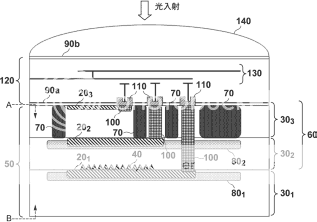
Indefatigable Japanese site Egami (translated) spotted another Canon patent. It concerns a 3-layer image sensor that appears to be particularly sensitive to light. No idea where such a sensor could be employed, maybe in a future generation of high-end cameras?

Patent description (machine translated):

  • Patent Publication No. 2013-93553
    • Publication date 2013.5.16
    • Filing date 2011.10.4
  • Imaging element of three-layer structure
    • Photodiode deep layer (hereinafter, PD) in the charge is diffused into the substrate
    • Thus sensitivity is poor red
  • Canon patent
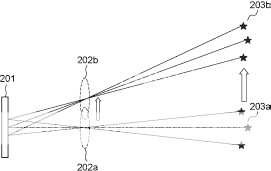
    • I as a photonic crystal of irregular shape, the boundary surface of the PD of red or green,
    • In the periodic structure of uneven spacing, less than twice the 1/4 times or more the wavelength of light, or I shall be two times or less 1/2 times or more
    • Irregular shape has the properties to be spatially-localized or resonant light
      • The incident light is diffracted, it combines with the light of the boundary plane, the resonant
      • Prolonged exists than normal, the light becomes easy to be absorbed by the PD Thus
Canon Patent: 500mm f/4 & f/5.6, 600mm f/4, 800mm f/5.6

Canon Patent

Canon Patent

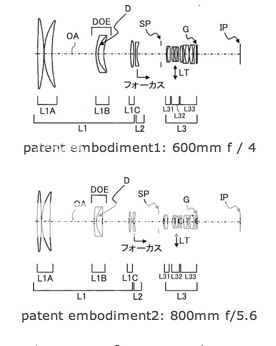
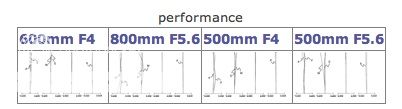
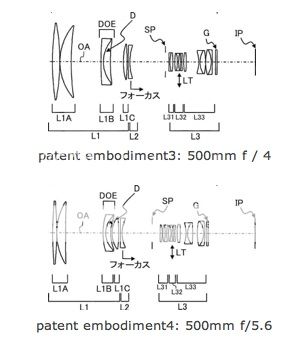
Egami (translated) spotted a patent filed by Canon regarding 500mm f/4, 500mm f/5.6, 600mm  f/4 and 800mm f/5.6 lenses.

Canon Patent

  • Patent Publication No. 2013-92575
    • Publication date 2013.5.16
    • Filing date 2011.10.24
  • Example
    embodiment
    No.
    Focal length [mm]
    Fno.
    Half angle [°]
    Total length [mm]
    BF [mm]
    Front lens diameter [mm]
    One 584.99 4.12 2.12 420.00 89.03 141.99
    Two 779.99 5.80 1.59 460.00 97.84 134.48
    Three 488.99 4.11 2.53 320.00 61.00 119.00
    Four 488.99 5.70 2.53 280.01 65.01 85.79
    Five 584.96 4.12 2.12 420.00 88.88 141.98

    Image height 21.64mm

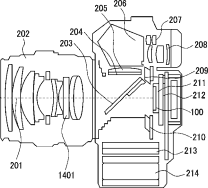
  • How to reduce the size of the large-aperture super telephoto lens
    • Effective diameter of the first group with the largest
    • I reduce the number of the first group
      • It is necessary to reduce aberration by increasing the number
      • Can not reduce the aberration and reduce the number
    • I increase a refractive power of the first group
      • The thickness of the lens increases, the effect of weight reduction is canceled
      • Impact of manufacturing error is large high refractive index
  • Canon patent
    • The aspherical in the first group
    • Performing a variance of sensitivity was composed of opposite sign component of the first group, and also, prevent an increase in thickness
    • DOE is provided to correct chromatic aberration with a small number of lenses
    • Inner focus
    • Anti-shake

Canon Patent: 18-90mm f/3.5-5.6, 18-135mm f/3.5-5.6, 30mm f/2.8 Lenses

Canon Patent
Image courtesy: egami

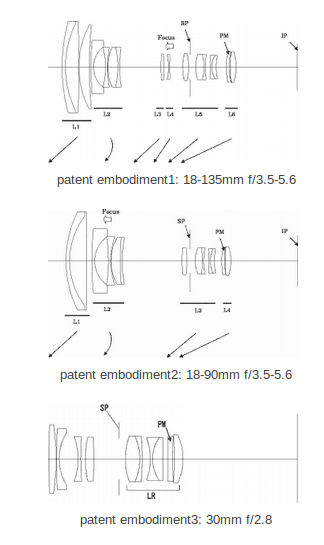
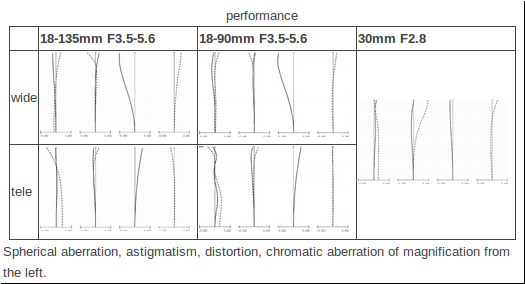
Egami (translated) spotted a new Canon patent. Three lenses are covered by the patent: 18-90mm f/3.5-5.6, 18-135mm f/3.5-5.6, 30mm f/2.8. The patent appears to refer to lenses that are resistant to temperature variation, i.e. that have consistent performance regardless of temperature variations .

Canon Patent
Image courtesy: egami
  • Patent Publication No. 2013-88736
    • Publication date 2013.5.13
    • Filing date 2011.10.21
  • Example 1
    • Zoom ratio 7.02
    • Focal length f = 18.60 – 130.50mm
    • Fno 3.59 -. 5.88
    • Half angle ω = 36.29 – 5.98 °
    • Image height 13.66mm
    • 187.48mm – 138.01 overall length of the lens
    • BF 35.60 – 70.79mm
    • Effective diameter of 58.92mm front lens
    • 16 pieces of 12-group lens configuration
    • One piece of one aspherical surface
    • One UD glass
    • 6-group zoom positive and negative negative positive positive
    • Inner Focus (Group 4)
  • Example 2
    • Zoom ratio 4.73
    • Focal length f = 18.60 – 87.97mm
    • Fno 3.59 -. 5.88
    • Half angle ω = 36.29 – 8.83 °
    • Image height 13.66mm
    • 164.98mm – 125.04 overall length of the lens
    • BF 35.60 – 69.29mm
    • Effective diameter of 61.54mm front lens
    • 13 pieces of 9 lens configuration
    • One piece of one aspherical surface
    • 4-group zoom positive and negative positive positive
    • Inner Focus (the second group)
  • Example 3
    • Focal length f = 29.48mm
    • Fno. 2.92
    • Half angle ω = 24.86 °
    • Image height 13.66mm
    • The overall length of the lens 78.43mm
    • BF 35.40mm
    • Effective diameter of 22.43mm front lens
    • 10 pieces of 8 lens configuration
    • One piece of one aspherical surface
  • Resin lens
    • Vulnerable to temperature change
    • There are restrictions on the type of coating, ghost and flare cause of
  • Canon patent
    • The final lens group is arranged a resin lens having a concave surface facing the image side, and place the glass lens on the image side
    • Weaken the power of the resin lens, I reduce the performance variation due to temperature change
    • Incident light axial rays is arranged in a low position of the resin lens, to suppress the influence of the birefringence variation of the resin lens
    • Likely to occur in the concave surface of the resin lens ghost is avoided by optimization of the power of the air lens in the shape of the glass lens and resin lens, in the meantime

Canon Patent: Image Stabilized Lens For Astro-Photography

Canon Patent

Egami (translated) spotted a Canon patent concerning an image stabilized lens for astro-photography. The lens is able to automatically track objects (stars etc). Canon has a DSLR suited for astro-photography, the EOS 60Da [shoplink 4110](price & specs)[/shoplink]. Such a lens obviously needs a camera that supports it. That means GPS, levelling, and a powerful CPU.

  • Patent Publication No. 2013-77910
    • Publication date 2013.4.25
    • Filing date 2011.9.29
  • Canon patent
    • In the lens anti-vibration mechanism from etc., let me change the direction of the optical axis
    • From the GPS, etc., I ask the coordinates and altitude
    • Detects the inclination of the posture from the electronic level, etc., to determine the direction of the optical axis
    • Calculate the speed and direction of movement of celestial angle of view, and controls the lens according to the calculation result

Canon Files Patent For High-Res Images Obtained By Pixel Shift

2013_74337_fig02

Image courtesy: Egami

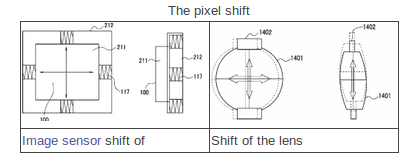
Egami (translated) spotted a patent filed by Canon that appears to be for high resolution pictures that are obtained by combining different shots. Basically a continuous shooting situation where you build a final image based on the images that have been shot. Motion could obviously be a big problem.

  • Patent Publication No. 2013-74337
    • Publication date 2013.4.22
    • Filing date 2011.9.26
  • If there is misalignment of the sub-pixels, it can obtain a high resolution image from a low resolution image
  • Canon patent
    • By continuous shooting and combining pixel shift, I get a high-resolution image
    • Method of pixel shift, lens and image sensor shift of
    • By setting appropriately the displacement amount corresponding to the super-resolution magnification optimization


Canon Patent For New Mount Type (non rotating elements when lens is not mounted)

Canon Patent For New Mount Type
Courtesy: Egami

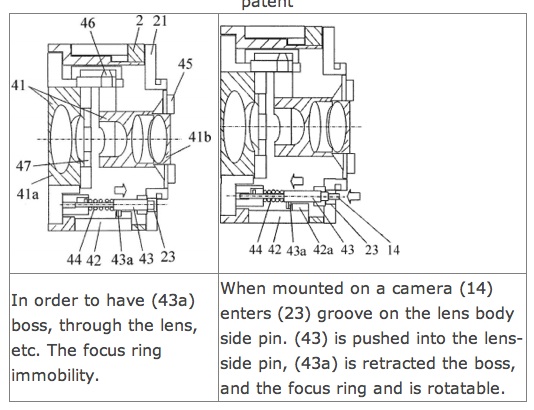
Egami (translated) spotted an interesting patent filed by Canon. When mounting a lens on a camera body, and holding the lens, the rotating focus or zoom ring can make the operation more difficult. Imagine you have to switch lenses fast, the rotating elements of the lens can slow down the mounting of the lens. The Canon patent is for a new lens mount type that blocks all rotating elements of a lens when the lens is not mounted on a body, hence making mounting the lens easier (and faster). This is achieved by pins on the lens mount that block the rotating members inside the lens barrel. The new mount type is compatible with existing EOS mounts. That means lenses that will feature this new kind of mount can be used with existing EOS bodies.

Patent description (machine translated)

  • Patent Publication No. 2013-37090
    • 2013.2.21 Release Date
    • 2011.8.5 filing date
  • Rotatable operation unit: a rotating member
    • Ring, other zoom ring, focus ring, aperture
  • Canon patent
    • If you remove the lens from the camera, the rotation is restricted
      • Pins are provided on the surface of the lens mount
      • The boss is attached to (inside the lens barrel) end of the pin
      • Inside the lens barrel, the boss is brought into contact with the rotating member
      • Because of the boss, the rotating member is rotated never
    • When mounted on the camera lens, rotatable
      • Pin is provided on the mounting side of the body
        • Etc. F or mount EOS mount, mount a lot of this method
      • Body side pin, and push the pin on the lens, the position of boss will move
      • To the rotating member does not contact the boss, can be rotated