Canon Develops World’s First 1 Megapixel SPAD Image Sensor
SPAD Image Sensor

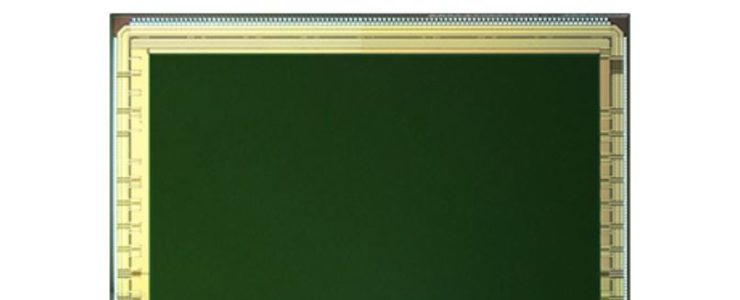
Canon’s research labs are developing the world’s first 1 megapixel SPAD image sensor, another highly specialized sensor for scientific applications.

The camera utilizing the sensor described in the press release below were jointly developed with scientists at the Swiss Federal Institute of Technology in Lausanne. A scientific article was also published: Megapixel time-gated SPAD image sensor for 2D and 3D imaging applications

Canon press release:

TOKYO, June 24, 2020—Canon Inc. announced today that the company has developed the world’s first1 single photon avalanche diode (SPAD) image sensor with signal-amplifying pixels capable of capturing 1-megapixel images. SPAD image sensors are ideal for such applications as 2-dimensional cameras, which capture and develop still image and video in an extremely short span of time. These sensors also hold potential for use in 3-dimensional cameras due to their ability to obtain information about the distance between them and a subject as image data.

A SPAD sensor is a uniquely designed image sensor in which each pixel possesses an electronic element. When a single light particle, called a photon, reaches a pixel it is multiplied—as if creating an “avalanche”—that results in a single large electrical pulse. The ability to generate multiple electrons from a single photon provides such advantages as greater sensitivity during image capture and high precision distance measurement.

The SPAD image sensor developed by Canon overcomes the longstanding difficulties of achieving this effect with high pixel counts. By adopting new circuit technology, Canon’s sensor uses a method known as photon counting to realize a digital image resolution of 1 megapixel. What’s more, the sensor employs a global shutter that allows simultaneous control of exposure for every pixel. Exposure time can be shortened to as little as 3.8 nanoseconds2, making possible clear and distortion-free image capture. In addition, the sensor is capable of up to 24,000 frames per second (FPS) with 1 bit output, thus enabling slow-motion capture of fast movement within an extremely short time frame.

SPAD Image Sensor

Thanks to its ability to capture fine details for the entirety of events and phenomena, this technology holds the potential for use in a wide variety of fields and applications including clear, safe and durable analysis of chemical reactions, natural phenomena including lightning strikes, falling objects, damage upon impact and other events that can’t be observed with precision by the naked eye.

The sensor also features a high time resolution as precise as 100 picoseconds2, enabling it to determine the exact timing at which a photon reaches a pixel with ultra-high accuracy. Leveraging this functionality, the sensor is capable of Time of Flight distance measurement. What’s more, with a high resolution of 1 megapixel and high-speed image capture, it is also able to accurately perform 3D distance measurements in situations where multiple subjects overlap—useful in such scenarios as a vehicle distance measurement for self-driving automobiles and grasping 3D spatial information for xR3 and similar devices.

Canon’s development of a SPAD image sensor enables 3D cameras capable of recognizing depth information to achieve a resolution of 1 megapixel is expected to rapidly expand the use of such cameras as the “eyes” of high-performance robotic devices. Going forward, Canon will strive to anticipate the needs of industry by continuing to advance its innovative image sensor technology, further expand the possibilities of what is visible, spur evolution in science and industry through high-precision detection of information and contribute to the development of fields yet to be discovered.

[more about SPAD sensors after the break]
Click here to open the rest of the article

Rokinon 14mm f/2.8 Deal – $249(reg. $329, limited time)

Rokinon 14mm f/2.8 deal

B&H Photo has a very good Rokinon 14mm f/2.8 deal, for limited time only and part of their Mega DealZone. Rokinon lenses are also branded Samyang.

Get the Rokinon 14mm f/2.8 IF ED UMC lens for Canon EF mount on sale at $249. Compare at $329. Free shipping.

There is more discounted gear and accessories (memory cards, cleaning kit, tripods, etc) on offer in B&H Photo Mega DealZone, definetly worth a look.

Rokinon 14mm f/2.8 deal key features:

  • Ultra Wide-Angle 14mm Lens
  • Compatible w/ Full Frame & APS-C Cameras
  • Hybrid Aspherical Lenses — Sharp Images
  • Multi-Layer Coating to Reduce Flare

More hand-picked deals are listed here.

Nik Collection 3 has just been released and is on sale with a 30% discount.

Today’s Gold Box and one day only deals at Amazon US, Amazon DE, Amazon UK, B&H Photo, eBay, Adorama.

Refurbished lenses and DSLRs at Canon Store (best deals might be found here)

Save $10 on Luminar 4 and/or Aurora HDR 2019 using our code “WATCH” at checkout.

Click here to open the rest of the article

Canon Sends Another Satellite Into Space, With High Res Cameras On Board

satellite

Canon is actively involved in the commercial conquer of space with their own satellite program.

Canon will send a second satellite equipped with an array of EOS 5D Mark III cameras into space, the Canon CE-SAT-IB. The CE-SAT-IB is Canon’s commercial version of the CE-SAT-I, an experimental earth observing microsatellite developed and built by Canon Electronics. The system provides an 1 m ground resolution from a 600 km orbit with a 6 km × 4 km frame size.

The launch will take place in New Zealand on July 4, and is coordinated by by Spaceflight Inc. Spaceflight Inc’s press release:

Canon Electronics Inc. kicks off constellation with first mass production remote sensing microsatellite, CE-SAT-IB, aboard Rocket Lab Electron, with another slated to launch in coming months

SEATTLE – June 16, 2020 — Spaceflight Inc., the leading satellite rideshare and mission management provider, today announced it is managing the launch of Canon Electronics’ CE-SAT-IB imaging satellite on Rocket Lab’s Electron. The mission will lift off from Rocket Lab’s Launch Complex 1 at the southern tip of Mahia Peninsula, on the east coast of New Zealand’s North Island. The launch window opens on July 4 NZT / July 3 UTC.

CE-SAT-IB is a 67 kilogram microsatellite which can resolve 90 centimeter objects on the ground from space. Additionally, Spaceflight is coordinating the launch of another Canon satellite, CE-SAT-IIB, which is slated to lift off after the CE-SAT-IB mission later in 2020, also aboard an Electron. It will carry three cameras with different resolutions and sensitivities.

“We’re looking forward to getting these next generation Canon spacecraft on orbit and helping them kickstart their constellation,” said Curt Blake, CEO and president of Spaceflight. “Our ability to find the most expedient rides to space for our customers is critical, especially when their business plans require a frequent cadence of launches. Offering end-to-end launch services across multiple launch vehicles gives our customers flexibility, along with confidence that we will get them where they want to go, aligned with their schedule.”

This mission, called Pics Or It Didn’t Happen by Rocket Lab, represents Spaceflight’s fourth launch with Rocket Lab in the past twelve months, and follows the successful launches of 10 spacecraft on earlier missions “Make it Rain” (June 2019), “Look Ma No Hands” (August 2019), and “Running Out of Fingers“ (November 2019). While this mission was scheduled to launch earlier this year, it was delayed due to the COVID-19 global pandemic. Spaceflight has continued to work closely with Canon Electronics, Rocket Lab, and government officials to launch as expeditiously and safely as the conditions allow. Like the previous missions, Spaceflight managed the launch capacity procurement, integration and mission management services for the rideshare spacecraft.

“This launch is very critical for Canon Electronics as we are launching a satellite where we have remarkably increased the ratio of in-house development of components compared to the previous launch,” said Dr. Nobutada Sako, group executive, Satellite Systems Lab, Canon Electronics Inc. “Partnering with Spaceflight on this mission has been very helpful and we look forward to a successful launch of our satellites.” 

Click here to open the rest of the article

Canon RF 85mm f/1.2L Review & Comparison With EF Version (DPReview TV)

Canon RF 85mm f/1.2L review

A Canon RF 85mm f/1.2L review by DPReview TV. This is one of the boutique lenses for the Canon EOS R system.

Chris and Jordan of DPReview TV posted a Canon RF 85mm f/1.2L review. And they compare the Canon RF 85mm f/1.2L with the Canon EF 85mm f/1.2L.

This week Chris and Jordan take a closer look at the Canon RF 85mm f/1.2L and – no surprises here – find it to be a technically excellent optic. They also compare it with the original EF-mount 85mm F1.2L, which is no slouch for its age, to see just how far the design has advanced in the past 15 years.

More Canon RF 85mm f/1.2L review stuff is listed here, and you won’t find a review that’s not praising this lens.

Canon RF 85mm f/1.2L: [shopcountry 56632]

Canon RF 85mm f/1.2L key features and description:

  • Focal length: 85mm
  • Aperture range: F1.2-16 (1/3 EV stops)
  • Filter thread: 82mm
  • Close focus: 0.85m (2.79 ft.)
  • Maximum magnification: 0.12x
  • Diaphragm blades: 9 (rounded diaphragm)
  • Hood: ET-89 round-shaped hood (supplied)
  • Length / Diameter: approx. 103.2 x 117.3 (4.06 in. x 4.62in)
  • Weight: approx. 1,195g (approx. 2.63lbs)
  • Optical construction: 13 elements in nine groups
Click here to open the rest of the article

Canon EOS-1D X Mark III Sensor DxOMarked, Clearly Behind Competition

canon eos-1d x mark iii sensor

The Canon EOS-1D X Mark III sensor was tested in DxOMark’s lab, and figures suggest it’s performance is behind the competition.

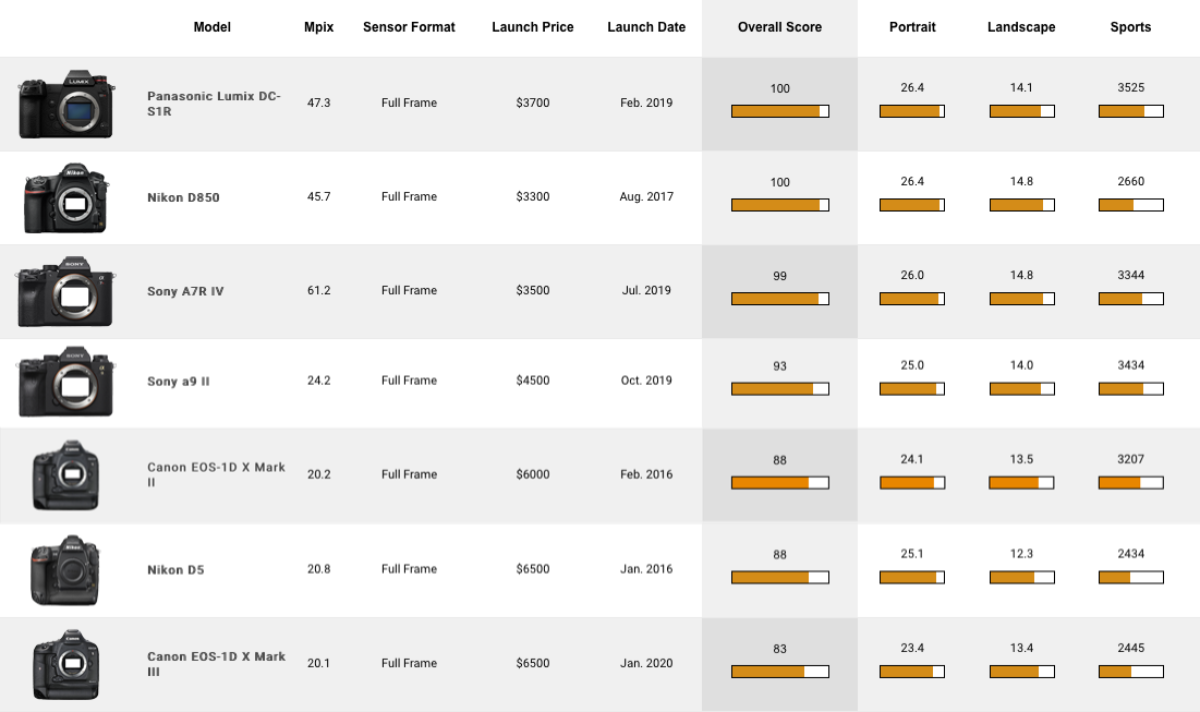
The Canon EOS-1D X Mark III has an overall score of 83. That’s less than the Nikon D850 (100) or the Sony a7R IV (99). Note that Nikon features a Sony-made sensor in the D850. To compare the 1DxIII with another sport oriented camera, the Sony a9 II, you can see the a9 II scores significantly better with 93. The EOS-1D X Mark III score is even behind the EOS-1D X Mark II (88).

We are firmly convinced that pure sensor performance figures do not describe a camera as a whole and are just one aspect of a camera. Never the less, the Canon EOS-1D X Mark III having a sensor score that’s so much lower than the competition is something that at least Canon’s marketing department should be worried about.

DxOMark’s conclusion:

Sports journalism is a highly competitive field and requires a camera that can keep pace with the action unfolding in front of the lens. The Canon EOS-1D X Mark III has been designed with that one goal in mind. Although we at DXOMARK test only sensor performance and no other features, at face value it’s an incredibly fast DSLR with not only blazing AF speed, incredible continuous shooting rates and a prodigious buffer, but also an equally impressive sensor. Admittedly, it’s not quite at the cutting edge in our metrics for sensor performance, but there’s far more to it than that.

Like the Nikon D5 and the Sony a9 II, such cameras are highly specific and a niche purchase. If you’re already a Canon user with a significant investment in lenses and other dedicated system accessories, then there’s not enough difference here in sensor dynamics to get you switch brands. If you’re new to the market, there’s a lot to consider, but even then the Canon EOS-1D X Mark III is still more than a worthy contender for your hard-earned cash.

Read the review at DxOMark…

More Canon EOS-1D X Mark III coverage is listed here.