Camera News: Fujifilm X-A7 Officially Announced, 4K Video And Newly Developed Sensor

fujifilm x-a7

Fujifilm X-A7 at a glance:

  • 24.2MP APS-C CMOS Sensor
  • UHD 4K and Full HD Video Recording
  • 3.5″ 2.76m-Dot Articulating Touchscreen
  • ISO 200-12800, Up to 6 fps Shooting
  • 117-Point Hybrid Autofocus System
  • Bluetooth and Wi-Fi Connectivity

Fujifilm announced the Fujifilm X-A7. Preorders are open at B&H Photo | Adorama | Amazon

Press release:

Fujifilm introduces the stylish “FUJIFILM X-A7” with newly-developed image sensor

– Equipped with AF capable of tracking a fast-moving subject and detecting face / eye at high speed and accuracy to capture every precious moment
– Producing high quality 4K video and sporting a large bright rear LCD monitor for excellent operability

Tokyo, September 12, 2019 — FUJIFILM Corporation (President: Kenji Sukeno) announced that it will launch the “FUJIFILM X-A7” (“X-A7”) in Autumn 2019, a new addition to the X Series of compact and lightweight mirrorless digital camera that deliver outstanding image quality with the company’s unique color reproduction technology.

Weighing just 320g*, stylish X-A7 carries a newly-developed 24.24MP APS-C sensor to deliver premium image quality with the company’s proprietary color reproduction technology. The sensor uses copper wiring to enable high-speed data readout, and features phase detection pixels across the entire sensor surface to enhance AF speed and accuracy. This enables AF tracking of a moving subject as well as Face / Eye detection AF with ease. The camera also records smooth 4K/30fps video and high-speed video, catering to the ever-growing need for high-quality video for use in Vlog** and other media.

Click here to open the rest of the article

A “unique” Macro Lens To Be Announced Along With The High Megapixel Canon EOS R?

canon rumors color calibration

A new Canon EOS R rumor surfaced.

It’s suggested that Canon might announce a “unique” macro lens for the Canon RF mount alongside with the high resolution EOS R camera expected within the next 6 months.

Unfortunately the source can’t tell what makes this macro lens “unique” and neither knows any specifications except the lens might be faster than f/2.8.

A few days ago a patent was spotted that seems to confirm our rumor about the resolution of the upcoming EOS R camera, around 80MP. A suggested specifications lists also surfaced:

  • A slightly larger body and grip than the EOS R
  • 80mp full-frame image sensor
  • A “new style” of joystick
  • Larger LCD than the EOS R
  • Larger viewfinder than the EOS R
  • The “viewfinder” can be tilted up

The high megapixel EOS R is going to replace the Canon EOS 5Ds/5Ds R. We were expecting the announcement in 2019 but it starts to appear it will come in 2020.

All high resolution EOS R rumors are listed here. More Canon rumors are listed here. Stay tuned.

Source: Canon Rumors

Deal: Canon EOS RP with Adapter – $1139.95 (reg. $1299, import model)

canon eos rp

Canon EOS RP at a glance:

  • 26.2MP Full-Frame CMOS Sensor
  • DIGIC 8 Image Processor
  • UHD 4K and Full HD 1080 Video
  • 2.36m-Dot OLED Electronic Viewfinder
  • 3″ 1.04m-Dot Vari-Angle Touchscreen LCD
  • Dual Pixel CMOS AF, 4779 AF Points
  • ISO 100-40000, Up to 5 fps Shooting
  • Wi-Fi and Bluetooth Connectivity

Seller RedTagCamera on eBay (100% positive ratings) has the Canon EOS RP with EF mount adapter on sale at $1,139.95. Compare at $1,299. Please note: this is an import model, 1 year US seller warranty applies. Import models are legally imported from another country through channels other than the maker’s official distribution system. Limited time offer.


Noteworthy KickStarter projects:

  1. SliderMini portable camera slider
  2. Universal camera strap with lifetime warranty
  3. DUO Daypack, quick access camera bag with lifetime warranty
  4. Kamlan 50mm f/1.1 lens for $199
  5. Peak Design super light travel tripod

Today only and selected deals:

More hand-picked deals are listed here.

Authorised Canon retailer B&H Photo has discounted EOS 5D Mark IV and EOS 6D Mark II bundles on offer for the holidays.

We offer 10% discount to subscriptions to Pixpa all-in-one platform for photographers.

Today’s Gold Box and one day only deals at Amazon US, Amazon DE, Amazon UK, B&H Photo, eBay, Adorama.

Canon Europe stores have a cash back promotions going on:

Refurbished lenses and DSLRs at Canon Store (best deals to be found here)

Save $10 on Luminar 4 and/or Aurora HDR 2019 using our code “WATCH” at checkout.

Sigma Announces Full-Frame Classic Art Prime Lenses, And More

sigma canon eos r Art Prime rf mount

Sigma press release:

SIGMA Welcomes New Line of Full-Frame Classic Art Prime Cine Lenses; Launches /i Technology-compatible Cine Art Prime PL mount lenses; and Announces SIGMA Mount Converter MC-31; See Them All at IBC 2019

September 10, 2019

Sigma Corporation today made the following announcements:

  1. Introduction of the new series “Full-Frame Classic Art Primes” to the lineup, a new solution from SIGMA that meets the most advanced technological demands for classical expression; Compatible with Cooke’s /i Technology communication protocol, these lenses are ideal for shooting and editing with the latest imaging technology
  2. Launch of new Art Prime PL mount lenses that support Cooke Optics’ /i Technology communication protocol in the latest addition to the SIGMA Full-Frame High Speed Prime Line.
  3. The development of SIGMA MOUNT CONVERTER MC-31, a converter that allows PL mount lenses to be used on L-Mount cameras.

All newly announced products will be on display at the 2019 IBC Show in Amsterdam.

SIGMA’s new “Full-Frame Classic Art Prime” offers unrivaled expression for artists
SIGMA’s answer to the demand for a classic, cinematic look from a prime lens is the brand new Full-Frame Classic Art Prime Line, compatible with 8K shooting with large format sensors, while achieving outstanding compact design.

Click here to open the rest of the article

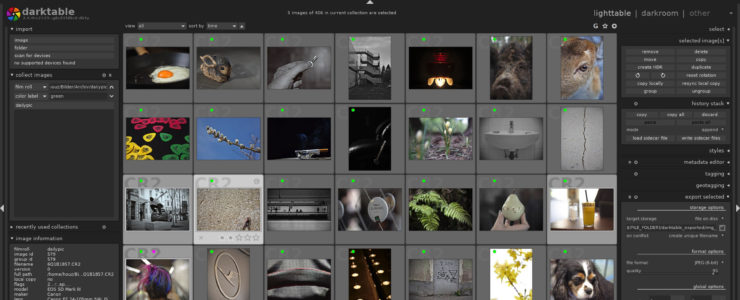
Darktable Is A Totally Free Yet Powerful Alternative To Lightroom

Darktable

Ever wondered if you could use a photo cataloging and editing software for free, without renouncing to powerful features, and across computer platforms? Enter Darktable

Darktable (learn more) is an open source photography workflow application and raw developer. A virtual lighttable and darkroom for photographers. It manages your digital negatives in a database, lets you view them through a zoomable lighttable and enables you to develop raw images and enhance them. It has the features that most Lightroom users need. Darktable is available for Windows, Mac OS X and Linux, and it won’t cost you a penny.

The video below by Anthony Morganti gives you a very good overview. To learn more and to master it, we recommend you follow Rico Richardson feed on YouTube where you’ll find lots of tutorials. You can also have a look at the online manual.

General features of Darktable:

  • Non-destructive editing throughout the complete workflow, your original images are never modified.
  • Take advantage of the real power of raw: All darktable core functions operate on 4×32-bit floating point pixel buffers, enabling SSE instructions for speedups.
  • GPU accelerated image processing: many image operations are lightning fast thanks to OpenCL support (runtime detection and enabling).
  • Professional color management: darktable is fully color managed, supporting automatic display profile detection on most systems, including built-in ICC profile support for sRGB, Adobe RGB, XYZ and linear RGB color spaces.
  • Cross platform: darktable runs on Linux, Mac OS X / macports, BSD, Windows and Solaris 11 / GNOME.
  • Filtering and sorting: search your image collections by tags, image rating (stars), color labels and many more, use flexible database queries on all metadata of your images.
  • Image formats: darktable can import a variety of standard, raw and high dynamic range image formats (e.g. JPEG, CR2, NEF, HDR, PFM, RAF … ).
  • Zero-latency, zoomable user interface: through multi-level software caches darktable provides a fluid experience.
  • Tethered shooting: support for instrumentation of your camera with live view for some camera brands.
  • Speaks your language: darktable currently comes with 21 translations:Albanian, Catalan, Czech, Danish, Dutch, French, German, Greek, Hebrew, Hungarian, Italian, Japanese, Polish, Portugese (Brazilian and Portugese), Russian, Slovak, Slovenian, Spanish, Swedish, Ukrainian.
  • Powerful export system supports G+ and Facebook webalbums, flickr upload, disk storage, 1:1 copy, email attachments and can generate a simple html-based web gallery. darktable allows you to export to low dynamic range (JPEG, PNG, TIFF), 16-bit (PPM, TIFF), or linear high dynamic range (PFM, EXR) images.
  • Never lose your image development settings darktable uses both XMPsidecar files as well as its fast database for saving metadata and processing settings. All Exif data is read and written using libexiv2.
  • Automate repetitive tasks: Many aspects of darktable can be scripted in Lua.

[via DIY Photography]

Did Canon And Nikon Adopt Telecentric Lens Design For Their Mirrorless Cams, 16 Years After Olympus?

telecentric

Did you ever hear about telecentric lens design?

Robin Wong had a closer look at telecentric lens design, and explains that:

[…] telecentric lens design [means] having the optics designed in a way that the light will hit the sensor more linearly without too much straying off, and this was already adopted by Four Thirds system lens mount in 2003

This technical approach was used by Olympus 16 years ago, when they introduced the Olympus DSLR E-1.

And Canon and Nikon?

Both Nikon and Canon took the advantage to introduce new mount. Nikon made 2 changes: 1) increase the lens mount throat diameter opening from 47mm to 55mm and 2) reduce the flange back focal distance from 46.5mm to 16mm. Similarly, Canon, maintaining their already large lens mount opening of 54mm (just 1mm shy of Nikon’s new Z mount opening), decreased their flange back focal distance from 44mm to 20mm […][…] having larger glass element to fully envelope the image sensor area allows light to hit the sensor more perpendicularly, and bringing the rear end glass element from the lens closer to the image sensor minimizes light strays and bending. The obvious benefits in terms of technical image quality? Minimized aberrations (chromatic, spherical, etc), improved corner./edge sharpness, and better per pixel optimized light capture overall.

Sound complicated? The video below tells you everything about telecentric lens design in 9 minutes.

[via Robin Wong va 4/3 Rumors]