Canon U.S.A. Receives The U.S. EPA Smartway Excellence Award For The Second Consecutive Year
2020 Award Recipients are Top Environmental Performers and Leaders for Freight Supply Chain Efficiency
MELVILLE, NY, November 5, 2020 – Recognized for its corporate commitment to sustainability and energy-conservation efforts, Canon U.S.A., Inc., a leader in digital imaging solutions, was awarded a SmartWay® Excellence Award from the U.S. Environmental Protection Agency for the second consecutive year. This honor distinguishes Canon as one of 17 shipper and logistics companies to receive this distinction, representing the best environmental performers of SmartWay’s 3,700 participating companies and organizations. Additionally, this award again establishes Canon as an industry leader in the freight supply chain environmental performance and energy efficiency by effectively hauling all freight with environmentally and energy-efficient SmartWay® carriers. Also for the second consecutive year, Canon was recognized by the EPA as a 2020 SmartWay® High Performer, an honor that acknowledges partner companies or partner fleets that exceed performance standards of efficiency and air quality among various sustainability benchmarks.
“As part of Canon’s corporate commitment to sustainability, it is our goal to implement eco-friendly measures as part of our transportation management operation, and we are honored to have our efforts recognized by the U.S. Environmental Protection Agency for the second year in a row,” said Kazuhiko Sasahara, vice president and general manager, Logistics Division, Canon U.S.A., Inc. “The SmartWay® Excellence Award further exemplifies Canon’s dedication to maintaining global environmental efforts, and directly aligns with our corporate philosophy of Kyosei, which we define as ‘all people, regardless of race, religion, or culture, harmoniously living and working together into the future’.”
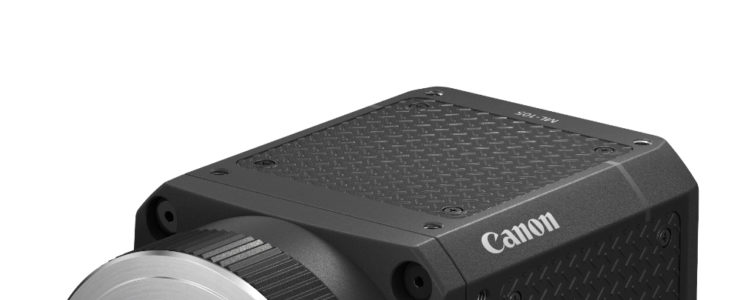
Canon officially announced the Canon ML-100 and Canon ML-105 industrial machine vision cameras.
The Canon ML-100 and ML-105 will be available with EF and M58 mounts. The M58 mount version of the Canon ML-100 multi-purpose camera is scheduled to be available at the end of December 2020. The other three models are scheduled to be available in April 2021.
New Industrial Machine Vision Cameras From Canon Utilize Next-Gen 19 Micron Sensor Technology For Color Low-Light Image Capture
Industrial and Modular Camera Design Offers Choice of Lens Mounts and Video Output
MELVILLE, NY, November 4, 2020 – Canon U.S.A., Inc., a leader in digital imaging solutions, today introduced the Company’s next generation of multi-purpose cameras, the ML-100, and the ML-105[i], which deliver amazingly high sensitivity to capture Full HD Color video with a minimum subject illumination of less than 0.0005 lux (at maximum 75 dB gain setting, equivalent to an ISO sensitivity of over 4,500,000). With the ability to capture color low-light images, these multi-purpose cameras can be utilized in industrial system design, where seeing color images is critical during day and night.
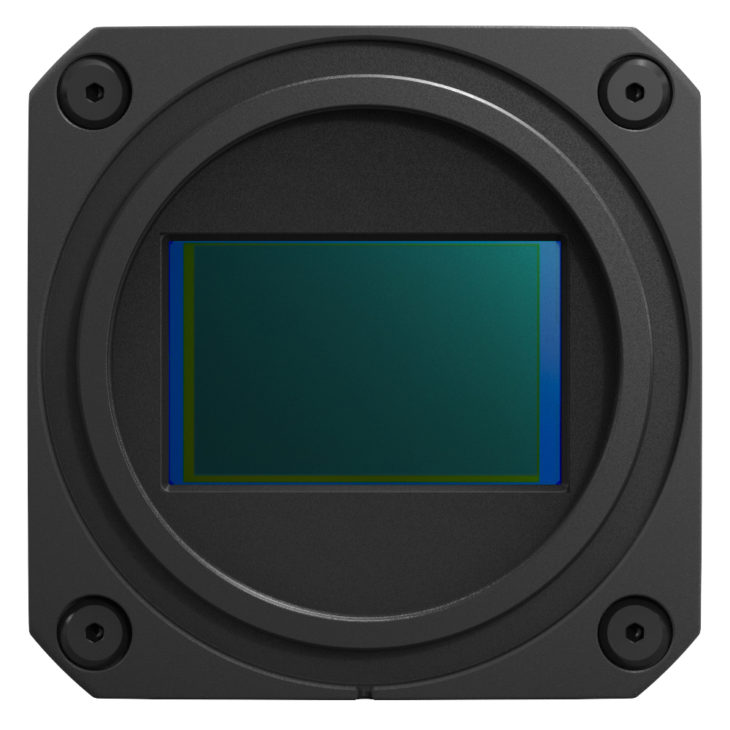
Canon’s new series of multi-purpose industrial machine vision cameras employ a next-generation 19um, 35mm full-frame CMOS sensor. The modular design of the cameras allows implementation and integration into industrial machine vision environments.
The ML series is available in two models with two different lens mounts and two video output configurations to choose from, for a total of four camera options. The ML-100 camera features a CoaXpress terminal, which allows for the transmission of video, camera-control data and power on a single coaxial cable, ideal for use in industrial systems. The CoaXpress terminal produces 12-bit RAW data output at up to 73 fps and allows for more flexibility during processing. The ML-100 features approximately 2.74 million pixels of maximum video output and supports Region of Interest, which can improve frame rate output up to 164 fps at 720p resolution. The ML-105 camera features a 3G/HD-SDI video terminal and can be suited for standard video environments where Canon image processing, including YCC 4:2:2 10-bit output, is required. The ML-105 features the Canon DIGIC DV4 Image Processor, capable of delivering Full HD resolution at 60fps. Both cameras can be ordered with either an EF or M58 mount for total system design flexibility.
The EF mount gives customers the ability to choose from Canon’s still and cinema lens lineup, while the M58 offers lens customization and design choice to the user.
The M58 mount version of the Canon ML-100 multi-purpose camera is scheduled to be available at the end of December 2020. The other three models are scheduled to be available in April 2021[ii]. For more information, please visit usa.canon.com.
After a series of leaks, Canon announced the Canon RF 50mm f/1.8 and RF 70-200mm f/4L IS for the EOS R system, and a new PIXMA printer.
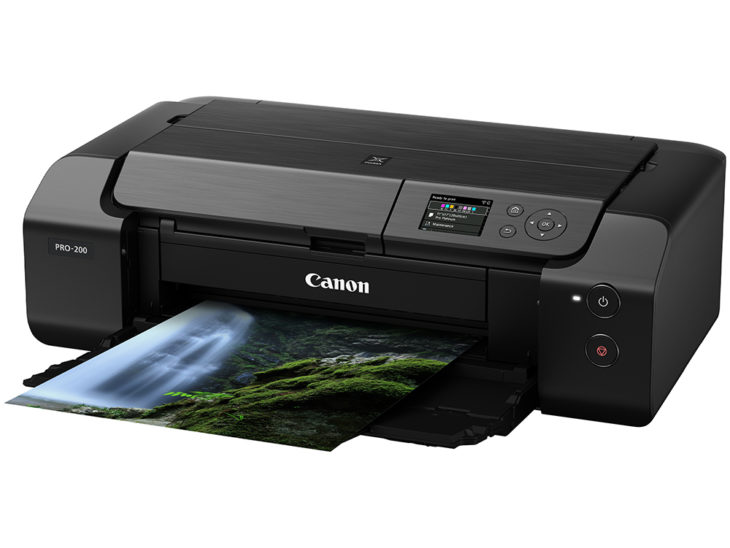
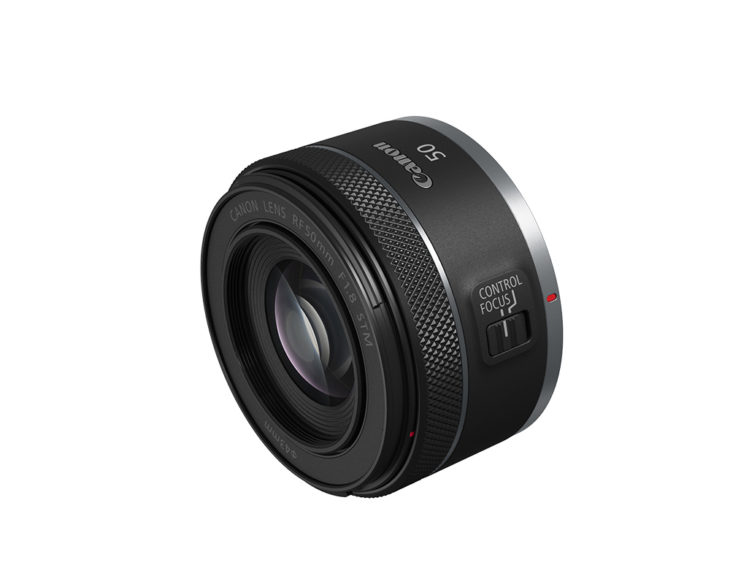
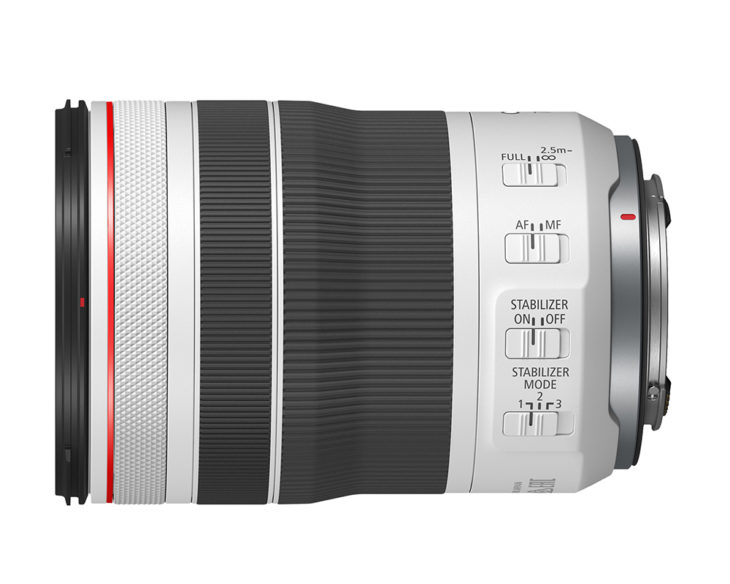
Canon released the Canon RF 50mm f/1.8 STM, Canon RF 70-200mm f/4L IS, and the PIXMA Pro-200 printer. The two lenses are scheduled to be available in early and mid-December 2020 for a suggested retail price of $199 for the RF 50mm f/1.8 and $1,599 for the RF 70-200mm f/4L IS. The Canon PIXMA PRO-200 printer is scheduled to be available later in November 2020 for a suggested retail price of $599.99.
Canon Adds Two RF Lenses And PIXMA PRO Printer Ideal For The Enthusiast Photographer
MELVILLE, NY, November 3, 2020 – Canon U.S.A. Inc., a leader in digital imaging solutions, is excited to introduce the compact and lightweight RF70-200mm F4 L IS USM and the RF50mm F1.8 STM, two completely re-designed RF mount lenses with bloodlines to immensely popular EF models that feature new lens formulas and enhanced elements. Canon is also introducing the PIXMA PRO-200 printer, which is ideal for photography students and graphic designers.
“As Canon began to further build out the company’s RF lens portfolio, the goal in mind was to create advanced lenses, for a variety of experience levels, that also featured a sense of familiarity for longtime Canon users,” said Tatsuro “Tony” Kano, executive vice president and general manager of Canon U.S.A.’s Imaging Technologies & Communications Group. “Canon prides itself on being able to uniquely offer both input and output solutions to our customers. We are equally excited to see the images captured with the new lenses, and the prints that are to be created with the new PIXMA PRO-200 printer.”
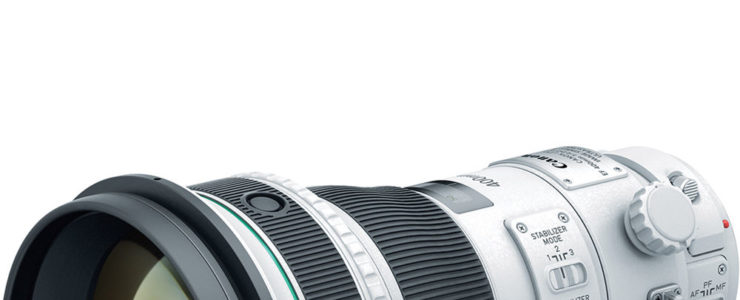
Canon RF70-200mm F4 L IS USM Lens The Canon RF70-200mm F4 L IS USM lens is ideal for photography enthusiasts ranging from advanced amateur to professional skill levels. The compact and lightweight nature of the lens makes it Canon’s shortest and lightest 70-200mm F4 zoom lens to date. This RF lens is approximately 32 percent shorter and 11 percent lighter than its EF counterpart with a large portion of the lens element arrangement closer to the camera body. This arrangement is designed to provide photographers with a more balanced feel and experience even at the zoom range’s telephoto end. Additionally, the shorter and lighter design allows the lens to more easily be stowed away in a camera bag when not in use.
The RF70-200mm F4 L IS USM features two independent Nano USM motors, providing an even greater level of high-speed autofocus for still image shooting as well as quiet and smooth autofocus for video shooting. The lens also incorporates a floating focus control that drives the two lens groups individually while using the two aforementioned Nano USM motors. The floating focus lens element shortens the focusing distance and helps reduce breathing, providing users with fast, consistent and reliable performance.
Additional Features of The Canon RF70-200mm F4 L IS USM Lens Include:
16 lens elements in 11 groups, including four UD lenses, that help to reduce chromatic aberration
Optical Image Stabilizer with up to 5 Stops[i] of Shake Correction
Up to 7.5 stops[ii] of Shake Correction with coordinated control of Optical Image Stabilizer and In-Body Image Stabilizer
Three stabilizer modes
Customizable control ring that allows photographers to adjust exposure compensation, shutter speed, aperture, or ISO
12-pin communication system
L-Series dust and weather-resistant build with a fluorine coating
Minimum focusing distance of 1.97 feet and a maximum magnification of 0.28x
Air Sphere Coating (ASC) that helps minimize lens flare and ghosting
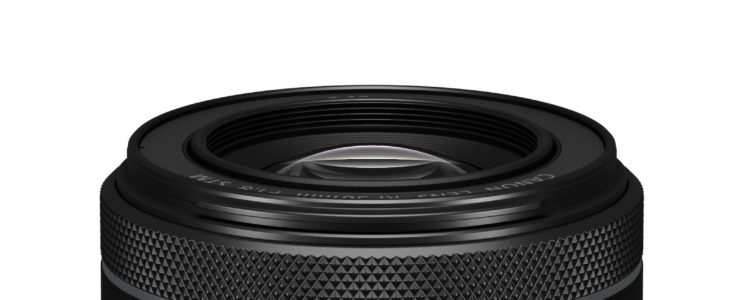
Canon RF50mm F1.8 STM Lens Creatives love using a 50mm lens because that focal length is similar to the natural viewpoint of the human field of vision. This perspective allows for the lens to be used in a wide variety of shooting situations, including portraits, landscapes and food photography. What’s more, Canon 50mm f/1.8 lenses have long been a popular tool for both photographers and creators due to their budget-friendly price point, extremely compact and lightweight form factor, and versatility.
The tradition continues with the RF50mm F1.8 STM that, in many ways, is improved over its EF counterpart. The first visually noticeable improvement is the customizable control ring that has become synonymous with RF lenses. The control ring allows photographers to adjust exposure compensation, shutter speed, aperture, or ISO and with a flip of the side switch can adjust focus. The inclusion of a PMo aspherical lens helps to reduce chromatic aberration and provides high-image quality even at the periphery of the image. Additionally, the combination of the lens shape and Super Spectra Coating (SSC) helps to minimize ghosting and flaring.
Additional Features of The Canon RF50mm F1.8 STM Lens Include:
Six lens elements in five groups
12-pin communication system
Minimum focusing distance of 0.98ft and a maximum magnification of 0.25x
Up to 7 Stops[iii] of Shake Correction with EOS R Series cameras with In-Body Image Stabilizer
Canon PIXMA PRO-200 Printer Continuing a long history of high-quality input to output digital imaging equipment, the PIXMA PRO-200 printer is 15% smaller than its predecessor, the PIXMA PRO-100. With the ability to print up to 13 inches x 19 inches and featuring improved ChromaLife 100+ dye-based ink, the latest PRO printer helps to create prints that are more representative of the original digital file. A helpful tool of the trade for photographers who print work for themselves and graphic artists or photography students working on their portfolios from their homes, the PIXMA PRO-200 printer also features:
A new 3-inch LCD screen to help users set up the printer, connect to WiFi, monitor ink and paper levels for an improved user experience
New Skew Correction feature, which automatically corrects shifts the paper may encounter during printing
Professional print and layout software, which can work as a stand-alone program, or integrated into Adobe® Lightroom® or Photoshop® as a plugin to work within a photographer’s workflow, to help take the guesswork out of making great prints
Vast media support to print on a variety of surfaces such as Canon Photo Paper Pro Luster and Premium Fine Art Rough, as well as the ability to print longer panoramic images in comparison to previous models
Pricing and Availability The Canon RF70-200mm F4 L IS USM, and RF50mm F1.8 STM lenses are scheduled to be available in early and mid-December 2020 for a suggested retail price of $1,599.00 and $199.99, respectively*.
The Canon PIXMA PRO-200 printer is scheduled to be available later in November 2020 for a suggested retail price of $599.99*.
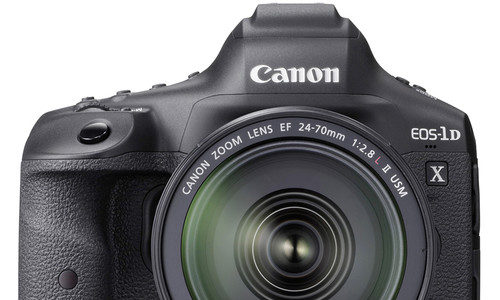
Canon EOS-1D X Mark III firmware 1.2.1 (download) incorporates the following fix:
1. Fixes a phenomenon, in which, after updating the camera’s firmware to version 1.2.0, the Smart Controller may respond slowly or not at all on some cameras. *)
*) The phenomenon described above may occur in cameras whose first two digits of the serial number are "01" "02" "03" or "04".

Firmware Version 1.2.1 also incorporates the following fixes and enhancements from Firmware Version 1.2.0:

1. Enhancements when using Browser Remote:
- The image list displayed will be refreshed automatically on the browser.
- On the shooting screen of the browser, you can set the movie resolution and a high frame rate.
- On the shooting screen of the browser, you can change the movie shooting mode.
- On the shooting screen of the browser, Live View will be displayed as soon as you select the movie shooting button.
2. Enhances Auto Focus (AF) for improved face and eye recognition at greater distances.
3. Fixes a phenomenon that may occur during viewfinder shooting, in which the shutter may not be released or the camera may not operate in the following settings:
- In One-Shot AF mode, when the AF Area Selection Mode is set as Zone AF, Large Zone AF or Automatic Selection AF.
- In AI Servo AF, when direct AF point selection is made using the smart controller.
- When the Register/Recall Shooting Function is assigned to the AE Lock button, in the Custom Controls.
4. Connectivity during FTP transmission, has been improved.
5. Improves Wi-Fi connectivity when using the Wireless File Transmitter WFT-E9.
6. Fixes a phenomenon, in which the card access time may take longer, when using certain CFexpress cards.
Things are changing in the mirrorless universe. The Canon EOS R5 and EOS R6 are a market hit for Canon, in Japan and around the world. And that despise all the crap that had to be thrown at Canon after launch.
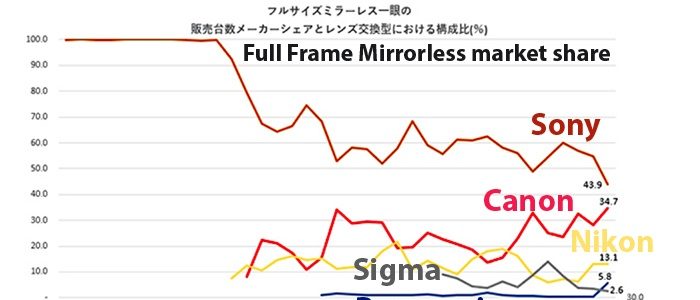
BCN Ranking reports that Canon is rapidly gaining market shares for mirrorless cameras in Japan. As you can see in the picture above, Canon’s market shares are raising steadily, and it’s because the huge success of the EOS R5 and EOS R6. I have no doubts that Canon will soon surpass Sony in mirrorless market shares.
There is more to learn from the BNC Report. You can see that Nikon struggles to grow market shares, that Panasonic is getting better (thanks to the S5), and the Sigma is not selling as much Sigma FPs as they likely wished.
Nikon is struggling (a lot)
Panasonic S5 finally moved up the market shares for Panasonic
Sigma is falling after the initial FP sales
Machine translated from BCN’s report:
As of April, the decline in mirrorless interchangeable-lens cameras was greater than that of the interchangeable lens type as a whole, and the number of units sold was 19.7% year-on-year, a decrease of more than 80%. However, it recovered rapidly after July. In September, the number of units sold was 97.8% compared to the same month of the previous year, and the amount was 90.3%, approaching the same level as the previous year. In reaction to the last-minute purchase before the tax increase that occurred in September last year, the number of interchangeable lenses as a whole increased temporarily to 52.1% and the amount of money was 56.3%. In such an environment, full-size mirrorless cameras are doing very well.
The positive environment for cameras, such as the Go To Travel Campaign, has been set up, and new full-frame mirrorless interchangeable-lens cameras are being released one after another. Canon will release the EOS RP in April, the R5 in July, and the R6 in August. Nikon released the Z5 in August, and Panasonic released the LUMIX S5 in September. After October, Sony will release the α7C and α7S III, and Nikon will release the Z6II and Z7II. Consumers’ choices are expanding all at once, and the camera market is returning to its bustling atmosphere.
The manufacturer share has also changed. Until the summer of 2018, Sony maintained a nearly 100% share of the market. Nikon and Canon entered the market one after another in the fall of 2018. Panasonic entered the market in February 2019 and Sigma entered the market in October, and the full-size mirrorless interchangeable-lens camera market was launched in earnest. However, the structure in which Sony maintains a market share of 50% or more has not changed, and the situation of one-strong vs. others has continued.
This year, sales of new products introduced by Canon in particular increased, and the share of sales volume was 34.7%. It is just behind Sony, which has fallen to 43.9%. Nikon’s flagship product has not yet been released, and the momentum is the same as before. With the introduction of a low-priced model, Panasonic has finally gained a presence despite its single-digit share of 5.8%. Sigma, which temporarily overtook Nikon, has only one model in its lineup, so it has been overtaken by Panasonic and is content with 2.6%.
This website or its third-party tools use cookies, which are necessary to its functioning and required to achieve the purposes illustrated in the cookie policy. If you want to know more or withdraw your consent to all or some of the cookies, please refer to the cookie policy. By closing this banner you agree to the use of cookies.