Canon Professional Network Article About DPP 4.0 (support for new DSLRs will soon be added)
DPP 4.0

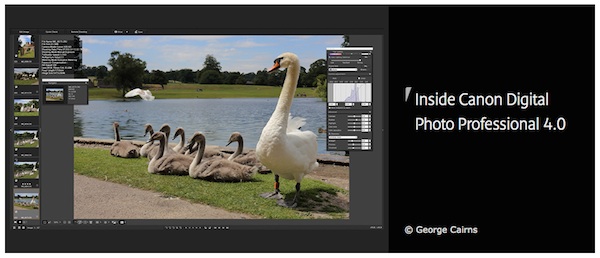
CPN Europe published a technical article about Canon’s new Digital Photo Professional 4.0, Inside Canon Digital Photo Professional 4.0:

Digital Photo Professional (DPP) version 4.0 is the latest release of Canon’s free RAW image management and editing software, and this incarnation is heralded as the first major update since the software was launched. Canon has responded to feedback from Digital Photo Professional users and incorporated feature requests and suggestions into version 4.0 to create a better looking package that offers a smoother, faster workflow. In this article CPN writer George Cairns examines how DPP 4.0 is better equipped to support your photographic workflow – as you import, browse and develop large numbers of RAW images – and investigates new features, such as the ability to make selective hue, saturation and luminance adjustments for eight colour gamuts.

The good news is that “support for more models will be added in due course“. When DPP 4.o was announced, the disappointment was big since for the time being DPP 4.0 (officially) supports only Canon’s latest full-frame cameras. However, you can already use DPP 4.0 with some newer Canon APS-C cameras (Rebel SL1/EOS 100D,  Rebel T4i/650D, EOS M, EOS 70D, Rebel T5i/EOS 700D) if you follow these simple instructions.

You can download DPP 4.0 here. Note: when you download DPP 4.0 you have to enter the serial number of your Canon DSLR. I downloaded DPP 4.0 from the EOS 5D Mark III support page using my EOS 70D’s serial number.
Read the article at CPN –>

Canon Used Magic Lantern RAW Footage For An Advertisement (no joke)

Wow, that’s funny. It appears that Canon used footage shot with an [shoplink 2431]EOS 5D Mark III[/shoplink] and the Magic Lantern RAW Hack for an ad (video above).

While it’s well known that Canon doesn’t really contrast ML (as Sony or other companies would certainly do), never the less it’s somewhat weird that a firmware hack not officially supported by Canon was used by the company to produce an advertisement for their Bring It campaign.

ML RAW footage appears 2 times in the ad, after 15 secs (first video below) and then after 18 secs (second video below), you may miss it if you are not watching carefully.

Canon is for sure one of the most conservative brands on the globe, but as it appears also one of the most pragmatically oriented :-) Happy for the skilled ML hackers, they got the credit they deserve.

[planet5D via nofilmschool]

Canon 5d Mark III RAW video skiing sample from Justin Majeczky.

A Flood of Emotion from Pastel Glyph.

Magic Lantern RAW

How Not To Do Camera Cleaning (aka: How To Destroy Your Camera In Few Steps)

Note: This is a fake tutorial – nothing shown in the video above is to replicate

Take the video above as humour or whatever you want to take it for, but in no case follow the instruction given in the video. It a perfect way to totally destroy your camera equipment. In the video a Canon EOS 5D Mark II is “cleaned” (= totally damaged).

Better to have a look at this cool accessory for removing sensor dust.

[via PetaPixel via No Film School via DIY Photography]

The History of Canon EF Lenses

394

Canon Asia posted the first 2 parts of an article about the history of Canon’s EF lenses (I think there will be a third part).

How it started:

In March 1987, Canon released the “EOS 650”, the first Canon camera that was built in with a professional AF system. This also marked the birth of the EF lenses. I can still recall that prior to the launch of the EOS series, the biggest concern among Canon users was whether Canon would make changes to the existing FD mount standards. Until then, the FD mount adopted by Canon cameras before the EOS series had commanded tremendous support among both professional photographers and advanced amateurs. The view of the majority was that developing an AF system was unlikely to necessitate a change in the mount standards. However, contrary to the popular anticipation, Canon chose to break away from the traditional FD mount with the adoption of a brand new EF mount standard for its EOS series. This decision led to distress among users who possessed a large number of FD lenses, some of whom even saw it as an act of “betrayal”. Today, many years after its launch, it is almost impossible to find any user who would disagree that the decision made by Canon then was correct.


Vacuum Cleaner Accessory To Remove Sensor Dust (update)

Remove Sensor Dust

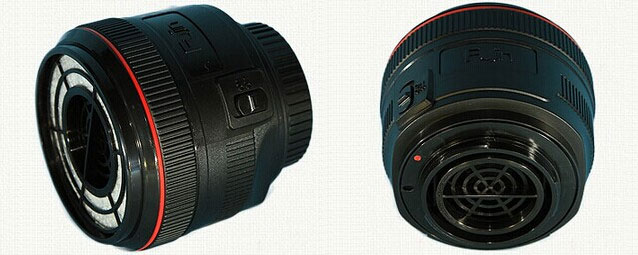
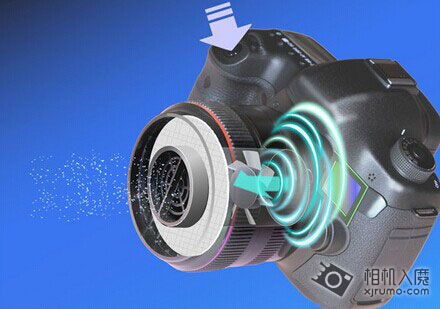
The object in the picture above is a new accessory for cleaning your DSLR’s sensor (remove dust on sensor). It’s actually the same principle of a vacuum cleaner, packaged into a lens shape.

The accessory is made by Chinese manufacture Nisshin Seiko, and for the time being it is available only for Canon mounts. Yes, you mount the “cleaner” on your DSLR as you would do with a lens. The accessory comes with a red ring that in some way resembles Canon’s “L” lenses.

The retail price is 3,500 Yen/210 Yuan/$34. For the time being it is not available in the USA.

Update: via DCFever I found the following video on YouTube (spoken in Japanese). It appears that the “vacuum cleaner” is (also) produced by the Japanese company Fujin.

Remove Sensor Dust

method04

[xjrumo.com via The New Camera]

Canon Aids Relief Efforts Following Earthquake In Southwestern China

Canon Rumor

Canon press release:

Canon aids relief efforts following earthquake in southwestern China

TOKYO, August 5, 2014—On August 3, a powerful earthquake struck southwestern China’s Yunnan Province, causing extensive destruction and loss of life. We at Canon would like to extend our heartfelt condolences to all those affected by this disaster and our thoughts go out to those suffering in its aftermath.

While we realize that the road to recovery will be challenging and time-consuming, we hope that the region will soon be able to begin the rebuilding and healing process.

The Canon Group is making a donation of RMB 3.2 million (approximately US$518,000) to aid in the relief efforts for the earthquake victims. The organization that will receive this donation is still under consideration.