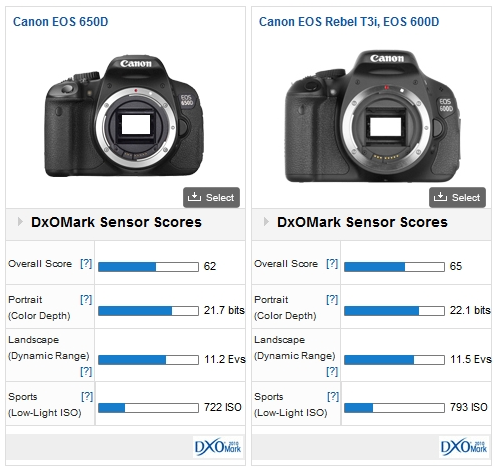
The Canon EOS 650/T4i got DXOMarked and now we have the rather unsatisfying result. Whatever you might think about DXO Marks they are here and we have to take it in account. Sure, it’s a purely engineering measure and it doesn’t tell the whole story. But they are an indicator for the sensor, its performance and properties. Not only the [shoplink 5623]Rebel T4i/650D[/shoplink] falls behind the [shoplink 333]Rebel T3i/600D[/shoplink], the previous iteration of the series, but it falls very short also when measured against its competitors ([shoplink 7465]Nikon D3200 (click here for specs)[/shoplink] and [shoplink 7466]Sony SLT-A65 (click here for specs)[/shoplink]). The DXOMark of the EOS 650D/Rebel T4i is 62, the 600D/T3i has 64.
I was surprised to read what DXOMark says about the the auto-focus of the EOS 650D/Rebel T4i: “innovative, quick, quiet, and powerful hybridized autofocus. In video mode, the autofocus operates continuously and takes full advantage of the emerging new line of lenses equipped with Stepping Motor (STM) technology“. This sounds good, especcially after the very critic review of the EOS M made by Engadget. Both cameras mount the same, hybrid sensor with dedicated photosites for auto-focus.
Don’t get too much impressed with these scores. Sure, they have something to say. But a feature-packed modern DSLR like the EOS 650D has much more to offer.
EOS 650D/Rebel T4i price check: [shopcountry 5623]
[via DXOMark]
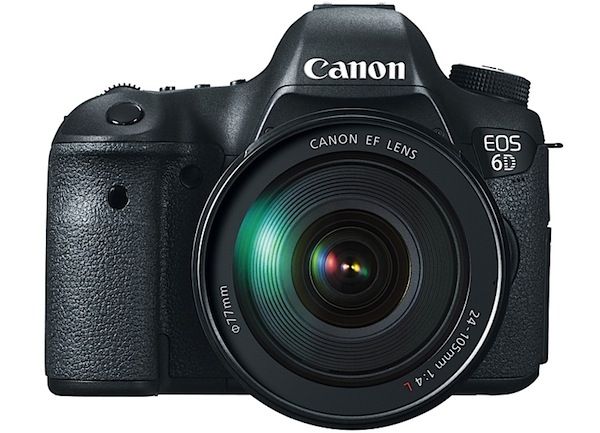
The upcoming Canon EOS 6D DSLR (click here for specs) is the company’s first DSLR to have built-in WiFi and GPS. It is also the lightest (680g) full-frame DSLR in its category. It has a 20 MP sensor, an 11-point AF system, offers High Dynamic Range processing in the camera, the silent shutter mode of the [shoplink 7373 ebay]EOS 5D Mark III (on sale for $3,093.33, click here)[/shoplink], DIGIC 5+ image processor, ISO up to 102400, and more. And it is an “entry-level” full-frame DSLR. With a price tag of $2100 it’s the cheapest full-frame DSLR you can buy new in 2012. Update: It turned out the the Nikon D600 is $3 cheaper (at least here) than the EOS 6D (thanks to reader EL for the information).
Canon EOS 6D DSLR specs:
20.2MP Full-Frame CMOS Sensor
3.0″ Clear View High Resolution LCD
DIGIC 5+ Image Processor
Built-In Wi-Fi and GPS Connectivity
Full HD 1080p with Manual Controls
11-Point AF with Center Cross-Type Point
63-Zone Dual Layer Metering Sensor
Extended ISO Range of 50-102400
Up to 4.5 Full Resolution FPS
Built-In HDR and Multiple Exposure Modes
The Canon EOS 6D DSLR can be preordered at the following shops:
Canon clearly had a precise category in mind when designing the Canon EOS 6D DSLR: photographers who need a professional tool with high image quality and want (or have) to share their pictures in a fast and easy way (e.g. bloggers, social sharing, photojournalists who need to upload pics). The WiFi and GPS (adds geographic and UTC time information to EXIF data) options of the Canon EOS 6D DSLR come handy for users who need connectivity to transfer pictures, either on the Internet or on another device, and are a welcome feature in a DSLR made by a company known for its conservative approach. The direct competitor, Nikon’s D600 (click here for specs), doesn’t have built-in WiFi and GPS. The Wi-Fi feature of the Canon EOS 6D DSLR can be used in combination with a smartphone (or tablet) that operates as a wireless remote control. Canon’s EOS free remote app can take control of live view and exposure , and is available both for the iOS and Android platform. Another thing is worth to be mentioned: the Canon 5D Mark II saw a concrete price drop since the announcement of the Canon EOS 6D DSLR.
So, the question raises: how does the Canon EOS 6D DSLR compare to other full-frame DSLRs? While we are waiting for a production model of the Canon EOS 6D DSLR, comparisons can only be made on the basis of specifications and analysis. The most comprehensive comparison (thanks to the reader who posted the link in a comment) between the Canon EOS 6D DSLR and the Nikon D600 DSLR I saw so far comes from digitalreviewcanada. Their exhaustive comparison goes into every detail (and I mean every). About the Canon EOS 6D DSLR they say:
It is interesting to see that Canon has chosen to take a different approach and rather than delivering higher end features, speed and performance, has designed the full frame Canon EOS 6D to excel as a low light / high ISO performer, and to cater to bloggers and the active social networking type by incorporating practical features like built-in Wi-Fi transfer and GPS tagging functionality.
photographytalk previews the Canon EOS 6D DSLR, discusses its features, and compares the camera with other Canon DSLRs and Nikon’s D600. About the EOS 6D they write:
Engineering a smaller and lighter full-frame DSLR to appeal to a wider market does limit the configuration of the points in the AF system. The 6D has 11 points and only the central point is cross-type. On the EOS 6D, they must be placed within a smaller area at the center of the frame. Nonetheless, the 6D will shoot in low-light conditions better than the 5D Mark III, -3EV compared to -2EV, respectively. This greater low-light capability compensates quite a bit for the AF points limitations. Another nice AF functionality is precise adjustment of the AF, as found in the 5D Mark III.
More about the Canon EOS 6D DSLR and the Nikon D600 in the following video (13min).
A lot of people is questioning which Canon full-frame DSLR to get. The next video tries to give an answer.
Jeff Lynch made a quick specifications-based comparison with the EOS 5D Mark III and EOS 5D Mark II. Useful if you want to have an overview on how these DSLRs compare.
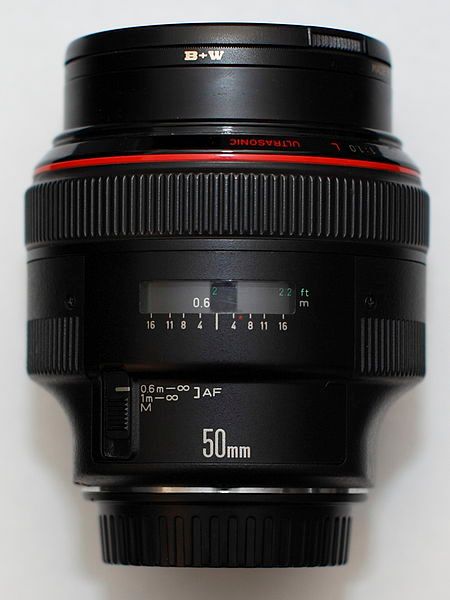
Before Canon made the [shoplink 177]EF 50mm f 1.2L[/shoplink], the Canon EF 50mm f/1L, now a discontinued lens, was the fastest in the company’s line-up. It might be difficult to find one nowadays, and if you do expect to pay it up to three times the price it had. Citing from Wikipedia:
The discontinued Canon EF 50mm f/1L USM is a professional L series autofocus lens. On the used market sells for as much as double the original retail value. It was the fastest SLR lens in production during its lifetime. This lens has a metal body and mount, and plastic extremities. It also features a wide rubber focus ring that is damped, a distance window with infrared index, and the ability to set the focus range from 0.6m to infinity, or 1m to infinity. In common with the EF 85mm f/1.2L USM it uses an electronic “focus by wire” system and requires power from the camera in order to manual focus. The 8-blade diaphragm and maximum aperture of f/1.0 give this lens the ability to create extremely shallow depth of field effects and to support low light situations. The optical construction of this lens contains 11 lens elements, including two ground and polished aspherical lens elements. This lens uses a floating front extension focusing system, powered by a ring-type USM motor. The front of the lens does not rotate, but does extend when focusing.
Despite its price and large maximum aperture, the 1.0L was not a particularly sharp lens at any aperture, and the two cheaper 50mm options offered far better sharpness when stopped down beyond about f/2.8. This, combined with the high production cost and low sales volume, led to it being discontinued in 2000 and eventually superseded by the f/1.2 edition.
Bryan Soderlind has a Canon EF 50mm f/1L (he payed more than $3000) and shares images and thoughts with us.
In an attempt to really get excited about switching to digital, I went “all the way” on my 50mm lens purchase. I bought the most expensive and rare 50mm Canon lens, the Canon EF 50mm f/1L. Previously I had used the 50mm 1.4 and 1.2 and couldn’t really differentiate between the two, they both were really amazing lenses.
The Canon EF 50mm f/1L lens is a rare, discontinued, and expensive lens Canon only made for a few years. The lens is made to shine at lower apertures and the look you get at 1.0 is like no other lens made. There is somewhat of a frustrating learning curve when using the lens at 1.0, getting anything in focus takes practice.
Strong backlighting tends to give a very wild unique flare and certain light sources produce a rainbow effect I haven’t seen produced by any other lenses. The lens really isn’t any better than other 50mm Canon lenses I’ve used once you stop down past 2.8, this lens was made for the wider apertures.
There is also a heavy vignette at wide open apertures, this could be seen as a positive or negative depending on your preference. The price and the ability to find the lens is a definite deterrent, but for me it was well worth it.
On Bryan’s page there are lots of sample pics shot using an [shoplink 254]EOS 5D Mark II[/shoplink] and [shoplink 2431]EOS 5D Mark III[/shoplink] with the Canon EF 50mm f/1L.
Available Canon 50mm lenses:
EF 50mm f 1.2L USM price check: [shopcountry 177]
EF 50mm f 1.4 USM price check: [shopcountry 175]
EF 50mm f/1.8 price check: [shopcountry 173]
Update: If you can’t wait to get the [shoplink 6091 ebay]EOS M you can find it on eBay (click here)[/shoplink] and on Amazon Japan (click here).
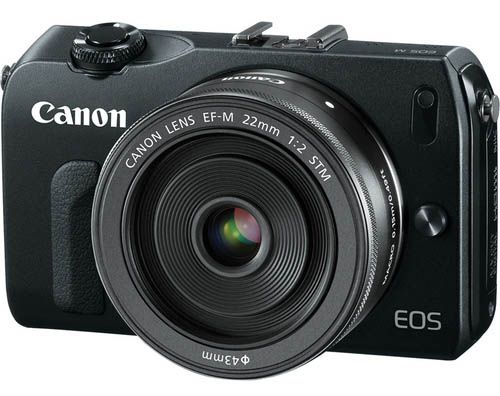
Now that the [shoplink 6091]Canon EOS M (click here for specs and kits)[/shoplink] is shipping in Japan (and other parts of Asia) Engadget got a Canon EOS M production model reviewed and felt the pulse of Canon’s somewhat timid (some may say half-hearthed) approach to mirrorless system cameras.
Don’t get me wrong, the EOS M is an excellent little camera sporting an 18MP APS-C sensor and all the latest of Canon’s digital photographic technology, and it can mount the whole range of the outstanding EF lens line-up. At the EOS M’s core you’ll find a lot of the technology employed in Canon’s DSLR line-up. The sensor, the touchscreen and user interface, the cpu and more are shared with the [shoplink 5623]Rebel T4i/EOS 650D DSLR[/shoplink]. Nevertheless, while having a price tag of $799, there are some shortfalls that let us a little puzzled. Auto focus is not as quick as you may expect (or want). The AF issue was known, but so far tested only in pre-production models. It’s sad to learn that it didn’t change in production models. This is probably the most criticized shortfall of Canon’s mirrorless attempt. And even if it will be cause some passionated flamewars in dedicated forums, this is an annoyance and not a real problem. Not enough problem for me: I am looking to get an EOS M for a trip I am planning in November.
The other one, already discussed issue, is the missing of a more powerful control dial (something you may miss, especially if you are accustomed to Canon’s DSLR’s, even if entry level). Liking or not liking to have to interact with a touchscreen is a subjective matter. I for myself prefer control dials. But that’s just me.
Enough of the bad news. Image quality is superb (as you can easily see in the samples), high ISO performance is as excellent as always with Canon (12800, 25600 expanded). Low light performance, sharpness, dynamic range are all outstanding. Just check the review. The EOS M is not disappointing if you are looking for outstanding IQ in a compact body.
The real question is: could Canon have done it better? And if yes, why didn’t they do?
Get Engadgets interesting and not always generous (towards Canon) review clicking here.
EOS M price check and availability: [shopcountry 6091]
Ever wondered how a Canon L lens is made? Well, there is a three part video series (by RazorFantasy) that covers each and any aspect of the manufacturing of the [shoplink 108]EF 500mm F4L IS USM lens[/shoplink]. Above is part 1, below part 2 and 3. Enjoy!
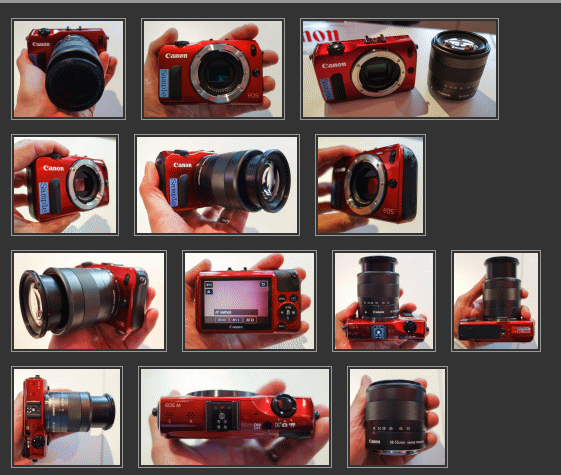
Photographyblog has a series of pictures of the cam itself, with different lenses mounted. ephotozine has another round of EOS M pictures and some first impressions to share. Next, let’s see some videos showing the EOS M’s features and interface. Please keep in mind that these are all pre-production models of the EOS M. First video comes from London Camera Exchange.
A Photokina related video by Thaiphoto DE. It shows also the Powershot G15 ($499 click here for spec), the EOS M with the 200-400mm mounted, and the new [shoplink 2160]EF 24-70mm f/2.8L II USM[/shoplink].
This website or its third-party tools use cookies, which are necessary to its functioning and required to achieve the purposes illustrated in the cookie policy. If you want to know more or withdraw your consent to all or some of the cookies, please refer to the cookie policy. By closing this banner you agree to the use of cookies.