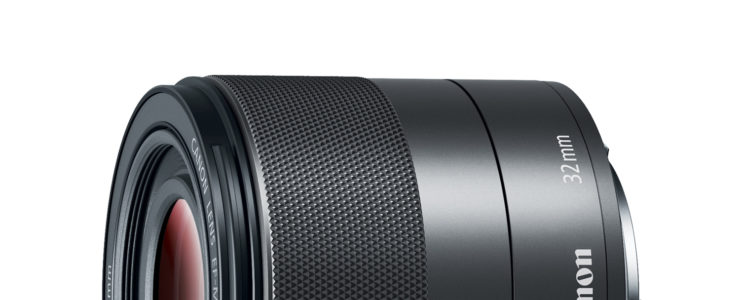
The Canon EF-M 32mm f/1.4 STM lens is the ideal lens for Canon EOS M users who are looking for a new prime lens to fit into their kit bag. It’s a simple, yet reliable, “nifty fifty” type lens by the time you take into account the crop factor of using it with an APS-C sized sensor.
[…] with lenses like this, Canon shows that it is still thinking about the various different consumers it is trying to cater for.
The Canon EF-M 32mm f/1.4 STM is only the third prime lens to be made for the M series, and thanks to its focal length and wide aperture, it has a range of practical applications. You might consider it a portrait lens – albeit best suited to environmental type portraits – as well as for low light, pet portraits, still life, food and more.
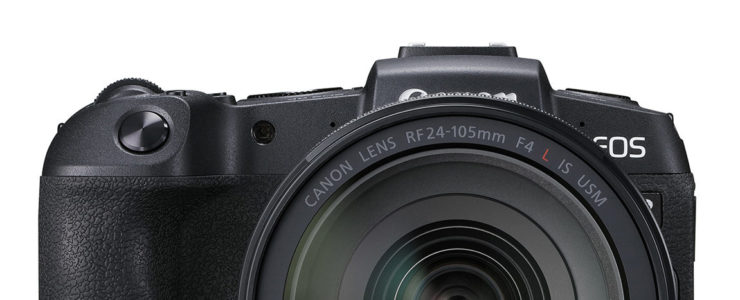
Photography Blog reviewed the new Canon EOS RP, the company’s entry level, full frame mirrorless camera.
From their conclusion:
[…] the EOS RP is surprisingly well-built, with the same level as weather-proofing as the popular EOS 80D DSLR, makes more logical design decisions, most notably the removal of the M-Fn bar and the addition of a dedicated shooting mode dial, and has a great 1080p video mode. It also offers fantastic auto-focusing, USB charging and Bluetooth connectivity, all in a very compact and lightweight chassis. And in some ways, the EOS RP even manages to outperform its big brother, the EOS R, most notably by offering Eye AF in both AF-S and AF-C focusing modes, and incorporating Focus Stacking for the first time on any Canon camera.
[…] Ultimately, the new EOS RP camera adds up to a lot more than the sum of its parts, offering full-frame mirrorless image quality at an APS-C price point. While it’s far from being the most technologically advanced camera ever released, Canon’s cunning repackaging of existing tech in a logical design for its target audience could make it one of the best-selling.Read the review….
World wide pre-order links for the Canon EOS RP (most should have the RP in stock):
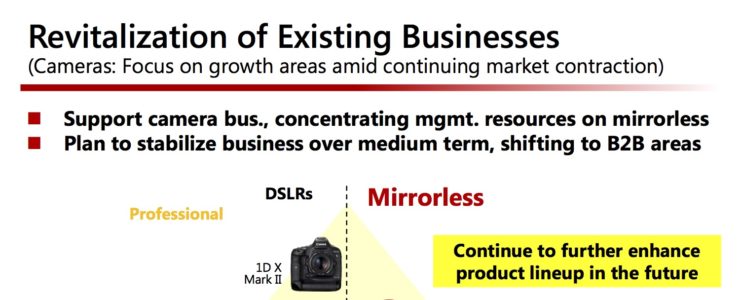
Canon published the company’s corporate strategic documents.
From the presentation material (full doc below, see image above) it’s clear that mirrorless technology is where Canon will put most resources and energy in the next years.
There is also talk about a new businesses that “will drive future growth”. That’s commercial printing, network cameras, medical, and industrial equipment.
The documents reveal the important, strategic role the Canon EOS M50 played in Canon’s move to put a dent in the mirrorless market.
Says Fujio Mitarai, chairman and CEO:
[…] for cameras, which are mainly a consumer-oriented product, the overall market continues to shrink due to improvement in smartphone camera features. Even against this backdrop, however, we continue to see positive growth in mirrorless cameras, known for their compact and light-weight designs, thanks to improvements in performance, which is now on par with DSLRs.
Although we have been taking a cautious approach to mirrorless cameras until recently, we have begun to successively launch strategic models, and will strive to further enhance our lineup going forward as well. The overall market will continue to shrink for some time, however, we will work to support our camera business by focusing management resources on the growing market segment of mirrorless cameras.

If you are particularly keen to difficult DIY projects, this one may be for you.
Andy George of How To Make Everything redefines the concept of DIY with this project: a lens build from scratch using raw sand, rocks, and metal, and a huge amount of skills too, I guess.
Previously, Andy built a pinhole camera, as you can see in the video below.
Not satisfied with the pinhole camera, Andy decided to build a lens from the scratch. Well, it took him a dozen attempts before getting it done right. Guess making your own glass isn’t everyone’s thing. The video below explains all steps. Enjoy.
What a great camera that was the Canon EOS 40D. I liked it so much I never sold mine. True, it has “only” 10MP, it was released in 2007, but still…
Carl Garrard posted a review about the mighty Canon EOS 40D, and he seems to be as fond about the 40D as I am. It’s simply a great camera, with great build quality and ergonomics. Indeed, it’s build like a tank and no xxD camera after the EOS 40D ever had the same build quality.
Carl writes:
In addition to the 40D being just a lovely wonderful experience to use, I’m very happy with the image quality that I see on my computer, especially when using raw and jpeg. Canon has excellent jpeg quality and it allows you to customize the output from the camera. If you’re the type of person that doesn’t want to use Raw processing in your workflow, this will benefit you.
However I must suggest, highly suggest in fact, that you also record a raw image every time you take a picture. Even if you never intend to process a raw file, later in life you’ll appreciate that you did. By saving a raw file now, you’ve ensured that in the future you can manipulate those images, and create new Jpegs with it that degrade in quality over time.
Memory and storage are so cheap that is completely unwise to not shoot in Raw. Think of raw as the negatives that you get back from film processing. You save them for later and you never know when one day when you’ll need to redevelop an image from the negative. Raw images and film negatives are future-proof insurance that will preserve your images forever.
Lastly, when I think of the EOS 40D compared to all of my current or previous Canon cameras, I feel its a sort of a perfect compromise between a few bodies.
– Perfect handling and feel, like the 50D
– Large pixels and similar color profile, like the original 5D
– Great low ISO IQ like my 6D (similar DR too)
– Fast continuous shooting (6.5fps) and excellent locking continuous AF system like most Canon’s
Build like a tank!
There is nothing wrong with the EOS 40D’s image quality, as you can see below.
This website or its third-party tools use cookies, which are necessary to its functioning and required to achieve the purposes illustrated in the cookie policy. If you want to know more or withdraw your consent to all or some of the cookies, please refer to the cookie policy. By closing this banner you agree to the use of cookies.