DxO PhotoLab 7 Released (new color calibration and editing tools)

PhotoLab 7

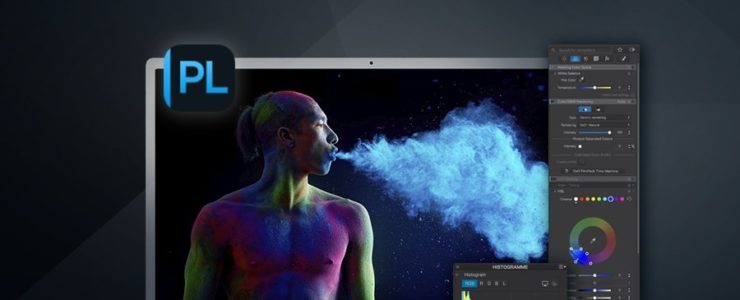
DxO released a new version of their award winning photo editing software, i.e. PhotoLab 7 (click here for more information). PhotoLab 7 does not require a subscription and can be installed on up to three computers.

Press release:

DxO PhotoLab 7 introduces unique color calibration and editing tools, revamped local adjustments, and a powerful B&W workflow.

Paris (France): DxO Labs, creator of pioneering photo-editing software for over 20 years, is proud to present PhotoLab 7, its complete RAW image-processing and correction software.

“Our goal has always been to give photographers the ultimate in image quality, and PhotoLab 7 takes this another step further. Combined with our ultra-wide gamut and soft proofing functionality, the introduction of the color calibration tool and support for LUTs creates a whole new level of control.” (Fabrizio Dei Tos Navalesi DxO Product Director)

New for PhotoLab 7

Commitment To Color

PhotoLab 7 enables photographers to apply true-to-life, scientifically accurate color profiles to their images. PhotoLab 7 unique tool, working in concert with one of six industry-standard color checker charts from Calibrite and Datacolor.

Cinematic-Style Grading

We are excited to introduce Look Up Tables (LUTs) into PhotoLab 7: now available with 17 DxO starter presets. LUTs builds on our previous advances made in color management where we re-engineered our color processing algorithms, introduced DxO Wide Gamut our extended working color space and improved Soft Proofing mode. Using LUTs will enable our exacting photographers to speed up their workflow and apply their favorite style adjustments to their images.

HSL Editing Can Now Be Adjusted Locally

PhotoLab first began to set the standard in color control through its innovative HSL Color Wheel. The spectrum of color control tools now available in version 7 is the result of years of concerted effort to deliver lifelike and expressive colors demanded by serious photographers. Photographers can now enjoy the powerful easy-to-use HSL ColorWheel as part of their local adjustments, enabling them to adjust the color of a subject’s clothing, or subtly warming the highlights of a landscape scene, all with the highest quality and total creative freedom.

A Natural Black-and-White Workflow

PhotoLab 7 has new tools that help photographers create their definitive monochrome workflow. The interface introduces a new tab to switch between color and monochrome and a range of new film renderings – plus PhotoLab 7 includes introduces a six-channel mixer for complete tonal control across black-and-white photography.

Local Adjustments Revamped

The ability to make precise local adjustments is a vital part of creative photo editing. PhotoLab 7 makes this easy by organizing local adjustment tools into a new dedicated palette in the workspace. This evolution keeps the interface cleaner and makes photos more visible while they’re being worked on, allowing even greater precision from our popular U PointTM tool.

Price and Availability

New customers can download Windows and macOS versions exclusively from the DxO website (https:// shop.dxo.com/en) at the prices listed below, a 30-day free trial is also available.

● DxO PhotoLab 7: $ 229
Owners of PhotoLab 5 or 6 can take advantage of a special upgrade price:

● DxO PhotoLab 7 upgrade price: $109
To upgrade, customers should log into their customer account at https://shop.dxo.com/login_upgrade.php/

Excire Foto 2024 Released, More AI Tools (and discounted for limited time)

Excire 2024

A truly impressive software for photo management that I am actively using has been released in a new version with many improvements, Excire 2024 – click here to check it out (trail version available). Excire Foto 2024 is available for both Windows and macOS. The software’s MSRP is $189, but a limited-time launch discount reduces the price to $149. Additionally, existing Excire Foto 2022 users can upgrade to Excire Foto 2024 for $59.

There are many improvements in Excire 2024. Highlights include five separate AI engines and two groundbreaking new features:

  1. Prompt-search AI, so that photographers can instantly retrieve any image in their photo library simply by typing in a text description (e.g., “Grand Canyon sunset” or “person by the Eiffel Tower with a yellow umbrella”).
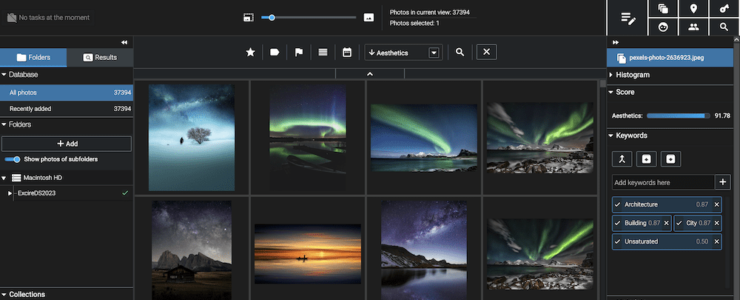
  1. X-tetics AI, which intelligently scores images based on their aesthetic qualities and has been trained on data from hundreds of thousands of photos and input from expert photographers.

To learn more about Excire Foto 2024’s groundbreaking new features, please visit www.excire.com/en.

Press release:

Step Into the Future: Excire Foto 2024 Is Redefining Image Management

PRC’s Revolutionary Photo-Organizing Software Offers Prompt Search, AI Image Evaluation, and More

Lübeck, Germany – September 27, 2023 – PRC, the AI company behind the award-winning Excire software, has today launched the latest iteration of its innovative photo-management program: Excire Foto 202

Powered by five state-of-the-art AI models, including a prompt-search AI that allows users to instantly retrieve images by inputting text descriptions and an X-tetics AI that intelligently rates each image based on its aesthetic qualities, Excire Foto 2024 propels photographers into a new era of image organization – one where keywording, image evaluation, culling, and retrieval are almost entirely automated, enabling photographers to spend less time behind the computer and more time on their craft.

“Our vision was to combine cutting-edge AI with intuitive design to provide an unparalleled photo-management experience,” said Erhardt Barth, CEO of PRC and a machine learning expert at the University of Lübeck. “Photos cataloged with Excire Foto 2024 aren’t just stored. They’re always at your fingertips, ready to be revisited any time you wish.”
An Image Workflow Like Never Before
Fast, effective, and essential for any photographer seeking a time-saving approach to image organization, Excire Foto 2024 boasts an array of features designed to shortcut traditional file-management bottlenecks and eliminate tedious workflow tasks for both hobbyists and professionals. With Excire, photographers can:

Instantly retrieve any image with X-prompt AI, a revolutionary new tool that puts entire photo catalogs at users’ fingertips. Thanks to X-prompt AI, photographers can find files in their Excire databases by inputting a text description, such as “fast red motorcycle on a country road at sunset.” Using the prompt tool is highly intuitive – just type a sentence into the provided search field and instantly view the results. Excire’s powerful AI engine is capable of understanding complex sentences, context, and even abstract concepts such as “happiness” and “sorrow.” Gone are the days of searching endlessly for lost files; instead, if the user can describe it, they can find it.

Evaluate photos with X-tetics AI, a newly designed feature designed to accurately judge image aesthetics. Trained using hundreds of thousands of photos as well as extensive input from expert photographers, the X-tetics AI feature independently evaluates each image uploaded to a user’s catalog, then outputs a unique Aesthetics Score for each file. Aesthetics ratings can then be used to swiftly identify the most shareable – and most deletable – images from photoshoots, as well as to uncover hidden gems from deep within an image database.

Automatically categorize files with X-tags AI, the innovative tool that analyzes each photo upon import and applies relevant keywords to aid in search and categorization. Thanks to X-tags AI’s unique capabilities, users can skip the tedium of manual keywording and can instead let Excire do the heavy lifting, making it easier than ever to categorize and retrieve images based on their content. While X-tags AI has appeared in previous versions of Excire software, the latest version boasts a revamped engine with enhanced content-detection capabilities for outstanding accuracy.

Manage photos with X-face AI and X-alike AI, two more powerful features for finding, organizing, and culling images. X-face AI’s advanced facial-recognition technology allows photographers to categorize and retrieve files containing specific individuals as well as certain facial characteristics, such as age, sex, and the presence of a smile. And X-alike AI’s image analysis enables users to search for similar files – based on an initial image prompt – or even identify near-duplicate images for deletion. Like X-tags AI, these features first appeared in previous iterations of Excire Foto, but the latest version boasts upgraded AI technology for improved results.


Click here to open the rest of the article

Canon Patent: Electric Tilt-shift Lens Operation

canon patent

This is a rather interesting Canon patent application, and it might well go into production one day.

Canon patent application 2023135457 (japan, published 9/28/2023) discusses technology and methods to implement an electronic, motor-driven tilt-shift lens operation. The following excerpt from the patent literature should make this more clear:

An object of the present invention is to provide a control device that can reduce the effort and time of operation and improve the convenience of tilt photography and shift photography.

Background Art

Patent Document 1 describes tilt photography in which the in-focus range is adjusted by moving two optical element groups in a direction perpendicular to the optical axis, and tilt photography in which the shooting angle of view is changed and distortion is corrected. An optical system is disclosed that can perform shift photography.

In recent years, the number of situations in which tilt photography and shift photography are used has been increasing, and there is an urgent need to reduce the effort and time required for operations in such photography. However, in the optical system of Patent Document 1, there is no mention of reduction in operational effort and time.

An object of the present invention is to provide a control device that can reduce the effort and time of operation and improve the convenience of tilt photography and shift photography.

Means for Solving the Problems

A control device according to one aspect of the present invention includes an imaging device including an imaging device, and a tilt effect that tilts a focus plane with respect to an imaging surface of the imaging device and moves a shooting range. A control device used in a camera system having a lens device including at least one optical member for changing at least one of a shift effect and a shift effect, in which a first operation instruction based on an operation on an operation unit is acquired, A first control unit that moves at least one optical member in response to an operation, and moves the at least one optical member to a preset position when a second operation instruction different from the first operation instruction is obtained. and a second control section.

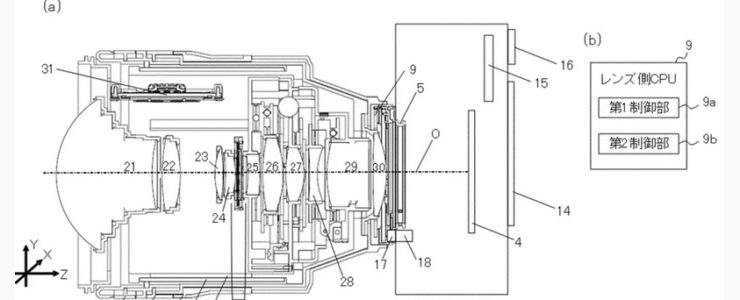
In this embodiment, by moving the sixth group lens 26 and the eighth group lens 28 in a direction perpendicular to the optical axis O, the tilt effect and shift effect can be changed. Specifically, by moving the sixth group lens 26 and the eighth group lens 28 in opposite directions, the tilt effect can be changed, and by moving them in the same direction, the shift effect can be changed. The lens-side CPU 9 controls the movement of the sixth group lens 26 via a drive section using a signal from a detection section (not shown) that detects the amount of movement of the sixth group lens 26. Further, the lens-side CPU 9 controls the movement of the 8th group lens 28 via the drive section using a signal from a detection section (not shown) that detects the amount of movement of the 8th group lens 28. The drive unit that moves the sixth group lens 26 and the eighth group lens 28 is, for example, a stepping motor or a voice coil motor (VCM). Note that it is also possible to change the tilt effect by tilting (rotating) the lens.

FIG. 3 [on top, editor’s note] is an explanatory diagram of the operation unit 500 for changing the tilt effect and shift effect. The operation unit 500 includes a direction key 501, a slide switch (selection unit) 502, and a decision/cancel button 503. The operation unit 500 is provided on the lens barrel 2 so that it can be operated by a photographer. Note that although the operating unit 500 is provided on the lens barrel 2 in this embodiment, it may also be provided on the camera 3. Further, a part of the operation unit 500 (for example, the direction key 501) may be provided on the lens barrel 2, and another part (for example, the enter/cancel button 503) may be provided on the camera 3. Further, instead of the direction key 501, an operating member such as a joystick, a lever, or an operating ring may be used. Furthermore, instead of providing the operation section 500, a screen for executing the same functions as the operation section 500 may be displayed on the display section 14, for example. Furthermore, the functions of the operation section 500 may be assigned to an existing operation member provided in the camera system 1.

More Canon patents are listed here.

[via asobinet]

Canon Patent: 200-1000mm F5.6-11 IS And 200-800mm F5.6-8 IS Lenses

canon patent

Here is a new Canon patent application: two super telephoto zooms for the RF mount.

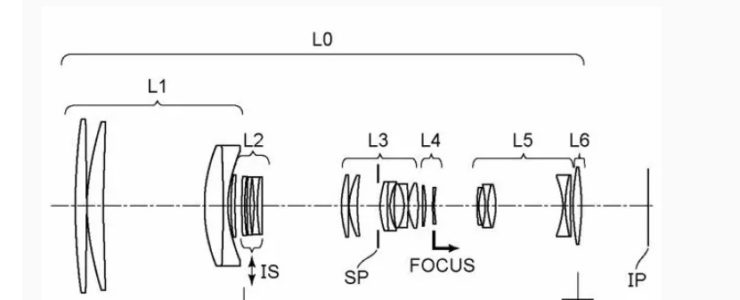
Canon patent application 2023135180 (Japan, published 9/28/2023) discusses optical formulas for two super telephoto zoom lenses for the RF mount:

  • 200-1000mm F5.6-11 IS
  • 200-800mm F5.6-8 IS

From the patent literature:

To obtain a zoom lens whose entire system is compact and whose optical performance is suppressed from deteriorating due to focusing.

BACKGROUND ART

As an imaging optical system, a telephoto zoom lens having a long focal length at the telephoto end is known. (Patent Document 1) Such a zoom lens is required to be small, yet easy to perform high-speed focusing, and to suppress deterioration of optical performance due to focusing.

However, the zoom lens disclosed in Patent Document 1 has a large number of lenses in the fourth lens group, which is a focus group, and also has relatively strong refractive power. Therefore, it is difficult to simultaneously increase the speed of focusing and suppress deterioration in optical performance due to focusing.

SUMMARY OF THE INVENTION

Therefore, an object of the present invention is to provide a zoom lens whose entire system is small in size and whose optical performance is suppressed from deteriorating due to focusing, and an imaging device having the zoom lens.

Example 1

  • Focal length: 206.00-778.20
  • F value: 5.71-9.18
  • Half angle of view: 6.00-1.59
  • Image height: 21.64
  • Total length: 330.11-420.11
  • Back focus: 40.03-96.02

Example 2

  • Focal length: 200.00-998.33
  • F value: 5.71-11.00
  • Half angle of view: 6.17-1.24
  • Image height: 21.64
  • Total length: 346.80-456.78
  • Back focus: 43.85-105.49

Example 3

  • Focal length: 206.00-775.95
  • F value: 5.83-8.00
  • Half angle of view: 6.00-1.60
  • Image height: 21.64
  • Total length: 330.08-420.12
  • Back focus: 38.46-38.46

More Canon patents are listed here.

[via asobinet]

Canon Set To Release Two RF 35mm f/1.2L Lenses?

canon rumors canon news eos r7 mark ii canon eos rv

A new Canon rumor surfaced from the interweb of wet photography desires. Two 35mm f/1.2L lenses? Why not! One of them might be a “DS” version, like Canon did with the RF 85mm f/1.2L.

Without further ado, here is the rumor:

  • If the Canon RF 35mm F1.2L USM is released, it will likely become the best-selling L single focus lens. This lens has been rumored and anticipated since the RF mount’s inception five years ago.
  • A sales representative who sells Canon lenses to certain retailers in certain countries mentions the RF35mm F1.2 L USM and says that two models of this lens will be announced by the end of 2023. .
  • There are two models of the RF85mm F1.2L USM. You can get the “DS” version for a few hundred dollars more than the regular model. This function provides the effect of “improving” the blur.
  • Rumors about the release of such a lens have been going on for a long time, but this is the first direct information I’ve heard from someone I work with in the industry.

[via asobinet]

Canon EOS-1D X Mark III Firmware Update Released (version 1.8.0)

Canon EOS-1D X Mark III manual

Canon released a firmware update for the venerable Canon EOS-1D X Mark III.

Canon EOS-1D X Mark III firmware update 1.8.0 delivers:

  1. Adds the ability to register the focus position in the preset functions of the CR-A100 Camera Remote Application.
    When used with the Robotic Camera System CR-S700R, it helps the user to focus on the intended subject distance when shooting.
  2. Adds the ability to erase voice memos added to images and to add voice memos to protected images.
  3. Adds enhanced security when transferring images via FTPS transfer.
  4. Fixes minor issues.

Canon EOS-1D X Mark III firmware 1.8.0 download at Canon Europe.