Canon announced the Canon RF 10-20mm f/4L IS STM lens for the EOS R system. The Canon RF10-20mm F4 L IS STM lens is expected to be available in November for an estimated retail price of $2,299.
Going Wide: Canon Introduces The RF10-20mm F4 L IS STM to Its Lens Lineup
MELVILLE, NY, October 11, 2023 – Today, Canon U.S.A., Inc., a leader in digital imaging solutions, announced the launch of the RF10-20mm F4 L IS STM lens, a full-frame ultra wide-angle lens that can help the work of a professional photographer or serious enthusiast stand out from the crowd.
Opening the door to supreme full-frame visual possibilities, the RF10-20mm F4 L IS STM lens continues Canon’s respected reputation for optical excellence associated with L-series lenses. This new addition enhances optical performance with a modern mirrorless lens design that is fully equipped with key features, including:
New Image Stabilization (IS) technology, to help minimize wide-angle “fluttering” at outer areas of frame
Impressively compact size and light weight (1.25lbs/570g) at half the weight of EF series 11-24mm f/4 L lens
Super quiet Canon STM focus drive motor, which is ideal for video and marking the first time this technology appears in a Canon L-series lens
Speaking directly to the professional video and stills visual storyteller, the RF10-20mm F4 L IS STM features a built-in lens hood and lens function button on the barrel for customizing functions such as AF settings, Pre-Recording, Zebras and more. For landscapes, cityscapes, architectural, real estate and weddings, the RF10-20mm F4 L IS STM lens is a widely important lens for any professional to have at the ready.
A new Canon patent for a wide-angle single focus lens for a camera with an 1 inch imaging sensor. A new PowerShot camera?
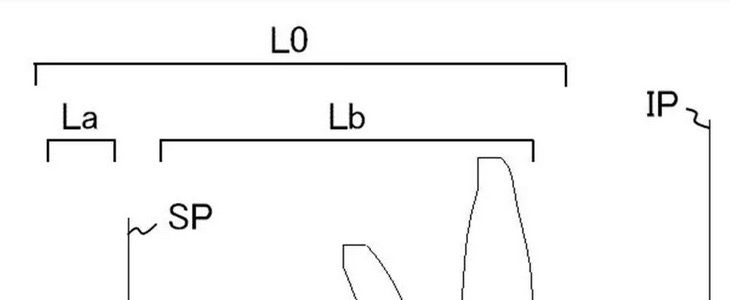
Canon patent application 2023-140823 (Japan, published 10/5/2023) discusses optical formulas for a 28mm-35mm equivalent wide angle lens for a camera with an 1 inch imaging sensor.
From the patent literature:
Optical system and imaging device having the same
The present invention provides an optical system that is compact and has high optical performance, and an imaging device that includes the same.
BACKGROUND OF THE INVENTION
In recent years, with the miniaturization and increase in the number of pixels of image pickup devices, optical systems used in image pickup devices are required to be small and have high optical performance.
Problems to be Solved by the Invention
The optical system described in Patent Document 1 uses a telephoto type power arrangement to reduce the overall length, and uses a plurality of aspheric lenses to reduce distortion and image plane. Curvature is being corrected. However, in the optical system described in Patent Document 1, the Petzval sum of the entire system is large and the incident angle of the off-axis light beam is also large, so when trying to apply it to an imaging device with a large imaging element, it is difficult to correct field curvature or reduce the amount of peripheral light. Decrease is an issue.
Production-grade AI models for professional use cases
Topaz Video AI focuses solely on completing a few video enhancement tasks really well: deinterlacing, upscaling, and motion interpolation. We’ve taken five years to craft AI models robust enough for natural results on real-world footage. Topaz Video AI will also take full advantage of your modern workstation, as we partner directly with hardware manufacturers to optimize processing times. (Many of them already use Topaz Video AI to benchmark AI inference.) Own the software and use it for as many projects as you like, right in your existing workflow.
Here is another Canon patent for electric tilt-shift lens operation. The other one was published last week.
Canon patent application 2023-140195A (Japan, published 10/4/2023) discusses technology and methods for a tilt-shift lens with electronic controls.
From the patent literature:
An object of the present invention is to provide a control device that can establish a desired focus plane for a desired subject or object plane using a desired tilt effect in hand-held photography.
BACKGROUND ART
Conventionally, an optical system has been proposed that has a tilt effect that tilts a focusing surface so that an object surface tilted with respect to the optical axis of an imaging optical system is brought into good focus over the entire surface. . Patent Document 1 discloses a surveillance camera system that includes a lens unit and a camera device that have a tilt effect, determines the amount of tilt for each specific area set as a shooting range, and focuses on a subject using a desired focus plane.
However , in the camera system disclosed in Patent Document 1, when the position of the camera device changes, it is necessary to set the tilt amount for each specific area. Therefore, when hand-held photography is performed using the camera system of Patent Document 1, there is a possibility that the desired tilt effect may not be obtained.
SUMMARY OF THE INVENTION
An object of the present invention is to provide a control device that can establish a desired focus plane for a desired subject or object plane using a desired tilt effect during hand-held photography .
Means for Solving the Problems
A control device as one aspect of the present invention includes an imaging device including an imaging device, and at least one optical member for tilting a focusing surface with respect to an imaging surface of the imaging device. A control device used in a camera system having a lens device having an optical system including an acquisition unit that acquires information about a designated subject, and a subject for constructing a focus plane based on information about the designated subject. and a control unit that acquires information regarding the position of the.
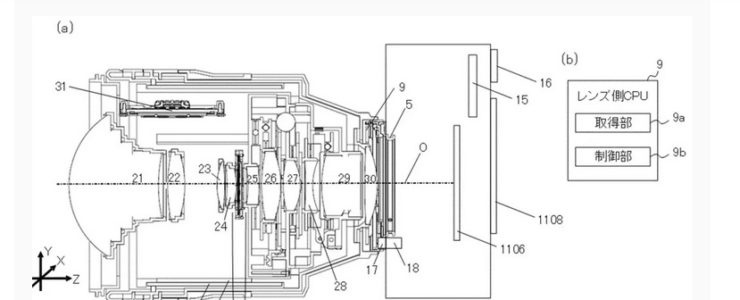
The lens barrel 2 has an optical system, a zoom operation ring 6, a guide barrel 7, a cam barrel 8, a lens-side CPU 9, and an aperture mechanism 11 . The optical system includes a first group lens 21, a second group lens 22, a third group lens 23, a fourth group lens 24, a fifth group lens 25, a sixth group lens 26, a seventh group lens 27, an eighth group lens 28, a ninth group lens 29, and A 10-group lens 30 is provided. In this embodiment, by moving at least one lens (optical member) included in the optical system, at least a tilt effect that tilts the focus plane with respect to the imaging surface of the image sensor 1106 and a shift effect that moves the imaging range are achieved. You can get one. Each lens is held by a lens barrel with a cam follower. The cam follower engages with a straight groove parallel to the optical axis O provided on the guide tube 7 and a cam groove inclined with respect to the optical axis O provided on the cam tube 8. When the zoom operation ring 6 rotates, the cam cylinder 8 rotates, and the positional relationship of each lens in the Z-axis direction changes. As a result, the focal length of the lens barrel 2 changes. The focal length of the lens barrel 2 can be detected by a zoom position detection section (not shown) that detects the amount of rotation of the zoom operation ring 6. The lens-side CPU 009 changes the aperture diameter of the optical system by controlling the aperture mechanism 11. In this embodiment, by moving the sixth group lens 26 and the eighth group lens 28 in a direction perpendicular to the optical axis O, a tilt effect or a shift effect can be obtained. Specifically, by moving the sixth group lens 26 and the eighth group lens 28 in opposite directions, a tilt effect can be obtained, and by moving them in the same direction, a shift effect can be obtained. The lens-side CPU 9 controls the sixth lens group 26 via a drive section using a signal from a detection section (not shown) that detects the amount of movement of the sixth lens group 26 . Further, the lens side CPU 9 controls the 8th group lens 28 via a drive section using a signal from a detection section (not shown) that detects the amount of movement of the 8th group lens 28. The drive unit that moves the sixth group lens 26 and the eighth group lens 28 is, for example, a stepping motor or a voice coil motor (VCM). Note that it is also possible to obtain a tilt effect by tilting (rotating) the lens.
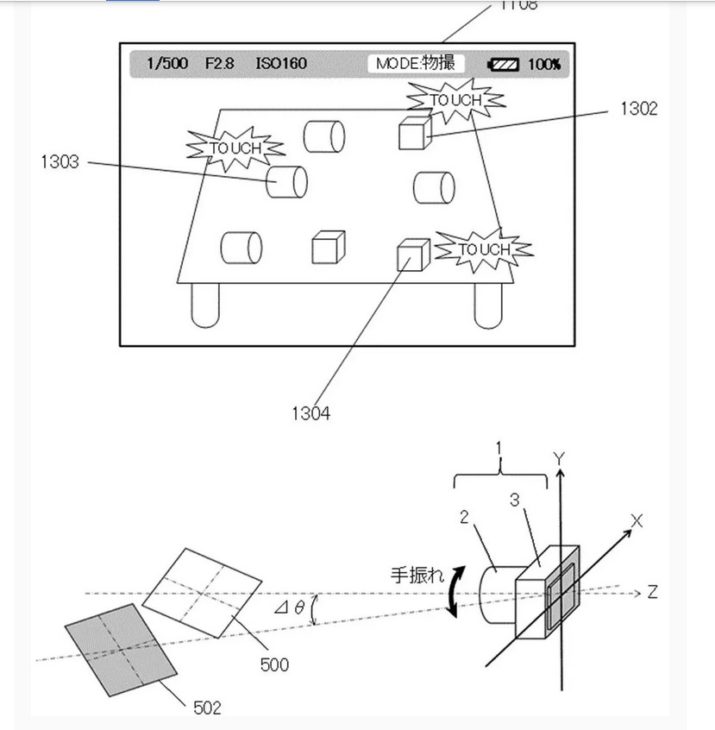
In the camera system 1 of this embodiment, if three points to be focused are specified, the subject plane 500 is constructed as described above, and photography can be performed with the desired subject in focus . However, for example, in so-called “reverse tilt photography (miniature photography)” in which cityscapes and people are photographed by blurring the top and bottom of the photograph, the photographer may decide where to focus and what to blur. In that case, the vector OB is defined by the spatial coordinate points O and B designated by the photographer. The photographer instructs the surface 501 to rotate by an angle θctrl using the vector OB as the rotation axis. For example, the photographer can instruct the surface 501 to rotate by an angle θctrl by performing a touch operation of sliding a finger back and forth on the display unit 1108. Further, instructions may be given using line-of-sight input using the EVF, rotating operation of the aperture operation ring 20, and buttons or dials (not shown). Alternatively, it may be determined automatically according to the set shooting mode of the camera 3. The photographer aligns the object surface 500 with the surface 501 that provides the desired degree of blur while maintaining the desired object (spatial coordinate points O, B) in focus.
Again, a Canon EOS R5 Mark II rumor. Again, the alleged release date has changed.
Latest rumor has it that Canon might announce the Canon EOS R5 Mark II in February 2024. Says the source of the rumor:
Specific dealers have been told that February will bring a major camera announcement in February [sic], which is the same month as the CP+ show in Japan.
Dealer NDA’s have not been signed for the announcement, as it is still too early, but Canon is gearing up for a major high-end push in 2024 and they are getting dealers prepared.
This is also the time of year when dealers have finalised their holiday buys, especially ahead of Black Friday in November and Christmas season in December. So there are no more camera announcements coming in 2023.
So, there will be camera announcements in February, as every year before CP+, no NDAs have been signed, and Canon is gearing up for “a major high-end push in 2024”. Not sure where the rumor is. Sound more like wishful thinking to me.
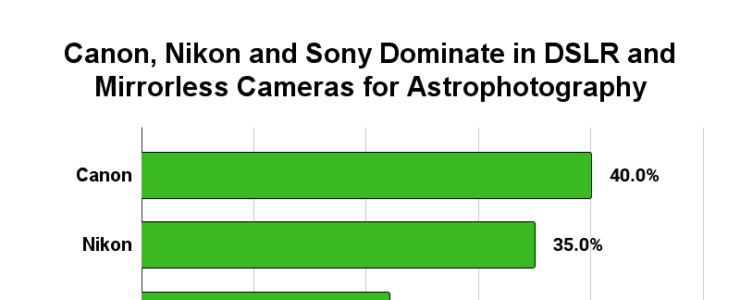
Yes they do: Canon is the most used camera gear in astrophotography (see image on top). That’s what came out from a recent research.
The folks at Skies & Scopes analyzed 828 images listed for the Astronomy Photographer of the Year competition in the past six years to learn what equipment was used:
This website or its third-party tools use cookies, which are necessary to its functioning and required to achieve the purposes illustrated in the cookie policy. If you want to know more or withdraw your consent to all or some of the cookies, please refer to the cookie policy. By closing this banner you agree to the use of cookies.