Canon might release a Canon RF 24-105mm f/2.8L IS for the EOS R system, according to a new rumor.
A low rated rumor (by the source itself) suggests Canon might soon release an RF 24-105mm f/2.8L IS lens. Says the source:
[…] we have an anonymous report that Canon plans to announce a Canon RF 24-105mm f/2.8L IS in the first half of 2023. On the surface, that is a lot of overlap of focal ranges. There is the RF 24-70 f/2.8L IS, RF 24-105 f/4-7.1 IS STM and the RF 24-105mm f/4L IS. Adding a 4th lens to this range just doesn’t feel likely. It does remind us of the EF 24-70 f/4L IS Macro, a lens a lot of people thought didn’t make sense with the overlap, but actually turned out to be a pretty popular lens.
Production-grade AI models for professional use cases
Topaz Video AI focuses solely on completing a few video enhancement tasks really well: deinterlacing, upscaling, and motion interpolation. We’ve taken five years to craft AI models robust enough for natural results on real-world footage.
Topaz Video AI will also take full advantage of your modern workstation, as we partner directly with hardware manufacturers to optimize processing times. (Many of them already use Topaz Video AI to benchmark AI inference.) Own the software and use it for as many projects as you like, right in your existing workflow.
This firmware includes the following enhancements and fixes:
You can now trim and resize images while transferring them to the FTP server.
After updating to firmware version 1.8.0, the phenomenon that Err70 occurred under certain conditions has been fixed.
Fixed minor bugs.
*1. and 3. are changes in Version 1.8.0, and 2. are additions in Version 1.8.1.
Concerning the previous firmware:
In firmware version 1.8.0, which had been stopped downloading, it was confirmed that Err70 etc. was displayed under certain conditions. Customers who have already updated to Version 1.8.0 are kindly requested to update to Version 1.8.1. We sincerely apologize for the inconvenience caused.
Canon posted the companies corporate strategy for the years to come.
As for the imaging sector (excerpt):
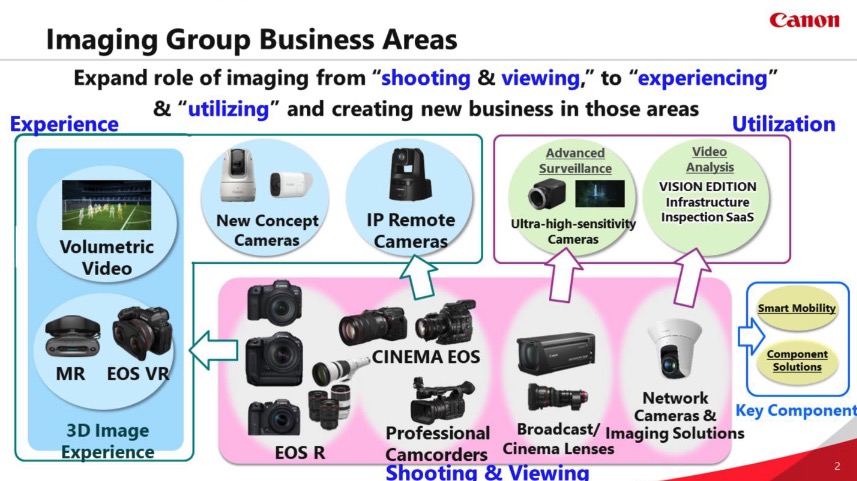
The main products currently supporting the Imaging Group are the EOS R System, the Cinema EOS System, professional camcorders, broadcast lenses, network cameras, etc.
For the purpose of shooting and viewing images, we have grown this business. From now own, however, through the development of new technologies and responding to market changes, we are promoting expansion into new business areas, namely image experience, image utilization and utilizing components as show on this charge.
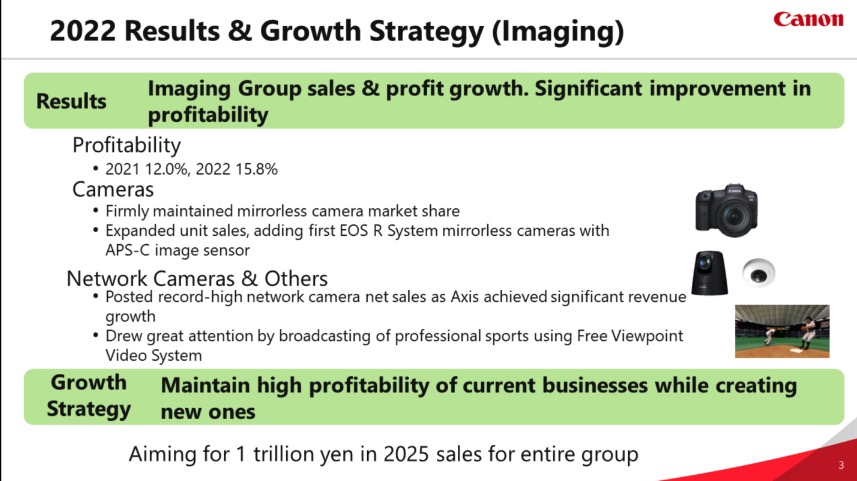
Our results of last year and our future growth strategy.
Last year, the Imaging Group achieved sales and profit growth and a significant improvement in profitability. As for cameras, our mirrorless camera market share remained stable thanks to our strong market reputation. We also posted strong sales of new products. Through this, our camera business is supporting earnings as a mainstay of Imaging.
As for network cameras, we posted record-high sales thanks to significant growth in AXIS revenue. Additionally, Free Viewpoint Video, which is a new initiative, is expanding its field of activities such as commercials and dramas. It was also well received by professional sports broadcasts in Japan and overseas. Our future growth strategy is to create new businesses while maintaining high profitability in existing ones. With EOS R and other existing products, we will create new markets and businesses by offering attractive products that anticipate market demands, strengthen our profit structure, activate group synergies, and deliver unprecedented value through products and solutions.
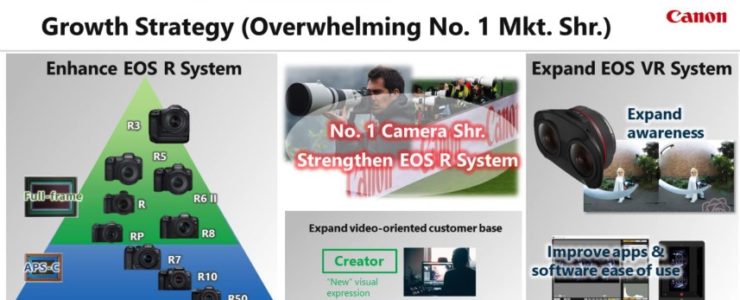
[…] This year, we expect the global market for interchangeable lens cameras to be around 5.5 to 6 million units and more than 70% of this to be mirrorless cameras. This year as well, we expect to maintain our No. 1 share of the interchangeable-lens camera market and at the same time aim to No. 1 in mirrorless cameras as sub-segment as well. In addition to market share, we will also work to expand sales volume of the EOS R System itself through three measures. The first is “enhancing the EOS R System.” To this end, we will expand our lineup of cameras and lenses to meet the diverse needs of our customers. Moreover, in recent years, the demographic of video-oriented users, such as video creators, media users, and SNS users, is thick and growing. We aim to expand the scale of the R system by including functions and performance that respond to user requests not only for still images but also for videos
This website or its third-party tools use cookies, which are necessary to its functioning and required to achieve the purposes illustrated in the cookie policy. If you want to know more or withdraw your consent to all or some of the cookies, please refer to the cookie policy. By closing this banner you agree to the use of cookies.