Canon patent for illuminated rear buttons on camera body
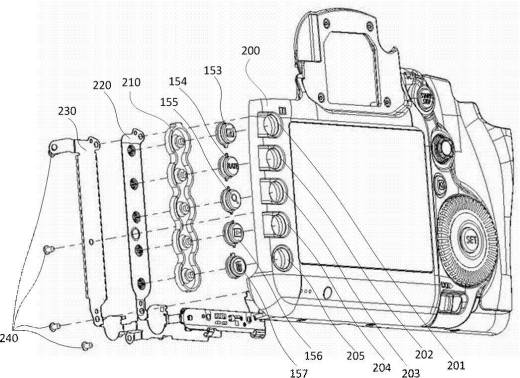
illuminated rear buttons
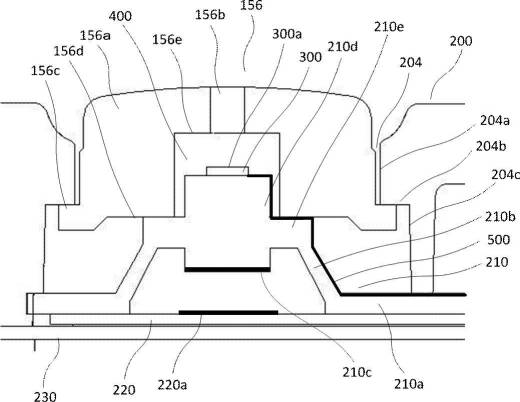
A drawing from the patent application

Interesting patent that already started speculations.

Patent JP2017-147019A (which can be seen here in its entirety) refers to illuminated buttons on the rear of a Canon camera body (a DSLR, typically).

This is something Nikon already has: illuminated rear buttons. This lead someone to the speculation that the EOS 7D Mark III may have these buttons. While possible, there are no hints it will. So far we have to deal with wishful thinking and not with a rumor.

The patent’s abstract:

To provide a light emission button mechanism that enables a letter or character on the surface of a button to emit light uniformly with a simple configuration without providing any dedicated separate member for light guiding and light shielding, and can prevent light leakage to the inside and outside of the device.
SOLUTION: A light emission button mechanism includes an operation portion having a light guide portion that transmits light, an exterior cover having a hole through which the operation portion is inserted, a switch unit having a movable unit which is elastically deformed by pressing the operation unit, and a contact unit which is to operate by further pressing the operation unit, light emitting mans which is arranged in a substantially sealed space formed by the operation unit and the switch unit and causes the light guide portion to emit light, and a conductive pattern connected to the light emitting means and formed in the switch unit, and at least the conductive pattern formed in the movable portion out of the conductive patterns is not linear.
Source

Nikon working on full-frame mirrorless camera, patents suggest (and where is Canon’s?)

mirrorless
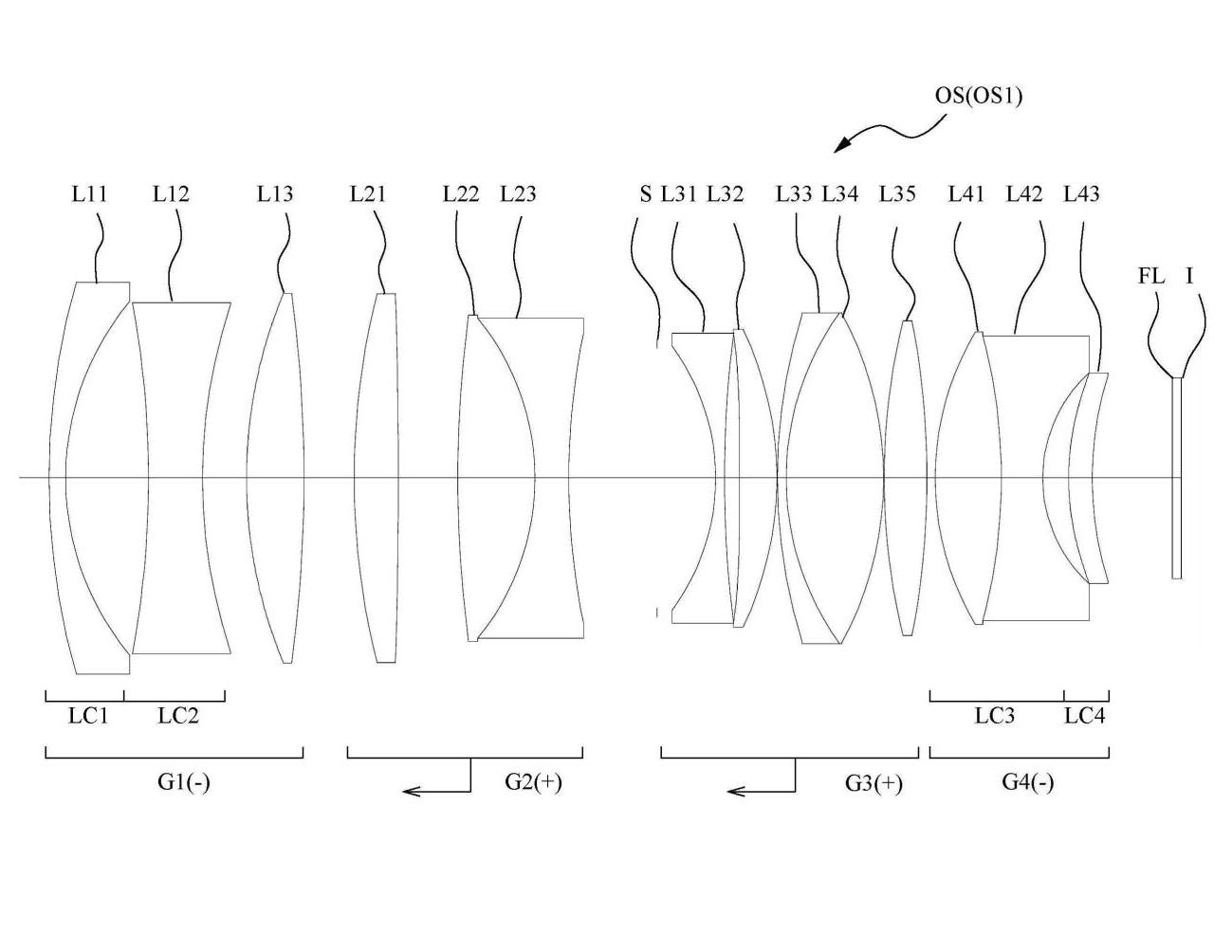
Patent for 50mm f/0.9 lens

While the Canon community is eagerly waiting to know more (or at least something really reliable) about the long rumored (and much wished) Canon full-frame mirrorless camera (all rumors), we learn that Nikon is also working on such a camera.

Two Nikon patents for 50mm f/0.9 and 35mm f/1.2 lenses specifically designed to be featured on a full-frame mirrorless camera have been spotted. It is a hint that Nikon has such a camera on a blueprint at least.

We found similar patents filed by Canon in the past (1 | 2), and even a patent for an EF/EF-S adapter for a full-frame mirrorless camera. I just wish we would know something more. The latest rumor regarding Canon’s full-frame mirrorless camera is here, I sum it up:

  • Different sources and sites were reporting that early prototypes exist, at least to be tested inside Canon’s labs. This intel came in 2016 and early 2017.
  • Canon is possibly working on a full-frame mirrorless camera with EF mount. There have been rumors saying that Canon is delaying this camera because of issues in implementing the EF mount. There is a lot of talk about this. If Canon manages to engineer a full-frame mirrorless camera with EF mount, thus allowing us to use our beloved EF lenses on a smaller and hopefully performing body, it will be a winner. Imagine what you could do with a MILC that goes along with your EF lenses. There is serious a chance we may see this.
  • The latest bit of info I got suggests Canon will announce a full-frame mirrorless camera with a sensor having a resolution of 36-38MP.
  • A possible announcement date is around Photokina 2018, which happens in September.
  • And for all those 4K fans out there: we have been told that, yes!, most likely it will feature 4K video.

Do you think we will see a Canon full-frame mirrorless camera in 2018?

  • Yes (56%, 195 Votes)
  • No (44%, 156 Votes)

Total Voters: 351

Loading ... Loading ...

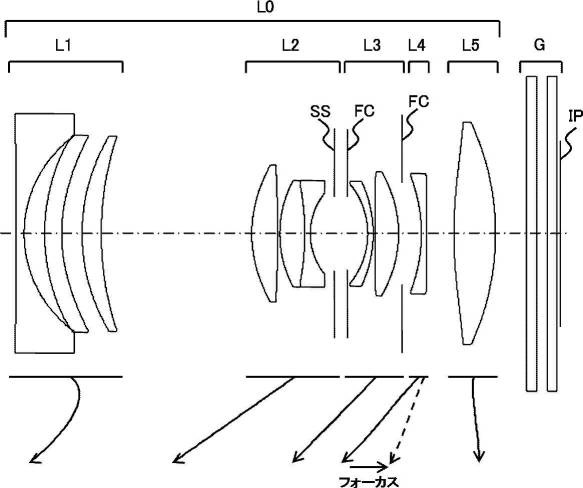
Does this Canon patent for a 15-43mm f/2-4 lens for APS-C sensors refer to the Powershot G1 X Mark III?


Very interesting patent for 15-43mm f/2-4 lens for APS-C sensors that may point to the upcoming Canon Powershot G1 X Mark III camera, rumored to have an APS-C sensor.

  • Zoom ratio: 2.74
  • Focal length: 15.65 29.18 42.90
  • F No.: 2.06 2.99 4.00
  • Half angle: 41.12 25.09 17.66
  • Image height: 13.66 13.66 13.66
  • Back focus: 8.52 8.01 7.20

Patent literature is hard to grasp. Any help is welcome.

In a zoom lens from which an interval of a lens group which comprises the 1st lens group of negative refracting power, the 2nd lens group of positive refracting power, the 3rd lens group of positive refracting power, the 4th lens group of negative refracting power, and the 5th lens group of positive refracting power, and is adjacent to on the occasion of zooming arranged in order from the object side to the image side changes, between said 2nd lens group and the 3rd lens group, have an aperture diaphragm and said 4th lens group moves on the occasion of focusing — said 4th lens group — most — a curvature radius of a lens surface on the object side — a time of setting a curvature radius of a lens surface on the image side to R4b most of R4a and said 4th lens group, 0.2<(R4b+R4a)/(R4b-R4a)<3.0 A zoom lens satisfying a becoming conditional expression.


[via Hi Lows Note]

Canon patent to reduce flare in Diffractive Optics

Canon patent
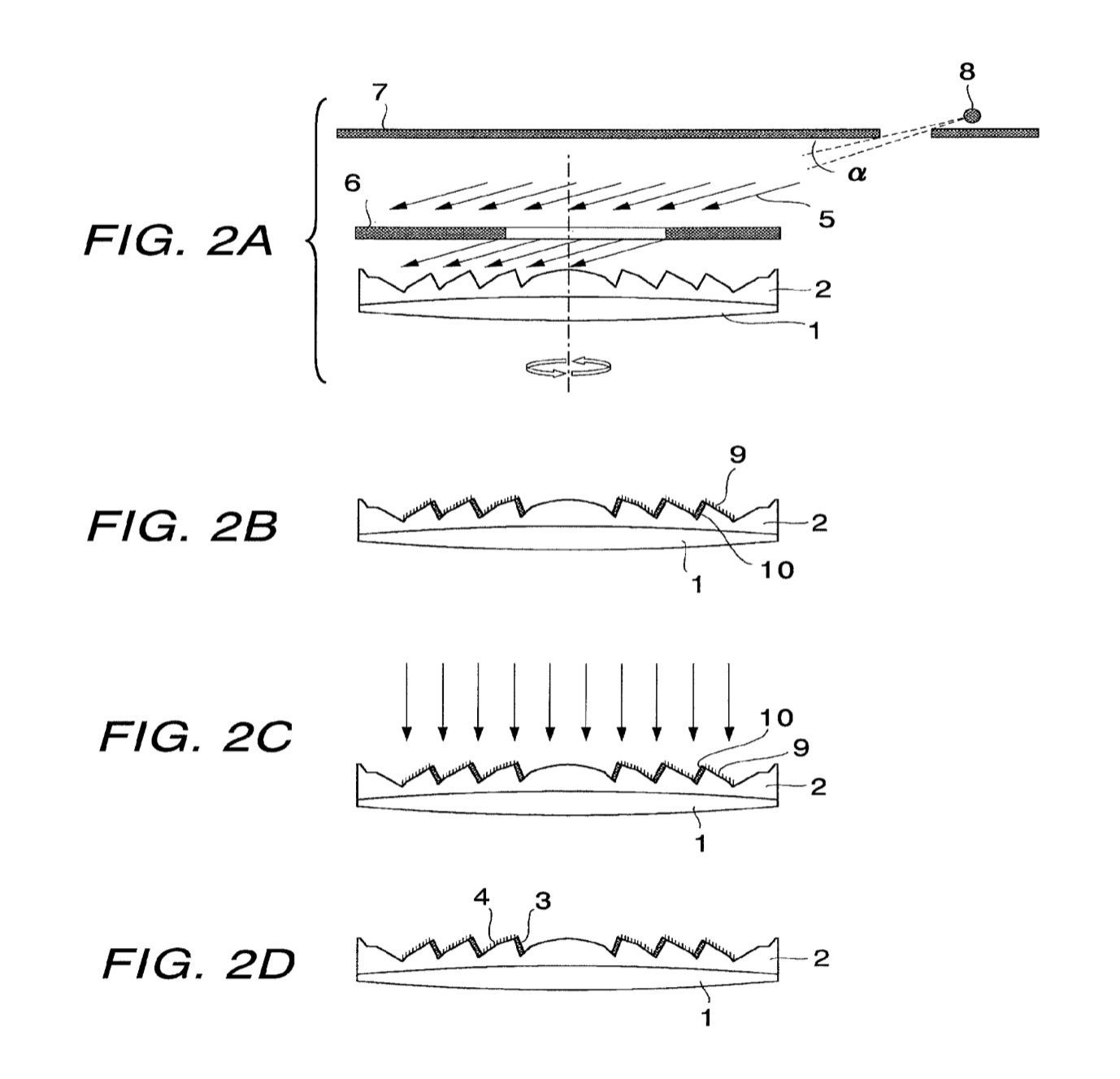
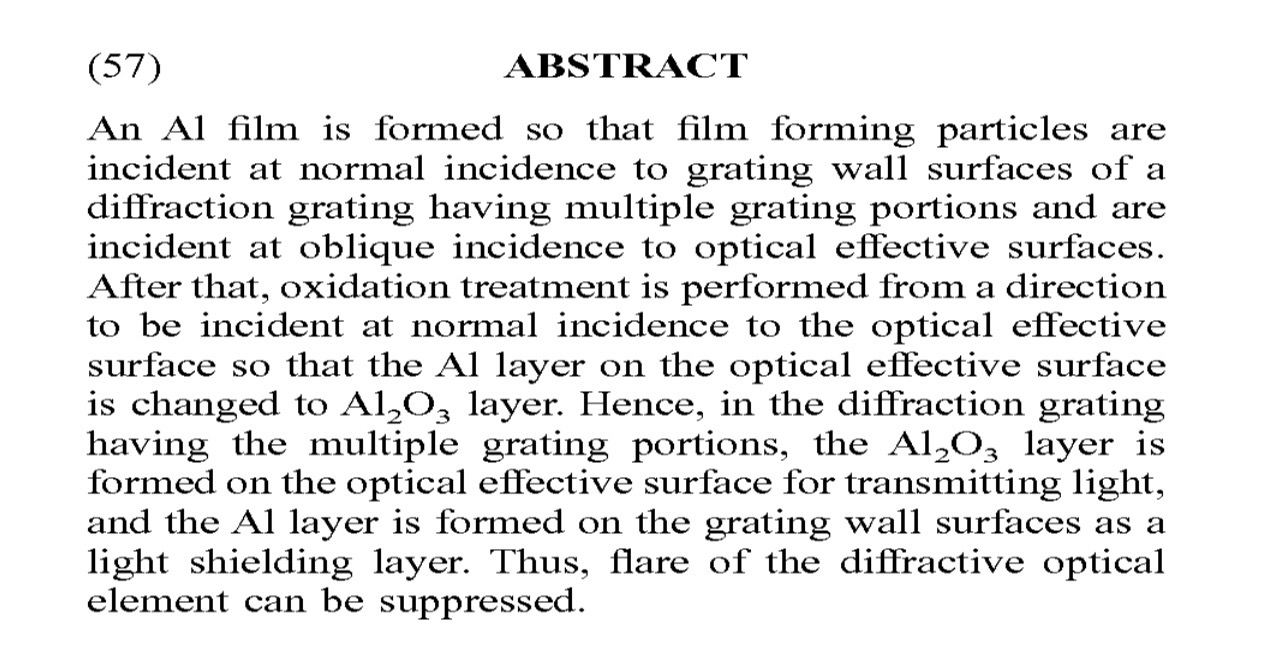
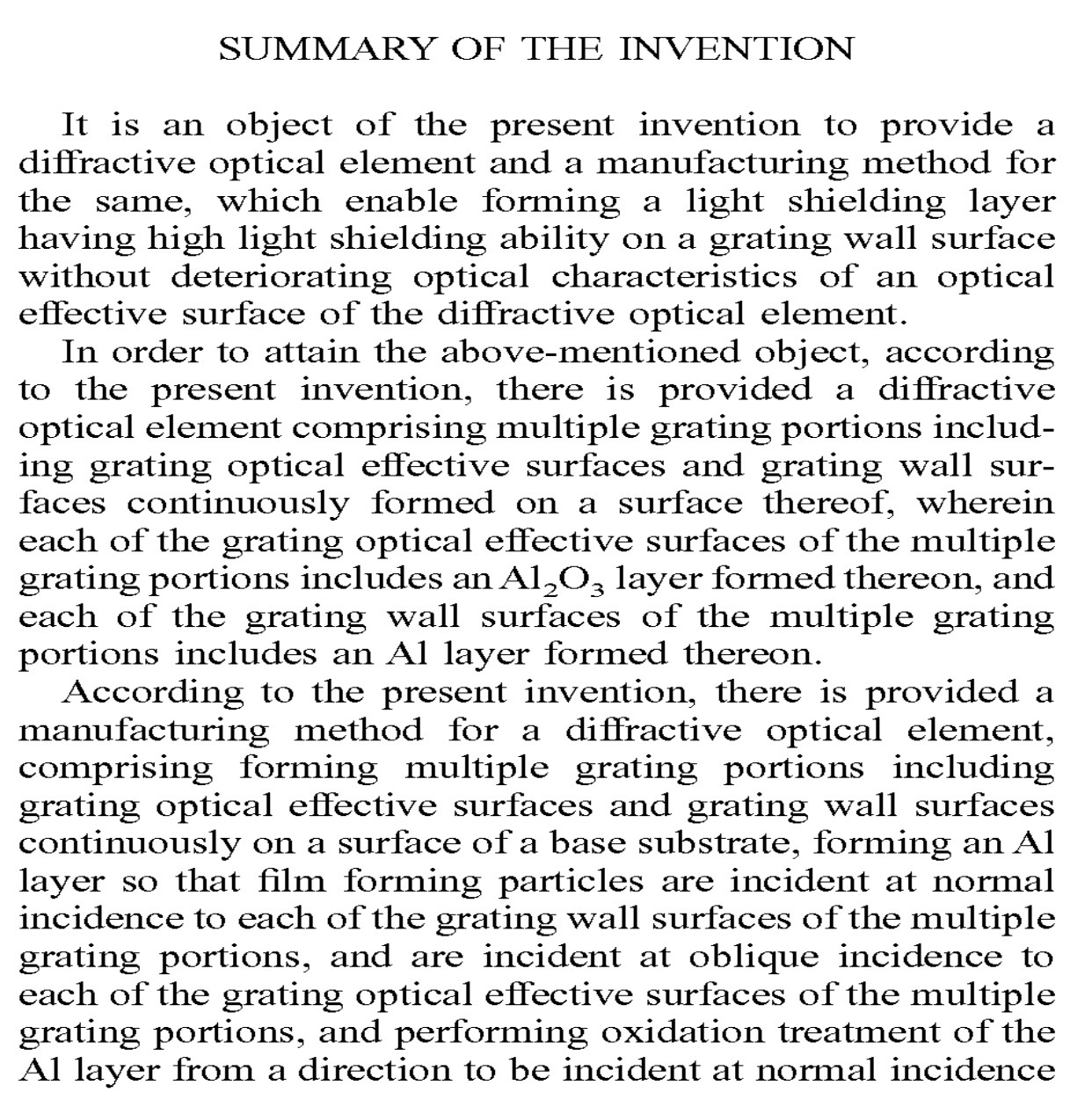
Interesting Canon patent to reduce flare in difrractive optical elements. Let’s start with the abstract:

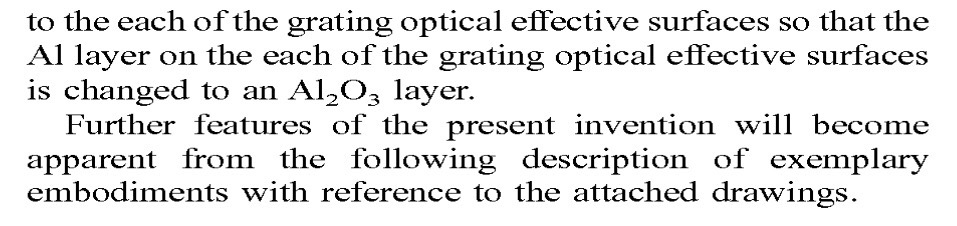
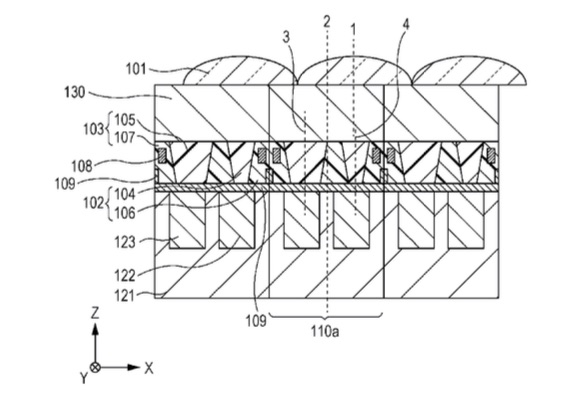
Basically, this means that an aluminium coating is applied to diffractive lens elements, in order to reduce light scattering. The aluminium layer is applied with an angle (you see it in the pictures), and is then partially oxidised so that the aluminium coating becomes transparent. According to the patents claim, flare is massively reduced (up to eight times).

Some more “patentish language”:

Canon patent
Canon patent

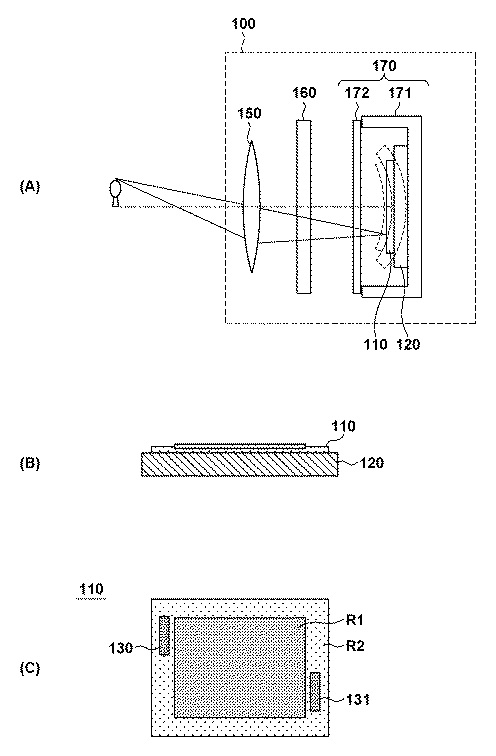
Yet another Canon patent for a curved sensor design

curved sensor

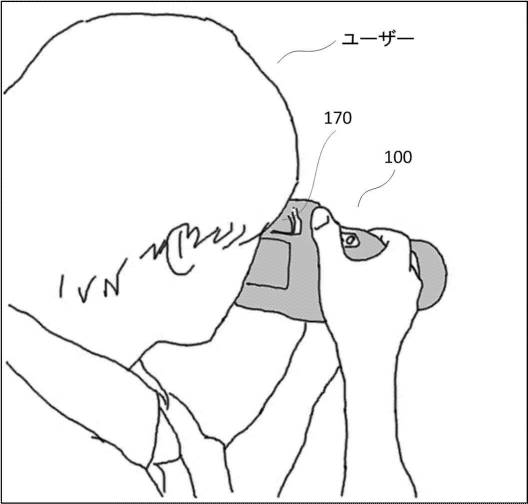
Another Canon patent for a curved sensor design. The fourth if I am not wrong, previously: 1 | 2 | 3

  • Patent publication number 2016-213571
    • Release date 2016.12.15
    • Application date 2015.4.30
  • Canon patent
    • Curved state based on the measurement result of the bending state to control the
    • Measurement method is pressure sensor, laser light

For those who dare: after the break you can read a machine translated excerpt from the patent literature.

[via Egami]
Click here to open the rest of the article