Canon Patent: 11-24mm f/4 IS, 12-24mm f/2.8 IS, And Already Released RF 14-35mm f/4L IS

Canon Patent

A new week, a new Canon patent application. More lenses for the RF mount and one already released lens.

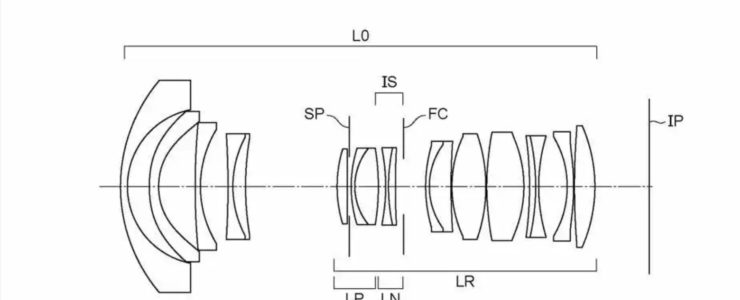
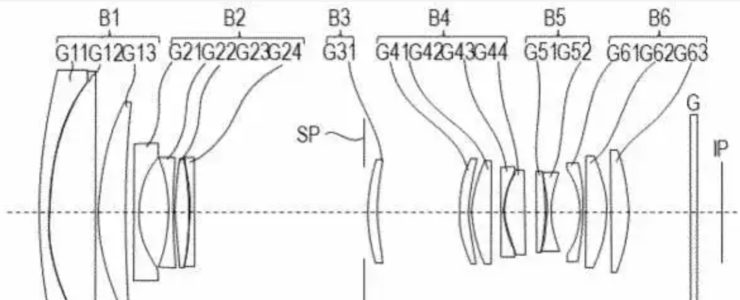
Canon patent application 2020-199535 (Japan) seems to describe the optical formula for the already released RF 14-35mm f/4L IS, and for two more wide angle zoom lenses for the RF mount: 11-24mm f/4 IS and 12-24mm f/2.8 IS.

PROBLEM TO BE SOLVED: To provide a zoom lens capable of achieving both wide angle of view and miniaturization, and further maintaining high optical performance even at the time of vibration isolation.

Example 1

  • Focal length: 11.33-23.30
  • F value: 4.08
  • Half angle of view: 59.63-42.88
  • Image height: 19.33-21.64
  • Overall length: 135.40-130.90
  • Back focus: 13.63-14.26

Example 2

  • Focal length: 12.36-23.30
  • F value: 2.91
  • Half angle of view: 57.41-42.88
  • Image height: 19.33-21.64
  • Overall length: 130.51-119.64
  • Back focus: 13.43-24.55

Example 3

  • Focal length: 14.42-33.95
  • F value: 4.08-4.12
  • Half angle of view: 53.26-32.50
  • Image height: 19.33-21.64
  • Overall length: 125.87
  • Back focus: 14.99

Example 4

  • Focal length: 15.45-33.95
  • F value: 2.91
  • Half angle of view: 51.37-32.51
  • Image height: 19.33-21.64
  • Overall length: 149.62-135.96
  • Back focus: 15.11

More Canon patent applications are listed here

[via asobinet]

Canon Patent: RF 11-24mm f/4L & RF 8-24mm f/4L Fisheye

canon patent

A new Canon patent application surfaced. It’s for RF lenses, as most of the recent Canon patents for lenses are.

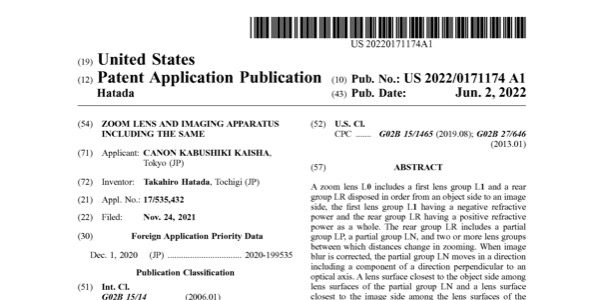
Canon patent application 20220171174 (USA) discusses optical formulas for a RF 11-24mm f/4L lens.

  • Focal Length: 11.33mm – 23.30mm
  • F-Number: 4.08
  • Half Angle of View: 59.63° – 42.88°
  • Image Height: 21.64mm

Canon patent application 20220171172 (USA) discusses optical formulas for a RF 8-24mm f/4L fisheye lens.

More Canon patent applications are listed here. Some particularly interesting patent applications we think might get into production are these:

[via Canon Rumors]

Canon Patent: 14mm, 16mm, 18mm, 20mm f/2.8 Lenses For Mirrorless System

canon patent

A new week, a new Canon patent application. Like prime lenses? Here are a bunch that might be available soon.

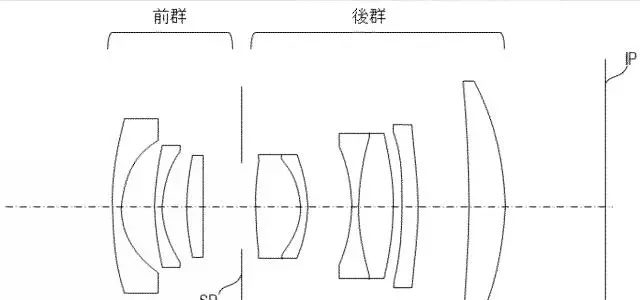
Canon patent application P2022085382 (Japan) discusses optical formulas for the following prime lenses for the RF mount:

  • 14mm f/2.8
  • 16mm f/2.8
  • 18mm f/2.8
  • 20mm f/2.8

PROBLEM TO BE SOLVED: To provide an optical system having high optical performance in a small size and light weight in a wide-angle lens, and an image pickup apparatus having the same.

BACKGROUND ART: As a shooting optical system having a wide shooting angle, an optical system having a negative refractive power is arranged on the object side, and an optical system having a positive refractive power is arranged on the image side, so-called retrofocus. A type of photographic optical system is known and is used, for example, in a single focus wide-angle lens.

Further, in digital cameras and video cameras, the number of pixels of solid-state image sensors such as CCDs and CMOS sensors is increasing, and high optical performance including chromatic aberration is required for photographing lenses, and miniaturization is also progressing.

In recent years, in a wide-angle lens system used in an image pickup apparatus, a wide angle of view is required in order to enable shooting in a wider range while the entire lens is small.

Generally, in a wide-angle lens, a wide angle of view is realized by arranging an optical system having a negative refractive power on the object side. In order to widen the angle of view, it is necessary to increase the negative refractive power on the object side, but as the radius of curvature of the lens becomes smaller, the lens processing accuracy deteriorates and the image generated mainly by off-axis rays It causes curvature of field and deterioration of chromatic aberration of magnification. In order to solve these problems, it is necessary to increase the lens diameter on the object side and increase the number of lenses, which is not preferable. In order to reduce the lens diameter, widen the angle of view, and achieve high optical performance, it is necessary to properly arrange the aperture and appropriately arrange the negative refractive power of the optical system arranged on the object side of the aperture. You will need it.

Example 1

  • Focal length: 18.20
  • F value: 2.90
  • Half angle of view: 45.00
  • Image height: 18.20
  • Overall length: 63.45
  • Back focus: 12.94

Example 2

  • Focal length: 14.28
  • F value: 2.91
  • Half angle of view: 51.88
  • Image height: 18.20
  • Overall length: 57.50
  • Back focus: 10.97

Example 3

  • Focal length: 16.48
  • F value: 2.90
  • Half angle of view: 47.84
  • Image height: 18.20
  • Overall length: 63.19
  • Back focus: 12.54

Example 4

  • Focal length: 20.10
  • F value: 2.91
  • Half angle of view: 42.16
  • Image height: 18.20
  • Overall length: 63.55
  • Back focus: 14.51

More Canon patent applications are listed here. Some particularly interesting patent applications we think might get into production are these:

[via asobinet.com]

Canon Patent: 35mm f/2.8, 85mm f/2.8, 130mm f/4 and 220mm f/4 Tilt-shift Lenses

canon patent

A new Canon patent for tilt-shift lenses with reduced composition shift.

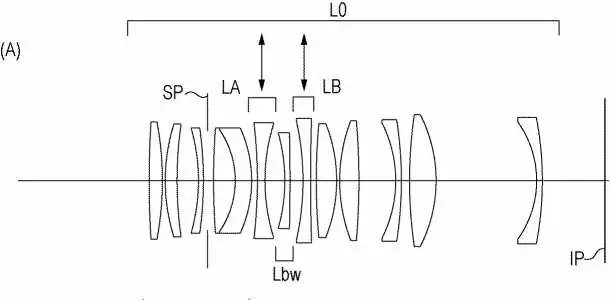
A new Canon patent application discusses optical formulas and methods for tilt-shift lenses with reduced composition shift.

  • 35mm f/2.8
  • 85mm f/2.8
  • 139mm f/4
  • 220mm f/4

From the patent literature:

  • BACKGROUND ART There is a demand for an image pickup optical system capable of obtaining good focus on the entire surface of an object surface tilted in the optical axis direction of the image pickup optical system.
  • Such an imaging application is called tilt photography, and an imaging optical system provided with a tilt mechanism (tilt mechanism) is known as an optical system that satisfies this demand. The Scheimpflug principle is used as the principle of tilt photography, and this imaging optical system is also called a Scheimpflug optical system.
  • On the other hand, in an imaging optical system having a tilt mechanism, the composition shifts (hereinafter, also referred to as “composition shift”) at the time of tilting, which may impair convenience.
  • On the other hand, there is known an imaging optical system provided with a plurality of lens portions that move in a component in the direction perpendicular to the optical axis direction (Patent Document 1). Patent Document 1 describes a lens portion A that generates a tilt effect by moving to a component in the direction perpendicular to the optical axis direction, and a shift effect (composition shift) by moving to a component in the direction perpendicular to the optical axis direction. The lens portion B is provided.
  • In Patent Document 1, the lens unit A moves in the direction perpendicular to the optical axis direction during tilt photographing, and the lens unit B moves with respect to the optical axis direction so as to correct the shift effect generated in the lens unit A. By moving in the vertical direction, tilt shooting with a small composition shift is possible.
  • PROBLEM TO BE SOLVED: To solve an image pickup optical system provided with a plurality of lens portions moving in a direction perpendicular to the optical axis direction as in Patent Document 1, in which the lens portions are perpendicular to the optical axis direction during tilt shooting. Since it is moved in the direction, aberration due to optical eccentricity occurs. This aberration due to eccentricity increases in the amount of vertical movement as the amount of tilt of the object surface to be tilted increases. Therefore, in the image pickup optical system of Patent Document 1, the amount of inclination of the object surface at which good focus can be obtained by tilt photography is small.
  • An object of the present invention is to provide an optical system capable of obtaining a large tilt photographing effect while reducing composition shift, and an image pickup apparatus having the same.

More Canon patent applications are listed here. Some particularly interesting patent applications we think might get into production are these:

[via asobinet]

Canon Patent: 16-160mm f/2-4 Lens For 4/3 Imaging Systems

canon patent

Here is a somehow different Canon patent. Different, because it refers to an imaging sensor standard Canon does not implement, that’s 4/3.

Canon patent application 2020191458 (Japan) discusses optical formulas for a 16-160mm f/2-4 lens for a 4/3 imaging sensor.

PROBLEM TO BE SOLVED: To obtain a zoom lens having high optical performance and an image pickup apparatus having the same while suppressing the increase in size of the entire optical system due to the increase in size of the image pickup element.

There is a demand for a lens having a high magnification ratio while being compact in an imaging optical system used in an imaging device such as a surveillance camera, a network camera, or a video camera using a solid-state image sensor.

In recent years, with the rapid expansion of the surveillance camera market, various demands for lenses for surveillance cameras have been raised. For example, there is a demand for miniaturization from the viewpoint of installability and inconspicuousness, and a demand for high definition and high sensitivity from the viewpoint of using surveillance video data as court evidence.

Example 1

  • Focal length: 16.47-160.13
  • F value: 2.27-4.12
  • Half angle of view: 33.30-3.87
  • Image height: 10.82
  • Overall length: 146.48
  • Back focus: 5.35

More Canon patent applications are listed here. Some particularly interesting patent applications we think might get into production are these:

[via asobinet]

Canon Patent: Tilt-shift Lens With Internal Moving Elements

canon patent

A new Canon patent application for tilt-shift lenses with moving internal parts. Thanks Fred for the tip.

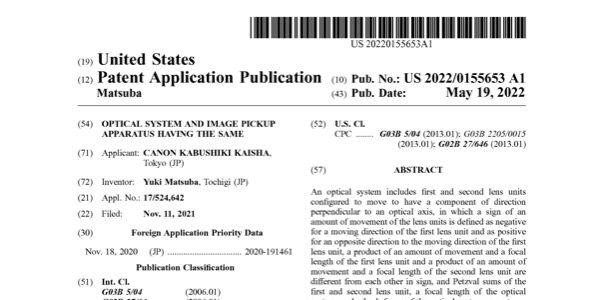
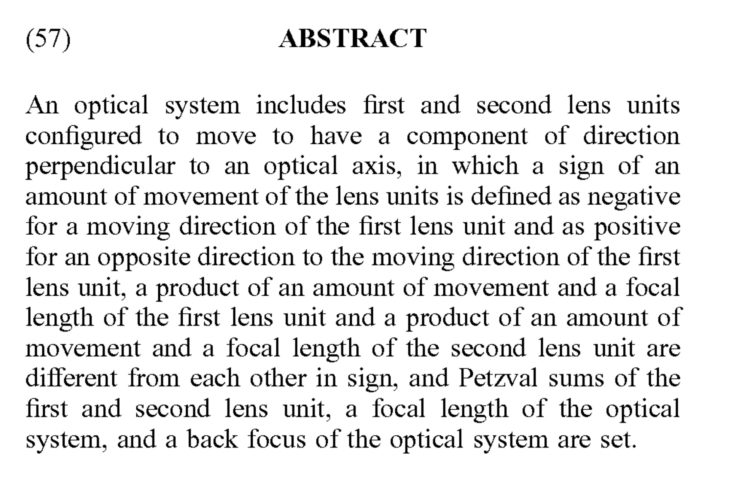
Canon patent application 20220155653 (USA) discusses optical formulas and methods for a tilt-shift lens with internal moving parts.

More Canon patent applications are listed here. Some particularly interesting patent applications we think might get into production are these: