Canon Patent: Automatic Shutter Mode Switch (mechanical/electronic)
canon patent

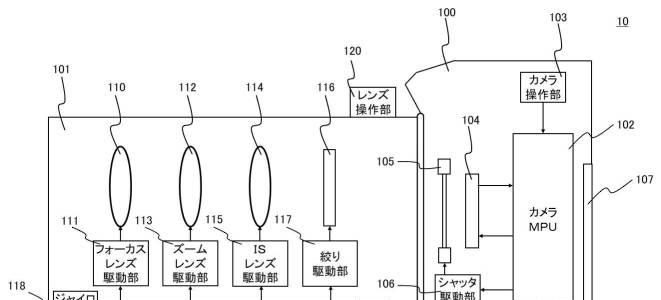
And yet another very interesting Canon patent application spotted by asobinet.com. What about your camera switching automatically the shutter mode?

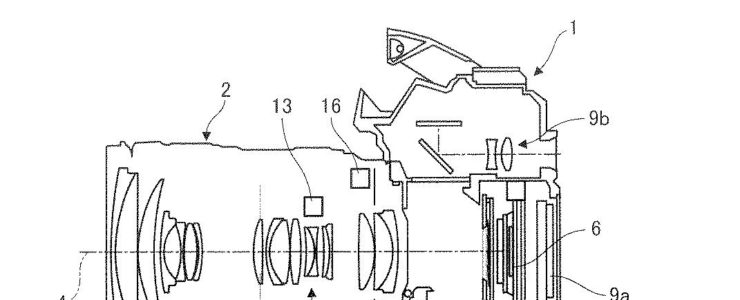
Canon patent application 2021-129230 discusses technology and methods to automatically switch from mechanical shutter to electronic shutter based on parameters. From the patent literature:

PROBLEM TO BE SOLVED: To provide a lens device, an image pickup device, a camera system, and a program capable of taking an image with an optimum shutter method without a user manually changing a setting.
Conventionally, an imaging device that realizes imaging by using a mechanical shutter and an electronic shutter in combination has been proposed. In Patent Document 1, flicker detection is performed based on a signal output from an image sensor, and based on the result, imaging is selected to select whether to use a mechanical shutter or an electronic shutter in the second and subsequent imaging of continuous imaging. The device is disclosed. When flicker occurs, the image pickup apparatus of Patent Document 1 uses an electronic shutter to improve the efficiency of the image pickup operation, thereby improving the frame speed during continuous shooting.
However, the shooting conditions in which it is preferable to use a mechanical shutter or an electronic shutter depend on requirements other than the frame speed. For example, when imaging is performed at a shutter speed at which the effect of rolling shutter distortion is large, it is desirable to use a mechanical shutter. Further, when imaging is performed at a shutter speed in which the shutter impact is sustained during the imaging period, it is desirable to use an electronic shutter in order to suppress image blurring. On the other hand, there are some users who like the sound and shooting sensation when using the mechanical shutter.
An object of the present invention is to provide a lens device, an image pickup device, a camera system, and a program capable of taking an image with an optimum shutter method without manually changing a setting by a user.

If I got it right the shutter switch is triggered by shutter speed and also by the tracked shooting distance:

The lens device is a lens device which can be mounted on an imaging device which picks up an image of a subject and an imaging device which has a mechanical shutter. A determination unit is provided with a determination unit which determines which of the mechanical shutter and the electronic shutter is to be used for starting imaging of an imaging device using information on an imaging device and information on a current imaging condition, and notifies the imaging device of a determination result.

Interesting fact: there is another Canon patent that discusses how to automatically silence the shutter based on subject and distance.

More Canon patents are listed here. Some particularly interesting patent applications we think might get into production are these:

Canon Patent: Automatic Shutter Silencing Depending By Distance And Subject

canon patent

Now this is a very interesting Canon patent application that shows well how much attention Canon pays to details that could enhance your photo shooting experience.

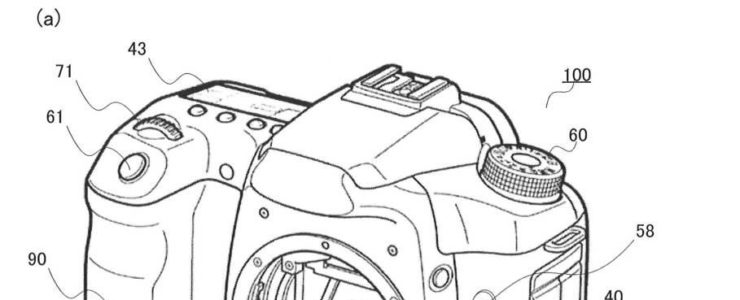
Canon patent application 2021-121063 (spotted by asobinet.com) discusses a shutter mechanism that dynamically suppresses shutter sound depending on the subject and the shooting distance. According to the patent, a distance detector (item 58 in the image above) is equipped on the camera, in order to automatically activate the silent shutter functionality.

Think about taking pictures of shy wildlife. The patent literature mentions that a subject is identified by image processing and the distance to the subject is measured. In case of animals and given a certain distance, the silent shooting might be automagically activated.

From the patent literature (machine translated):

If the silent function is automatically activated even when the sound emitted by the imaging control device is at a distance that does not reach the subject, a shooting operation is performed with a setting which is not suitable for the shooting situation and which unnecessarily suppresses the generation of sound. To provide a highly convenient imaging control device by detecting an object as an animal and automatically switching to a setting for suppressing a sound emitted from an imaging control device when a distance from an imaging control device to an object is short.

The imaging control device includes an imaging means for acquiring an image of an object, an animal detection means for detecting a specific animal from an image acquired by the imaging means, and an animal detection means for detecting a specific animal from the image acquired by the imaging means. This device has a measuring means for measuring a distance from an object, and a control means for changing a setting for suppressing a sound emitted from an imaging means according to a detection result of a specific animal by an animal detecting means and a measuring distance by a measuring means.

The patent argues that If the need to switch to silent shooting occurs frequently, having to activate it by hand might mean missing the right moment to snap. This technology might soon come to your next Canon camera. Btw, the camera depicted in the patent looks very much like a xxD model. I do not think this means anything, it’s just an image used to discuss the technology. I see this coming to a future EOS R model, maybe already on the upcoming Canon EOS R3?

More Canon patents are listed here. Some particularly interesting patent applications we think might get into production are these:

Canon Patent: Improved IBIS For Shooting HDR Photos

Canon patent

Here we are with another rather interesting Canon patent application: better IBIS (In Body Image Stabilisation) for shooting HDR photos.

Canon patent application 2021-089387 discusses how to improve IBIS during automatic exposure bracketing, for instance to take HDR pictures. This is to compensate differences between the single images because of movement. From the patent literature:

The present invention relates to a technique for performing a plurality of times of photographing for acquiring images used for image synthesis while suppressing image blurring of an image.

Background of invention:

In the dynamic range expansion processing of an image signal, for example, a plurality of signals having different output conditions are combined to generate a high dynamic range (hereinafter, also referred to as HDR) image signal. In an imaging apparatus, a photographing for synthesizing a plurality of images having different still image exposure periods is known, and is referred to as HDR photographing hereinafter. Since a plurality of photographing operations are performed in HDR photographing, a time required for completing all photographing operations becomes longer than a time required for photographing 1 images.

When HDR photographing is performed by an imaging device having an image blur correction function for correcting image blur of a captured image due to camera shake or the like, HDR photographing is possible while performing image blur correction. In this case, since it is necessary to perform image blur correction for a long time, a limit of a correction range related to an image blur correction lens (hereinafter, also referred to as a correction lens) becomes a problem. In other words, when the drive control of the correction lens in the imaging optical system is performed on the basis of a detection signal such as camera shake, it is impossible to perform the image blur correction beyond the movable range of the correction lens. Thus, when the image blur correction amount reaches the limit of the movable range (correction stroke limit), no further image blur correction effect is obtained.
[0004]

More Canon patents are listed here. Some particularly interesting patent applications we think might get into production are these:

Canon Patent: More RF mount lenses, RF 27mm f/1.4 And RF 35mm f/1.4

canon patent

And yet another Canon patent for RF-mount lenses spotted by asobinet.com. An RF 27mm f/1.4 and an RF 35mm f/1.4.

From the patent abstract:

In recent years, image pickup devices such as digital still cameras, video cameras, surveillance cameras, broadcasting cameras, and silver halide photography cameras using a solid-state image sensor have become more sophisticated. As an optical system used for this, the entire focus group is required to be miniaturized. Further, there is a demand for an optical system capable of satisfactorily correcting chromatic aberration, curvature of field, etc. at the time of shooting at the nearest distance while increasing the shooting magnification when focusing from infinity to the nearest distance. Further, with the shift to mirrorless large format cameras, there is a demand for a lens having a short back focus, a small size, and a large aperture. As an optical system that satisfies these requirements, a lens group having a positive refractive power, a focus lens group having a positive refractive power, and a focus lens group having a positive refractive power, which are arranged in order from the object side to the image side, are used.

It seems keeping thing small and light-weighted is a major topic in Canon’s R&D department.

Optical formulas for the 27mm lens:

Example 1

  • Focal length 26.79
  • F number 1.44
  • Half angle of view (°) 38.93
  • Image height 21.64
  • Lens overall length 134.78
  • BF 13.00

Example 2

  • Focal length 26.62
  • F number 1.44
  • Half angle of view (°) 39.10
  • Image height 21.64
  • Lens overall length 131.96
  • BF 20.00

Example 5

  • Focal length 26.70
  • F number 1.44
  • Half angle of view (°) 39.02
  • Image height 21.64
  • Lens overall length 133.24
  • BF 20.00

Optical formulas for the 35mm lens:

Example 3

  • Focal length 33.73
  • F number 1.44
  • Half angle of view (°) 32.68
  • Image height 21.64
  • Lens overall length 143.92
  • BF 20.00

Example 4

  • Focal length 33.87
  • F number 1.44
  • Half angle of view (°) 32.57
  • Image height 21.64
  • Lens overall length 131.26
  • BF 16.49

Canon Patent Shows What Might Be The Canon EOS R1 (with special grip)

canon eos r1

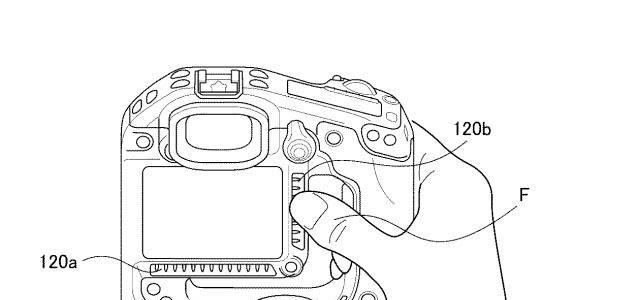
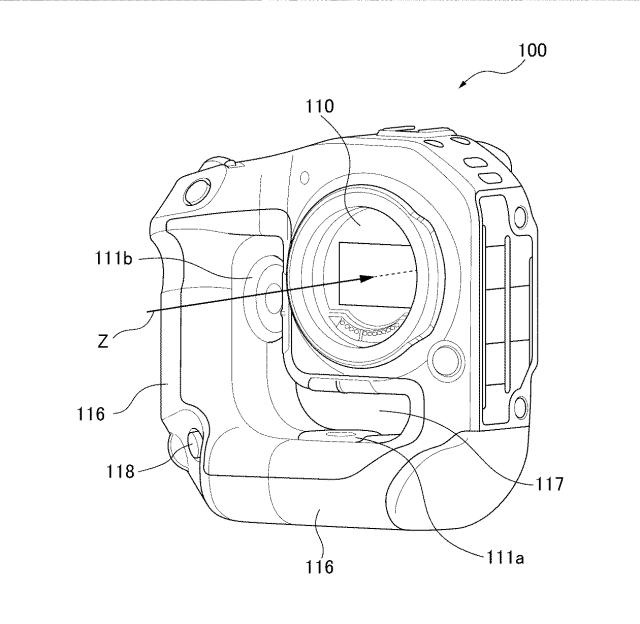
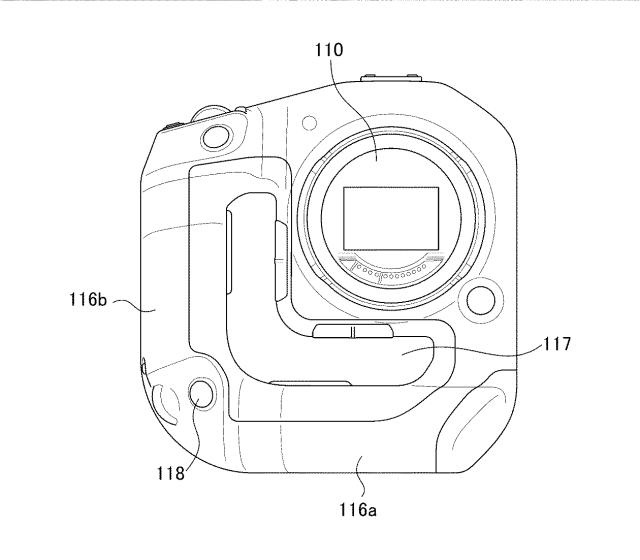
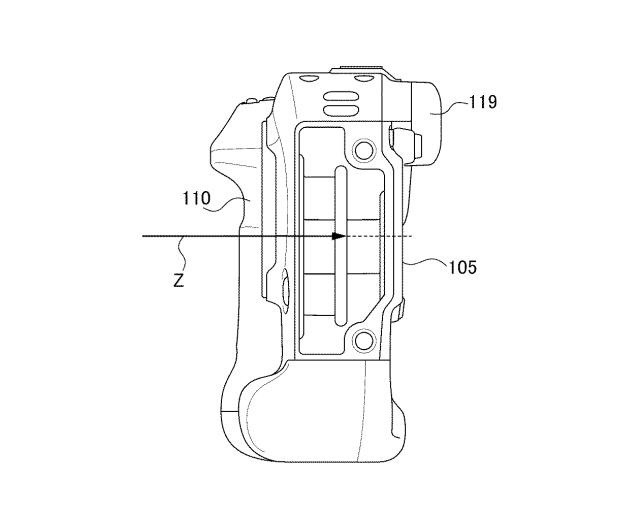
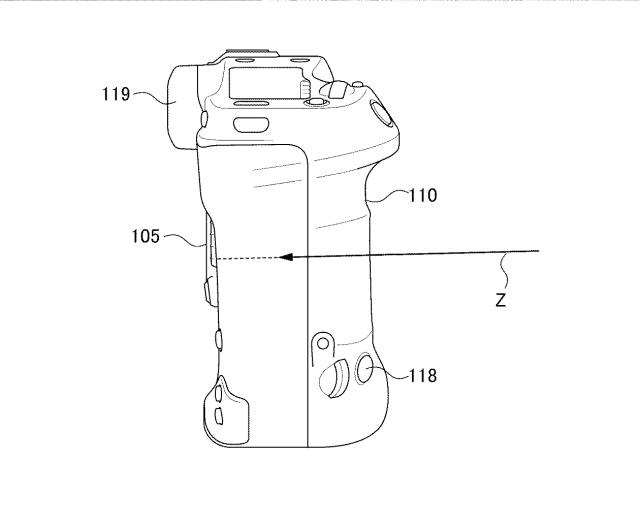
Here is a very interesting patent. It describes a special, ergonomic grip on a camera that might well be the Canon EOS R1 flagship mirrorless camera. Oh, and don’t get fooled: the patent was spotted by asobinet.com. Edit: as reader Ross E. Forp correctly states in the comment section, it might also be the Canon EOS R5c.

From the patent application abstract:

To secure good grip in any of a horizontal position and a vertical position, and to perform imaging without a risk of dropping the device when changing from a vertical position to a horizontal position or from a horizontal position to a vertical position.

The special grip has the function to allow to hold the camera more firmly.

the shape of the grip is very special, and it seems that good handling is realized despite the thin design by opening a cavity in the camera

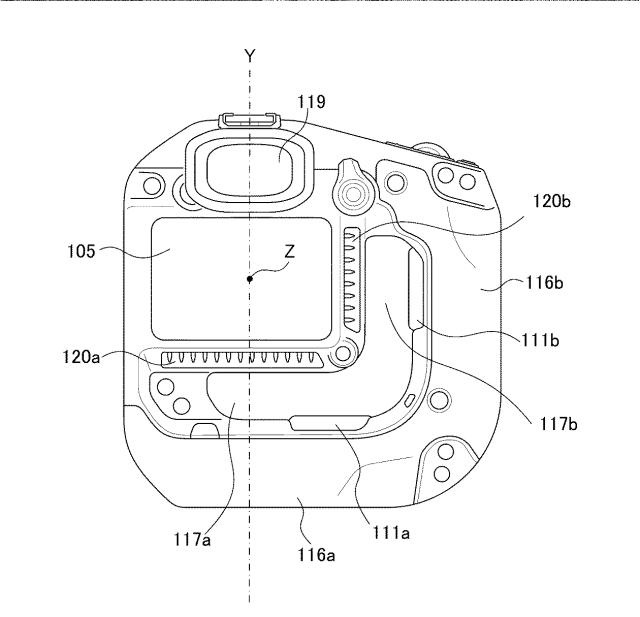
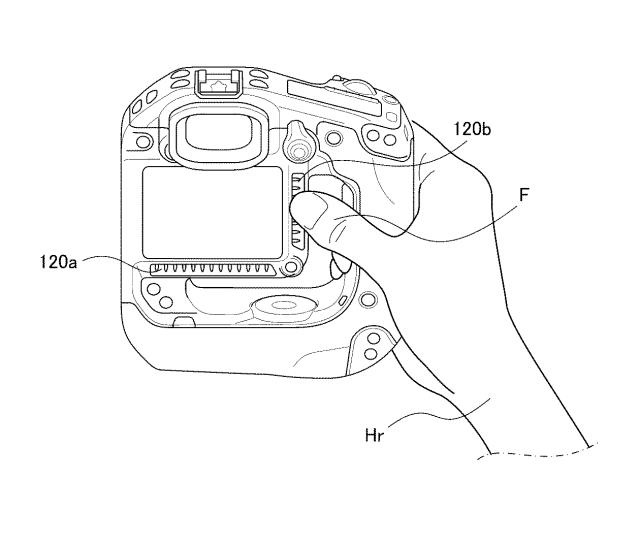
But there is more. The camera depicted in the patent drawings seems to have intake and exhaust openings that could point to an active cooling system (120a and 120b in the drawings). However, the patent literature appears to describe them as toiuch sensor (some kind of touch bar?).

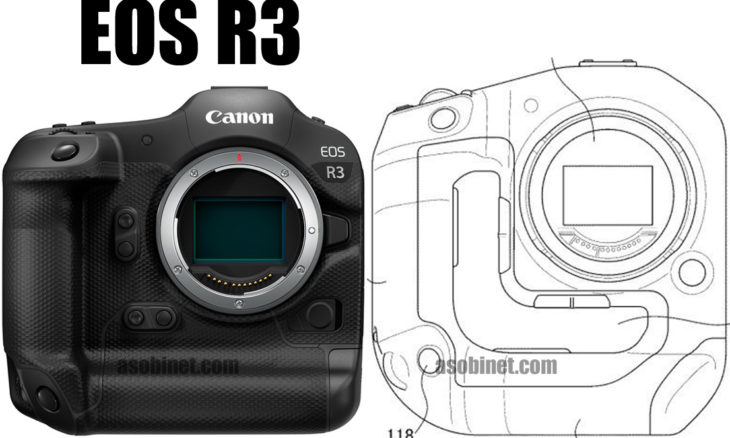
asobinet.com made a quick size comparison with the EOS R3, and it shows the camera in the patent is bigger.

Image courtesy of asobinet.com

What do you think, is this the Canon EOS R1?

Canon Patent: RF 100-400mm f/5.0-7.1, RF 100-300mm f/5.6-8.2

canon patent

Here is another Canon patent application, as usual spotted by asobinet.com. Two more RF-mount lenses are discussed.

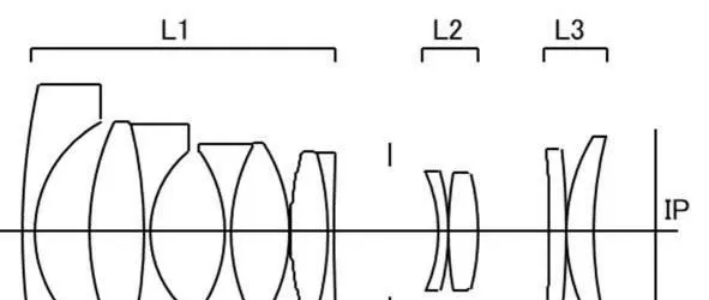
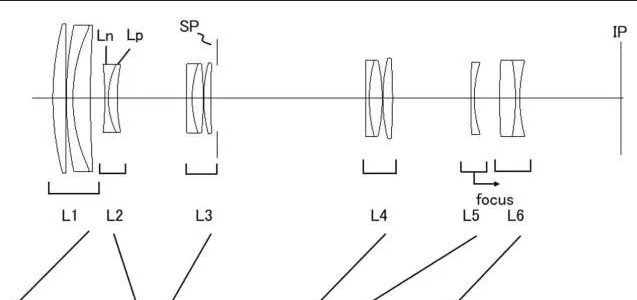
The Canon patent application discusses optical formulas for RF 100-400mm f/5.0-7.1, RF 100-300mm f/5.6-8.2 and RF-S 55-250mm f/4.5-7.1 lenses. Note that the last one has an “RF-S”.

The RF 100-400mm f/5.0-7.1 and RF 100-300mm f/5.6-8.2 seem to be inexpensive telephoto lenses for a full frame mirrorless camera, i.e. the EOS R. The RF-S 55-250mm f/4.5-7.1 is clearly designed for an APS-C sensor, according to asobinet.com. Hence, it might be for the EOS M system, or for the fabled EOS R with crop sensor.

Embodiment 1:

  • Wide-angle intermediate telephoto
  • Focal length 103.00 200.00 388.50
  • F number 5.00 6.26 7.10
  • Half angle of view (degrees) 11.86 6.17 3.19
  • Image height 21.64 21.64 21.64
  • Lens overall length 215.58 255.38 293.58
  • BF 38.40 58.61 78.01

Embodiment 2:

  • Wide-angle intermediate telephoto
  • Focal length 103.01 200.00 388.50
  • F number 5.00 6.45 7.10
  • Half angle of view (degrees) 11.86 6.17 3.19
  • Image height 21.64 21.64 21.64
  • Lens overall length 207.99 243.96 285.99
  • BF 45.82 78.95 112.66

Embodiment 3:

  • Wide-angle intermediate telephoto
  • Focal length 103.00 200.00 388.48
  • F number 5.18 6.70 8.24
  • Half angle of view (degrees) 11.86 6.17 3.19
  • Image height 21.64 21.64 21.64
  • Lens overall length 203.50 243.44 273.50
  • BF 41.10 76.59 114.00

Embodiment 4 (for APS-C sensor):

  • Wide-angle intermediate telephoto
  • Focal length 56.66 120.00 242.50
  • F number 4.66 6.45 7.10
  • Half angle of view (degrees) 13.55 6.49 3.22
  • Image height 13.66 13.66 13.66
  • Lens overall length 129.73 155.54 184.73
  • BF 19.19 43.59 64.21

Ideas and comments are welcome.

More Canon patents are listed here. Some particularly interesting patent applications we think might get into production are these: