Canon Patent: TS-E Macro Lens (might be the TS-E 90mm F2.8L Macro)
canon patent

A new Canon patent was spotted by asobinet.com. It’s for a tilt-shift lens and it might apply to an already released Canon lens.

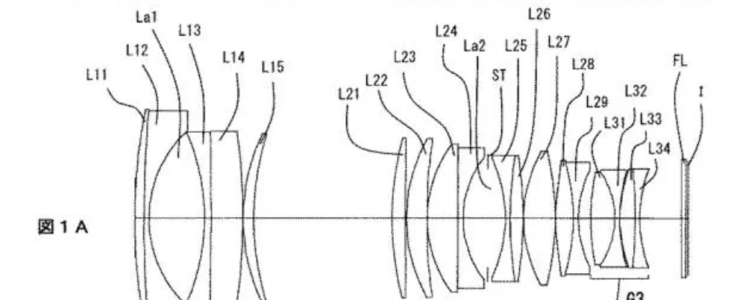
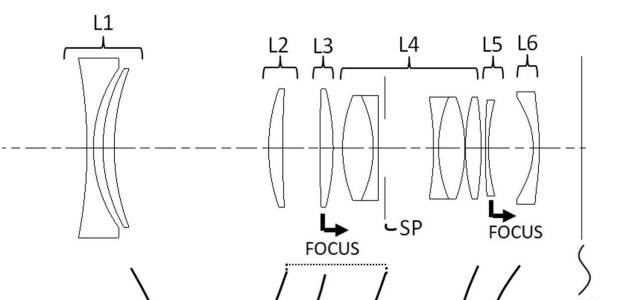
Canon patent application 2021-167982 (Japan) discusses optical formulas for a tilt shift macro lens. The patent literature hints at an already released lens, the Canon TS-E 90mm f/2.8L Macro. From the patent literature:

PROBLEM TO BE SOLVED: To obtain an imaging optical system which has less aberration fluctuation during focusing from infinity to a short distance, has high optical performance over the entire focus range, and can easily secure a sufficient amount of peripheral light.

In recent years, an imaging optical system used in an imaging device such as an interchangeable lens still camera has a large aperture ratio, little aberration fluctuation during focusing from infinity to a short distance, and has high optical performance over the entire focus range. Is required.

The double-Gauss type imaging optical system is characterized in that it is easy to make a large-diameter ratio and the aberration fluctuation with respect to the fluctuation of the object distance is relatively small. However, in a double Gauss type imaging optical system, if the entire system is moved during focusing from infinity to a short distance, the amount of movement of the pupil increases. As a result, when trying to secure the peripheral illumination over the entire focus range, the effective diameter of the lens increases and the entire system becomes large.

In order to have a large aperture ratio, high optical performance when focusing from infinity to a short distance, and to obtain a sufficient amount of peripheral light, it is important to appropriately set the lens configuration, the material used for each lens, and the like. Will become.

Thepresent invention is an imaging optical system having little aberration fluctuation due to focusing from infinity to a short distance, having high optical performance over the entire focus range, and easily securing a sufficient amount of peripheral light, and an imaging apparatus having the same. The purpose is to provide.

  • Focal length: 90.00
  • F value: 2.91
  • Image height: 34.00
  • Overall length: 132.06
  • Shooting magnification: 0.5

More Canon patent applications are listed here. Some particularly interesting patent applications we think might get into production are these:

Nikon Patent For Two Insane Lenses: 35-50mm f/1.2 & 50-70mm f/1.2

nikon

Nikon filed a patent application for two lenses that likely will never go into production. Did they file the patent just to show what could be made?

The two lenses discussed in the patent literature are a 35-50mm f/1.2 and a 50-70mm f/1.2. Sure, it’s feasible to manufacture them; but at what production cost?

Focal length: 35.00-51.60

  • F value: 1.23
  • Angle of view: 72.14-46.70
  • Image height: 21.70
  • Overall length: 210.04-168.19
  • Back focus: 17.77-25.82

Focal length: 51.60-70.00

  • F value: 1.23
  • Angle of view: 48.78-34.53
  • Image height: 21.70
  • Overall length: 210.03-169.53
  • Back focus: 18.93-26.72

[via asobinet via Mirrorless Rumors]

Canon Patent: Yet Another Take On The Vlogging Concept

canon patent

Not the first Canon patent regarding a video camera you might hold with one hand. Typical use case for run & gun vlogging.

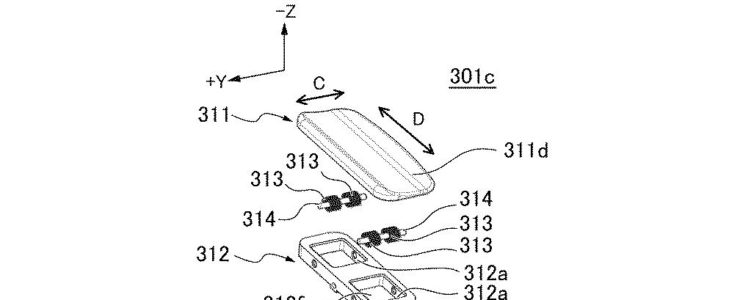
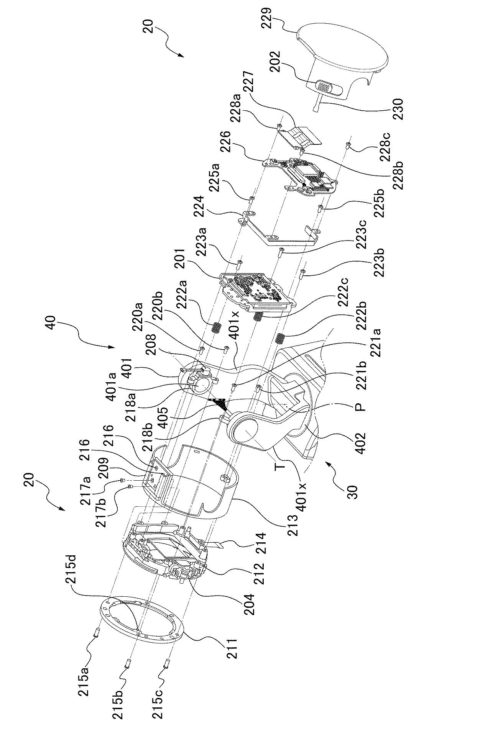
Canon patent application 2021-165785 (Japan) discusses methods and technologies for such a handheld vlogging device. From the patent literature:

[Problem] To perform various operations by one hand.

[Means for solving] A display part 303 is provided on the fixing part 30. The touch operation member 301 c is capable of performing at least an operation of the display unit 303 and is provided so as to be able to be pressed. The touch operation member 301 c can reciprocate in parallel with the push-in direction (Z-axis direction) and can reciprocate in a 1 predetermined direction (Y-axis direction ; C direction) substantially orthogonal to the push-in direction.

More detailed:

[Detailed description of the invention]
The present invention relates to an imaging device having a push-in operation portion which can be pushed in, and a photographing lens.

[Background of the Invention]In recent years, there has been a demand for moving image taking in a free posture and moving image taking from various angles in various situations. In the imaging apparatus disclosed in Patent Document 1, while the lens unit is rotated about one axis relative to the main body, the display unit can be reversed according to the direction of the lens unit while switching the imaging direction. This imaging apparatus is capable of switching between the self-photographing direction and the other-photographing direction by rotating the lens unit, and corresponds to various photographing styles.

Drawing from the patent literature

More Canon patent applications are listed here. Some particularly interesting patent applications we think might get into production are these:

[source JPO]

Canon Patent: RF-S 18-45mm f/4.5-6.3 Lens (for RF mount cam with APS-C?)

canon patent

A new Canon patent application for an RF mount lens. The interesting fact here: it seems to be be made for a camera with APS-C sensor. Is the EOS R with crop sensor really coming?

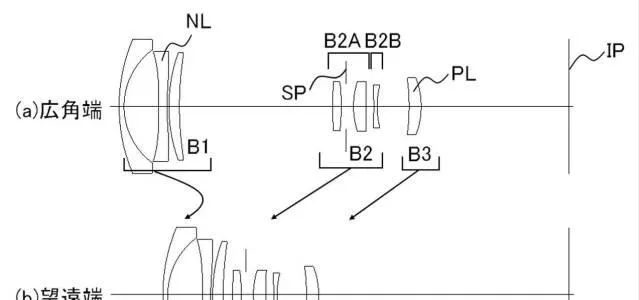
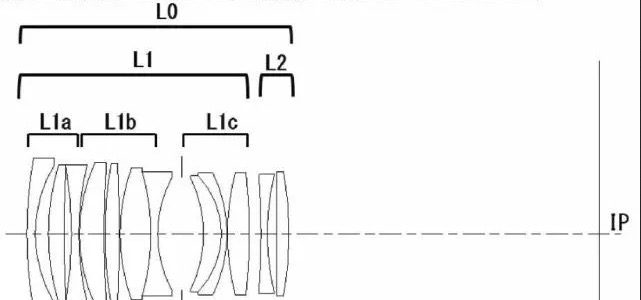
Canon patent application 2021-162822 (Japan, spotted by asobinet.com) discusses optical formulas for a 18-45mm f/4.5-6.3 lens. A kit lens you might add. From the patent literature:

PROBLEM TO BE SOLVED: To provide a lightweight zoom lens.

As a zoom lens used in an imaging device such as a still camera, a video camera, and a surveillance camera, Patent Document 1 discloses a negative lead type zoom lens in which the lens group on the most object side has a negative refractive power.

Embodiment 1:

  • Focal length: 18.53-43.65
  • F value: 4.54-6.50
  • Half angle of view: 33.78-17.38
  • Image height: 12.40-13.66
  • Overall length: 92.00-83.05
  • Back focus: 30.20-51.20

Embodiment 2:

  • Focal length: 20.01-43.64
  • F value: 4.60-6.50
  • Half angle of view: 31.79-17.38
  • Image height: 12.40-13.66
  • Overall length: 90.65-80.61
  • Back focus: 32.94-50.55

This definitely appears to be a lens for a APS-C sensors. asobinet.com notes that:

[…] the image height on the wide-angle side is 12.40 mm, which is a little too small, so it may be stretched by image processing. Since the back focus is longer overall, is it a mirrorless lens that uses a retractable structure? It’s similar to the patent application that appeared in 2019, but this time it’s different. The focal length at the wide-angle end is as low as 18.53mm, and you may feel that the angle of view is a little narrow for movie shooting.

The lens might also be for the EOS M system, although it seems less likely. Is an EOS R with an APS-C sensor really on Canon’s radar? We still have a somewhat hard time to believe it but there are signs it might be true. All comments welcome.

More Canon patent applications are listed here. Some particularly interesting patent applications we think might get into production are these:

Canon Patent: RF 28-70mm f/2.8L That Does Not Extend, Inner Focusing

canon patent

Here is a very interesting Canon patent application, once more for an RF mount lens. An RF 28-70mm f/2.8L with inner focusing and that does not extend might be in the works.

The Canon patent application spotted by asobinet.com (they did not disclose the patent number), discusses optical formulas for a RF 28-70mm f/2.8L lens. The interesting part, if I got it right from the machine translated Japanese text, is that the lens not only does all the focusing but also employs a design that is usually found on wide-angle lenses.

It sounds like a patent for a small and lightweight standard zoom. The characteristic of this optical system is that the total length is the longest at the wide-angle end and the total length becomes shorter toward the telephoto end. This is a common optical system for wide-angle lenses, but I don’t see this type of lens with standard zoom lenses, especially with large-aperture zoom lenses. If it is really put into practical use, it will be a very portable lens.

Did I get it right? The lens is indeed described to be shorter at the telephoto end (emphasis mine) in both embodiment:

  • Wide-angle intermediate telephoto
  • Focal length 28.84 36.81 67.90
  • F number 2.91 2.91 2.91
  • Half angle of view (°) 32.68 29.23 17.67
  • Image height 18.50 20.60 21.64
  • Lens total length 117.09 109.31 101.58
  • BF 9.99 13.47 21.59
  • Focal length 28.84 37.17 67.90
  • F number 2.91 2.91 2.91
  • Half angle of view (°) 32.65 28.90 17.67
  • Image height 21.64 21.64 21.64
  • Lens total length 132.62 122.81 111.18
  • BF 21.92 26.79 39.84

Moreover, the lens uses a floating focus structure to achieve autofocus. That means it might have very fast and and highly responsive AF. The patent literature is very clear in what should be achieved:

PROBLEM TO BE SOLVED: To provide a zoom lens having a short overall lens length, being compact and lightweight, and having high optical performance.

All comments welcome.

More Canon patent applications are listed here. Some particularly interesting patent applications we think might get into production are these:

Canon Patent: Head Mounted Display For Virtual Reality (RF 5.2mm f/2.8L)

rf 5.2mm f/2.8L

Today Canon announced the RF 5.2mm f/2.8L dual fisheye lens for VR. Here is a Canon patent for a head mounted display for VR applications.

Various Canon patent applications that deal with VR applications have been spotted by asobinet.com. Likely they are related to the RF 5.2mm f/2.8L lens.

Canon patent application 2021-89382:

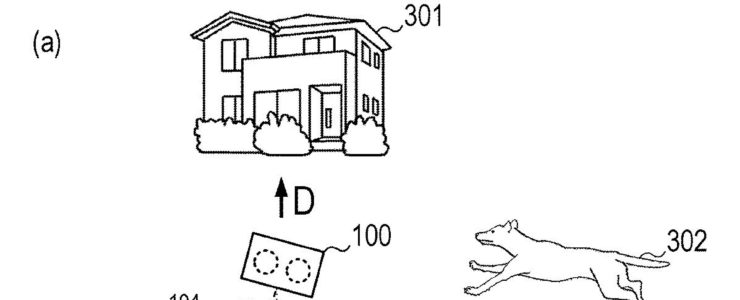
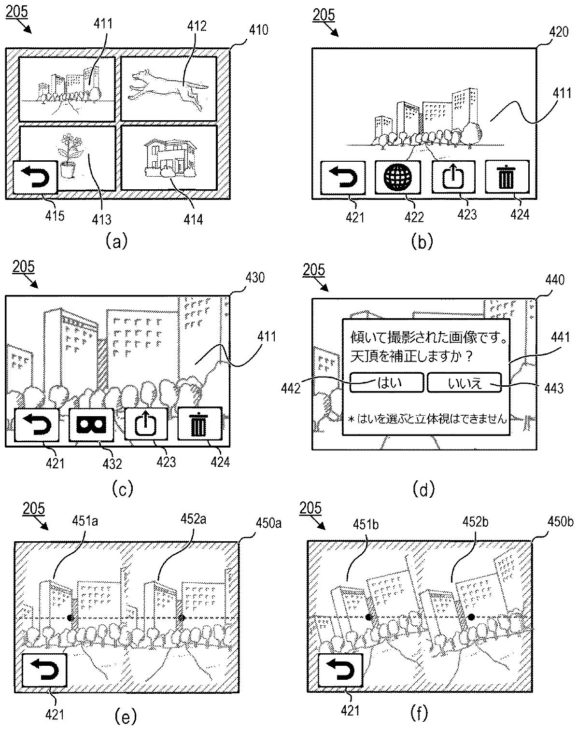
PROBLEM TO BE SOLVED: To provide an electronic device capable of more preferably displaying a VR image captured by using a plurality of optical systems.

[…] to obtain a wide-angle image with parallax using two optical systems, known technique for displaying a VR (Virtual Reality) image having a stereoscopic effect by displaying maps on the virtual sphere. A twin-lens VR camera for capturing an image with parallax has two optical systems oriented in the same direction, and captures two images with parallax by one imaging operation. As a twin-lens VR camera, a camera that captures a wide range of 180 degrees (hemisphere, 90 degrees in all directions from the center of an image) or more in each optical system is known. In addition, as a VR display method, “single-lens VR display” that displays one image by transforming the VR image into a virtual sphere, and VR images for the left eye and the right eye are displayed side by side in the left and right areas. “Binocular VR display” is known.

Canon patent application 2021-118415:

PROBLEM TO BE SOLVED: To appropriately dimm an external light entering between a head-mounted display (HMD) and a face.

In recent years, VR (Virtual Reality) technology that allows users to experience virtual reality and MR (Mixed Reality) technology that allows users to experience mixed reality by seamlessly fusing reality and virtual reality are known. ..
There is a head-mounted display as one of the technologies that allows you to experience the above. If there is a gap between the head-mounted display and the face when the head-mounted display is attached to the head, the displayed image will be difficult to see due to the influence of external light, and the immersive feeling such as virtual reality experience will be reduced.

Canon patent application 2021-118426:

PROBLEM TO BE SOLVED: To improve the compression rate of a moving image composed of a frame image having distortion of a lens and to suppress the processing amount.

Conventionally, a lens for stereoscopic photography has been used as an interchangeable lens system. By using a stereoscopic lens, a pair of left and right parallax images can be captured. When playing back a captured still image or moving image, the image for the right eye is displayed on the user’s right eye, and the image for the left eye is displayed on the left eye. As a result, an image having a parallax is projected on the right eye and the left eye, so that the user can visually recognize the image having a stereoscopic effect. As a related technique, a stereo adapter of Patent Document 1 has been proposed. The stereo adapter of Patent Document 1 has a left opening for capturing a left image and a right opening for capturing a right image, and is left in each region horizontally divided into two in the image pickup unit of the camera. The image and the right image are imaged at the same time.

Interesting times coming for EOS R photographers.