Canon EOS R7 vs Sony A6600 Review: 10 Main Differences, And A Full Comparison

Canon EOS R7 vs Sony a6600

How do the Canon EOS R7 vs Sony a6600 compare? What are the main differences? Read on to find out.

Canon EOS R7 at a glance:

  • 32.5MP APS-C CMOS Sensor
  • RF mount
  • Dual Pixel CMOS AF II
  • 4K60 10-Bit Video, HDR-PQ & C-Log 3
  • 30 fps E. Shutter, 15 fps Mech. Shutter
  • 2.36m-Dot OLED EVF
  • 1.6m-Dot Vari-Angle Touchscreen LCD
  • Sensor-Shift 5-Axis Image Stabilization
  • Dual UHS-II Memory Card Slots
  • Multi-Function Shoe, Wi-Fi and Bluetooth

Sony A6600 at a glance:

  • 24.2MP APS-C Exmor CMOS Sensor
  • BIONZ X Image Processor
  • UHD 4K30p Video with HLG & S-Log3 Gammas
  • XGA Tru-Finder 2.36m-Dot OLED EVF
  • 3.0″ 921.6k-Dot 180° Tilting Touchscreen
  • 5-Axis SteadyShot INSIDE Stabilization
  • Up to 11-fps Shooting, ISO 100-32000
  • 4D FOCUS with 425 Phase-Detect Points
  • Real Time Eye AF for Stills and Video
  • Headphone & Mic Ports, Wi-Fi & Bluetooth

Mirrorless Comparison posted their exhaustive Canon EOS R7 vs Sony a6600 review. You’ll find anything needed to compare both cameras. From their conclusion:

We list the 10 main differences and suggest you visit Mirrorless Comparison to get the entire picture. They cover anything from ergonomics to image quality and ISO performance, not to mention the many sample pictures. You might also watch the video-review at the end of the post.

The 10 Main Differences in a Nutshell

  1. Design: the A6600 is smaller and lighter, but the R7 has a more comfortable grip and a better button layout (except for the hybrid dial/joystick solution that I personally don’t like).
  2. Viewfinder / LCD: similar specs, but different position for the EVFs. The LCD monitor on the Canon offers better resolution and more touch capabilities. That of the Sony tilts up 180˚ but is not multi-angle.
  3. Cards and Battery: two slots for the R7 (UHS-II), one for the A6600 (UHS-I). Battery life is similar, but the Sony can last for a little longer.
  4. Image Quality: more resolution on the R7 sensor, but also more noise at high ISO, and when opening the shadows in post. I prefer the colours on the Canon for the most part.
  5. Autofocus: the R7 is more advanced and can recognise a larger variety of subjects. Eye AF for humans is more reliable and works for video on the Canon. That said, the A6600 does well when given a challenge (birds in flight).
  6. Drive Speed: The R7 has a superior continuous shooting speed of 30fps, but it comes with severe rolling shutter. With the mechanical mode, you can work at 15fps. The Sony maxes out at 11fps. Neither excels in terms of their buffer capabilities.
  7. Image Stabilisation: you can push the R7 further when it comes to hand-held still photos, and it also delivers smoother results for movie recording.
  8. Video: both cameras offer great quality in 4K up to 30p. The R7 goes up to 60p, but with a choice of reduced sharpness, or a heavy 1.8x sensor crop. The Canon can record 10-bit 4:2:2 internally, whereas the Sony has more advanced settings to fine-tune the image.
  9. Extra Features: The R7 packs a few more functionalities, like focus bracketing and focus stacking, as well as the Pre-Shooting mode.
  10. Price and Lenses: The A6600 is less expensive, but not by much, unless you find a special offer. The Sony E-mount system is vaster and more complete (if we look at native lenses).

And here is Mirrorless Comparison’s video review:

Canon Patent: Adding Functionality To The Rear Dial By Making It Clickable

Canon patent

This Canon patent shows once more that ergonomics and user interfaces are constantly researched and further deveolped.

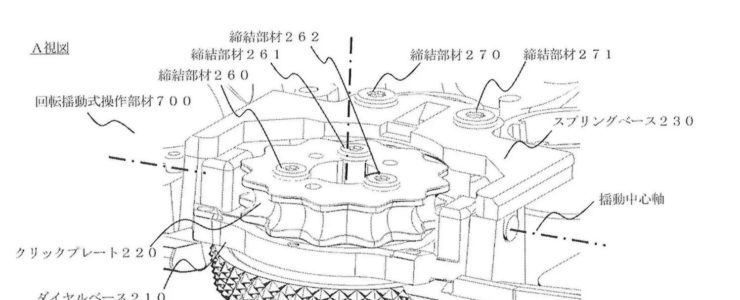
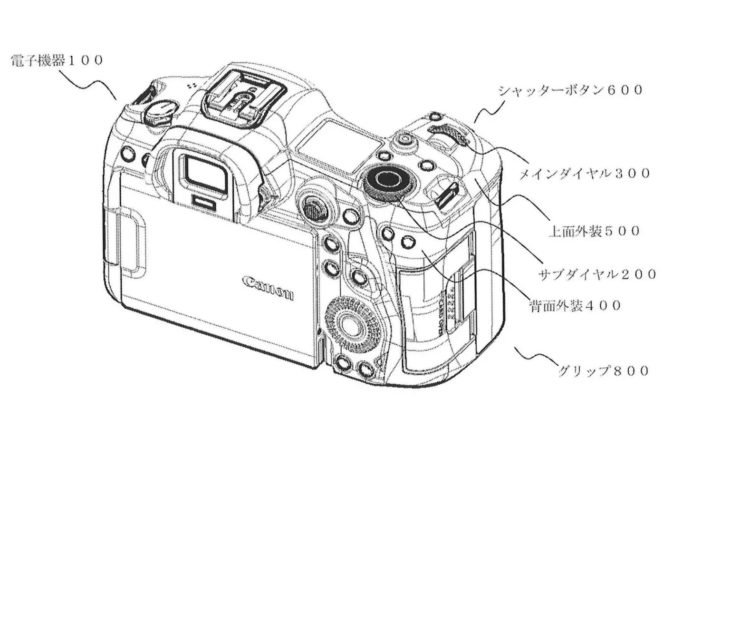
Canon patent application 2023009898 (Japan, published 1/20/2023) discusses methods to make the rear dial clickable, e.g. to add functionality. From the patent literature:

An object of the present invention is to provide a rotary operation member capable of a compound operation that prevents an erroneous operation during a rotary operation.

Description of the Related Art

Conventionally, in an electronic device having a rotating/swiveling operation member such as a dial, there has been proposed a structure capable of performing a combined operation of a rotating operation and a swinging operation of the rotating operation member.

However, the prior art disclosed in the above-mentioned patent document requires a plurality of means for producing a rotating operation and a swinging motion, and there is a concern that the swinging operation may be erroneously performed during the rotating operation.

SUMMARY OF THE INVENTION

Accordingly, it is an object of the present invention to provide a rotating and swinging operating member that performs rotating and swinging operations with a common member while preventing erroneous operation during rotating operation.

EFFECTS OF THE INVENTION

According to the present invention, it is possible to provide a composite operating member that is capable of rotating and swinging operations and that is excellent in immediacy while preventing erroneous operations.

Canon patent

More Canon patent applications are listed here.

[via asobinet]

Canon Patent: Shutter Button Vibrates When Focus Is Acquired

canon patent

And here is the third Canon patent application of today (see here and here), and this is a rather cool one in our opinion.

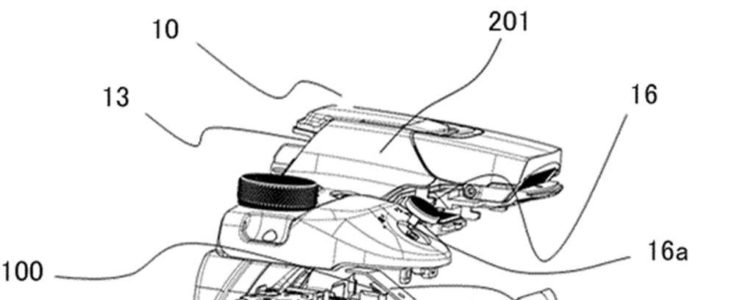
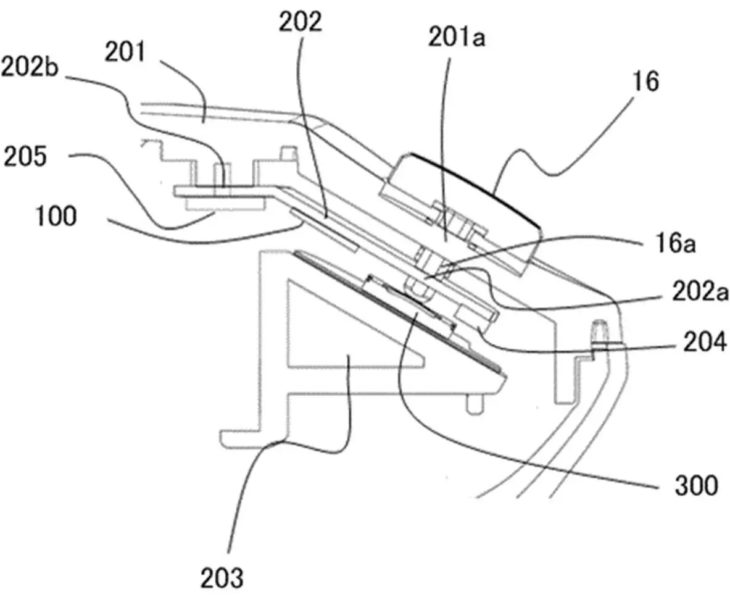
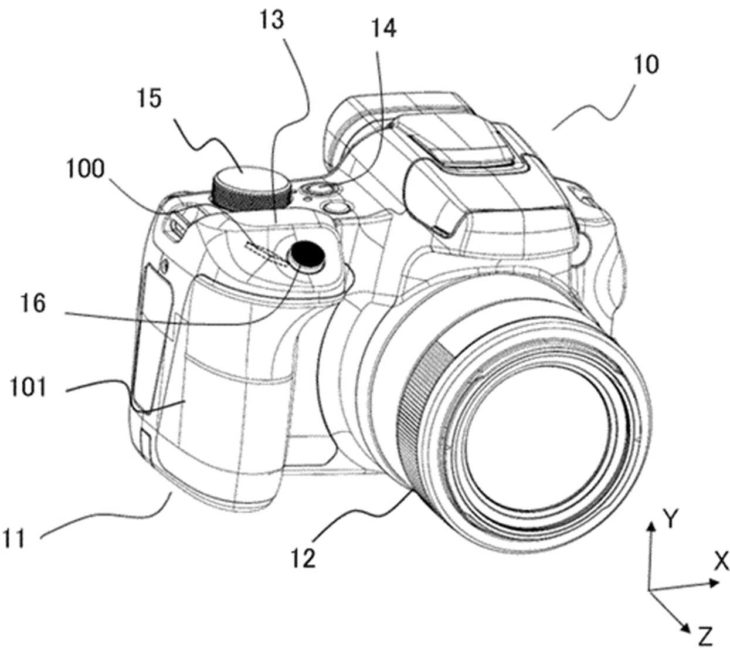
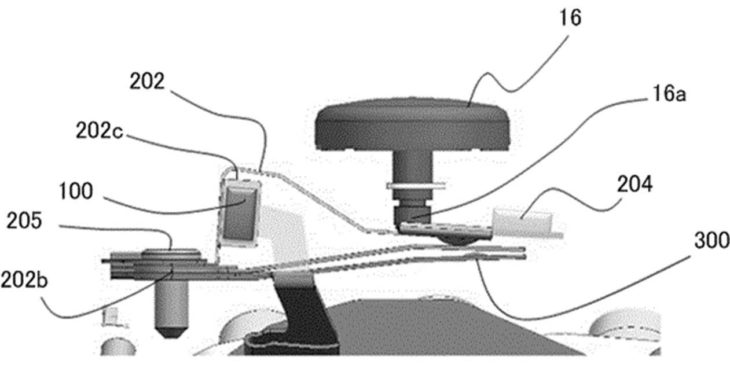
Canon patent application 2023009356 (Japan, published 1/20/2023) discusses methods to make a shutter button that vibrates when autofocus is locked. Pretty cool, isn’t it? Think of situations where silence is important, but getting to know when AF locks is too.

From the patent literature:

An optical device capable of increasing vibration transmitted to a release button with an inexpensive and compact configuration is provided.

Description of the Related Art

Conventional single-lens reflex cameras generate camera shooting sounds such as shutter sounds and mirror drive sounds when a release button is operated to take a picture. Thereby, the user can recognize by the sound that the camera has performed the photographing operation. However, in recent years, when photographing athletes, the sound of the camera being shot distracts them from their concentration. becoming a problem. As a countermeasure for this problem, mirrorless cameras have become popular and the driving sound of the mirror has been eliminated. For this reason, among mirrorless cameras, there is a silent shutter camera that significantly suppresses the camera shooting sound even when shooting in a quiet place by reducing the shutter sound.

However, since the silent shutter camera is almost silent, when the user operates the release button to take a picture, it is difficult to determine whether or not the image has been reliably recorded. In order to address this problem, a configuration has been disclosed in which the release button is vibrated so that only the user can perceive the shooting operation while suppressing the camera shooting sound.

SUMMARY OF THE INVENTION

It is an object of the present invention to provide an optical apparatus capable of increasing the vibration transmitted to the release button with an inexpensive and compact configuration.

More Canon patent applications are listed here.

[via asobinet]

Canon Patent: 18-55mm F4-6.5 & 20-60mm F4-6.5 For Full Frame Mirrorless

canon patent

Two Canon patents today, this one and the one featured here.

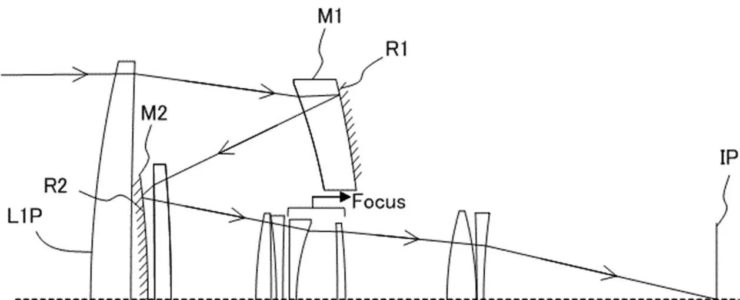
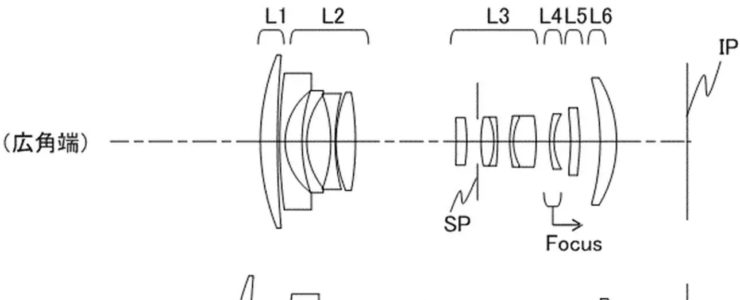
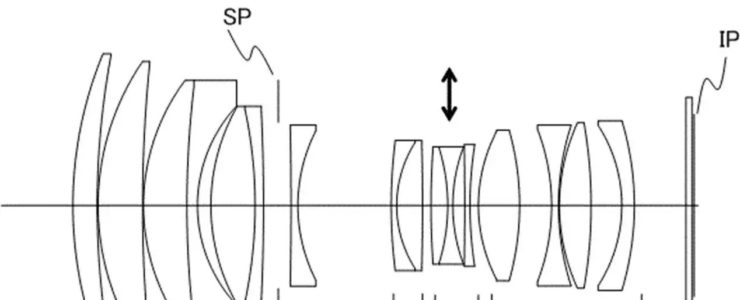
Canon patent application 2023010106 (Japan, published 1/20/2023) discusses optical formulas for what seem to be two possible kit lenses, both for full frame mirrorless cameras, i.e. the RF mount:

  • 18-55mm f4-6.5
  • 20-50mm f4-5.6

From the patent literature:

A compact zoom lens that achieves high optical performance while widening the angle of view is provided.

In recent years, there has been a strong demand for a lens system used in an imaging apparatus to have high optical performance while the entire lens system is compact. In order to achieve good optical performance while miniaturizing the entire lens system, it is important to appropriately set the refractive power of each lens group, the moving conditions for zooming, and the like of each lens group. In particular, in a camera with a large image pickup element, when a desired magnification is secured while widening the angle, the front lens tends to become large, and it is necessary to appropriately configure each lens group.

SUMMARY OF THE INVENTION

It is an object of the present invention to provide a compact zoom lens that achieves high optical performance while widening the angle of view.

Example 1

  • Focal length: 18.50-53.01
  • F-value: 4.11-6.48
  • Half angle of view: 49.17-22.02
  • Image height: 18.50-21.64
  • Overall length: 117.88-150.43
  • Back focus: 19.52-24.90

Example 2

  • Focal length: 19.72-53.16
  • F-value: 4.12-6.07
  • Half angle of view: 48.13-22.43
  • Image height: 18.50-21.64
  • Total length: 126.89-162.14
  • Back focus: 21.40-51.52

Example 3

  • Focal Length: 18.50-58.92
  • F-value: 4.12-6.48
  • Half angle of view: 49.09-19.95
  • Image height: 18.50-21.64
  • Total length: 132.01-160.73
  • Back focus: 24.47-37.26

More Canon patent applications are listed here. Some particularly interesting patent applications we think might get into production are these:

[via asobinet]

Canon Patent: 100mm F1.8 IS & 150mm F1.8 IS Lenses

Canon patent

Here we have a new Canon patent, two fast primes for the EOS R system.

Canon patent application 2023009759 (Japan, published 1/20/2023) discusses optical formulas for two fast prime lenses, both for the full frame RF mount:

  • 100mm f1.8 IS
  • 150mm f1.8 IS

From the patent literature:

An object of the present invention is to provide an optical system and an imaging apparatus having the optical system that can reduce the weight of a focusing group.

Description of the Related Art

Conventionally, a telephoto type imaging optical system (telephoto lens) having a long focal length is known. A long focal length is, for example, a focal length that is longer than the size of the effective imaging range. In general, telephoto lenses become larger and heavier as their focal lengths become longer. In addition, among various types of aberration, variations in axial chromatic aberration and chromatic aberration of magnification occur particularly during focusing.

SUMMARY OF THE INVENTION

It is an object of the present invention to provide an image pickup optical system and an image pickup apparatus having the same, which can reduce the weight of the focusing group.

Example 1

  • Focal length: 85.40
  • F-value: 1.85
  • Half angle of view: 14.22
  • Image height: 21.64
  • Overall length: 109.49
  • Back focus: 13.39

Example 2

  • Focal Length: 101.78
  • F-value: 1.85
  • Half angle of view: 12.00
  • Image height: 21.64
  • Overall length: 123.44
  • Back focus: 13.39

Example 3

  • Focal length: 131.00
  • F-value: 1.85
  • Half angle of view: 9.38
  • Image height: 21.64
  • Total length: 146.99
  • Back focus: 13.64

Example 4

  • Focal length: 148.00
  • F-value: 1.85
  • Half angle of view: 8.32
  • Image height: 21.64
  • Overall length: 159.49
  • Back focus: 14.69

The Canon RF 135mm F1.8L USM Starts Shipping on January 26, 2023

Canon RF 135mm f/1.8L

Canon announced the availability of the Canon RF 135mm F1.8L USM lens.

At a glance:

  • RF-Mount Lens/Full-Frame Format
  • Aperture Range: f/1.8 to f/22
  • Nano USM AF System
  • Optical Image Stabilizer
  • Ultra-Low Dispersion Elements
  • Air Sphere Coating
  • Lens Function Buttons and Control Ring
  • Rounded 9-Blade Diaphragm

The Canon RF 135mm F1.8L USM will start shipping (in Japan) on January 26, 2023. We can assume the date is significant for other geographical regions too.

Canon RF 135mm f/1.8L IS world wide preorders: [shoplist 70316]

Click here to open the rest of the article