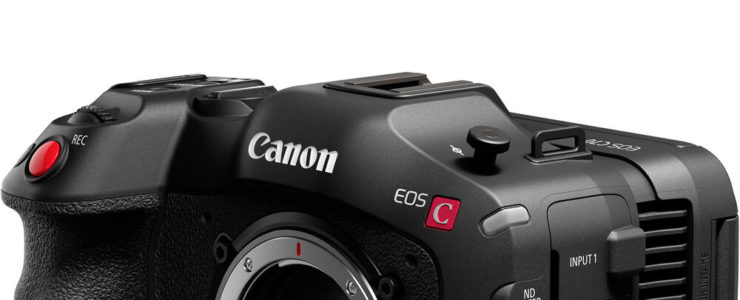
This morning a Twitter user posted three specification sets for three possibly upcoming Cinema EOS cameras. Fake or real?
User how2fly posted more or less at 4am EST on Twitter the following specification sets for yet unreleased and never rumored cameras in the Cinema EOS lineup:
EOS C700DR
4K Full Frame Cine Camera
Up to 4K/240p in Fast Mode
4K/180p in WDR Mode
BSI Stacked 9.6um 4K WDR Sensor
20+ Stops Dynamic Range in WDR Mode
5ms Readout in 4K WDR Mode
Dual DIGIC DV 8 Image Processor
EOS C500S
8K Full Frame Cine Camera
Up to 8K/60p
4K/120p in all modes
BSI Stacked 4.65um 8K DGO Sensor
Dual Pixel Autofocus
17+ Stops Dynamic Range in DGO Mode
10ms Readout in 8K DGO Mode
Dual DIGIC DV 8 Image Processor
EOS C300S
8K Super 35mm Cine Camera
Up to 8K/60p
4K/120p in all modes
BSI Stacked 3.2um 8K DGO Sensor
Dual Pixel Autofocus
16 Stops Dynamic Range in DGO Mode
10ms Readout in 8K DGO Mode
Dual DIGIC DV 8 Image Processor
Please note: we have no records about this Twitter user. We recommend you take this with a grain of salt, a big one. What do you think, are these specs something to write home about?
Not sure if this is a general issue, i.e. a bug, or not. Some users experience a weird phenomenon, a sensor twist, on their EOS R5 (and it seems also for some R6s) when IBIS is set to “always on”.
User juanmaasecas documented the phenomenon in the video below. He writes about his observation (emphasis mine):
Some weeks ago I found what I think is an annoying bug with the IBIS in the Canon R5 (some users also experience it with the R6).
When the ibis is set to “always ON”, the sensor twists after the first picture is taken, producing a blurred picture. If you keep pressing the shutter half (while in continuous autofocus or just In single) and then take more pictures, the rest are just fine.
I went to Canon repair center/showcase here in Hong Kong, and the cameras there show the issue as well (that is why I didn’t leave my camera for repair), and yet canon has not yet repaired the issue (I discovered it first in firmware 1.2.0 that I bought the camera with, but still happens in 1.3.0 and 1.3.1).
Here is the observed phenomenon:
Someone here having seen this sensor twist on his or her EOS R5 or EOS R6? Please let me know in the comments section.
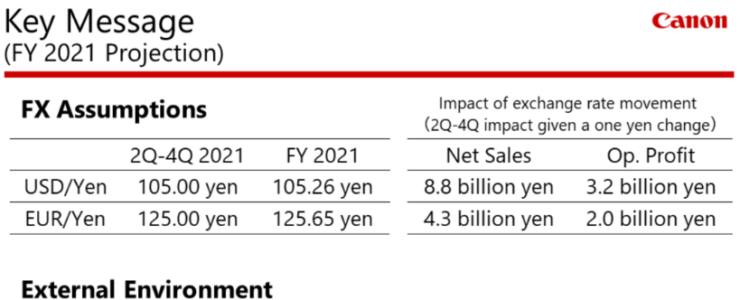
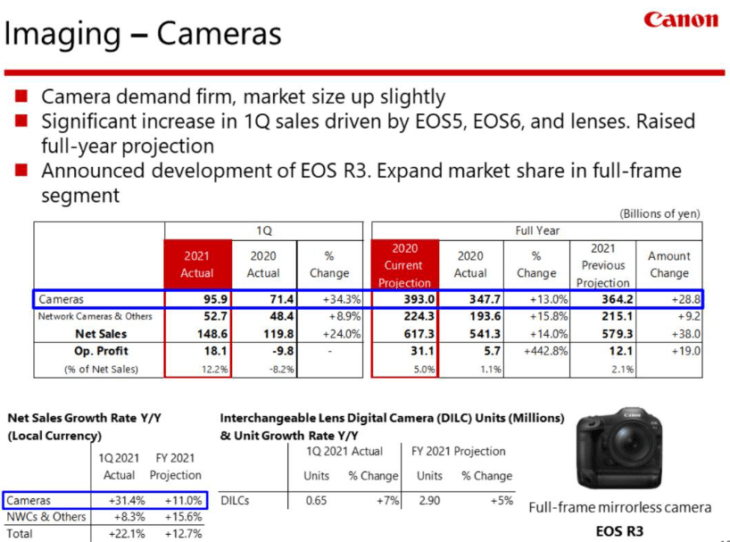
Canon released the company’s Q1 2021 financial results. Things look good for Canon and they even increased sales predicitons. The Canon EOS R5 and EOS R6 are driving camera sales.
Here are some excerpts from Canon’s presentation material (emphasis mine):
For Imaging, because the size of the camera market is already approaching the number of users that are particular about visual expression, we expect the market to be limited to moderate contraction going forward. As current sales of mainly new products are exceeding our plan, we raised our full-year projection for both sales and profit.
[…]
As for cameras, even amid continued restrictions on people’s movement, demand for cameras remains solid, supported by the need for high-quality visual expression. Based on this, we still expect the 2021 camera market to be up slightly or 5.8 million units.
In the first quarter, revenue was significantly higher than last year, as sales remained strong, driven by the EOS R5 and EOS R6 which were launched in the second half of last year. Additionally, the synergy effect of having competitive camera bodies and expanding our lineup of RF lens, which command high margins, led to an increase in average selling prices. This, and the establishment of efficient online sales activities nurtured through COVID-19 is leading to an improvement in profitability.
For the full year, reflecting the situation surrounding sales in the first quarter, we not only raised our projection for camera unit sales by 100 thousand to 2.9 million, but also raised our projection for revenue.
To further strengthen mirrorless camera lineup, in April we announced the development of a new model, the EOS R3, which is equipped with a backside illumination stacked CMOS sensor that achieves high-speed signal processing, which allows for a number of functional improvements such as continuous shooting performance. At the same time, we announced 3 new RF lenses, bringing the total to 22 and we will continue to enhance this lineup going forward. By raising the appeal of the R series, we aim to further raising our market share in the full-frame category and increase sales.
Additionally, for new types of cameras, such as the PowerShotZoom that was launch at the end of last year and has attracted quite a bit of attention for its ease of capturing long-range images with one hand, we are steady creating new markets.
Canon’s Q1 2021 documentation and material can be downloaded here. Previous Canon financial results are listed here.
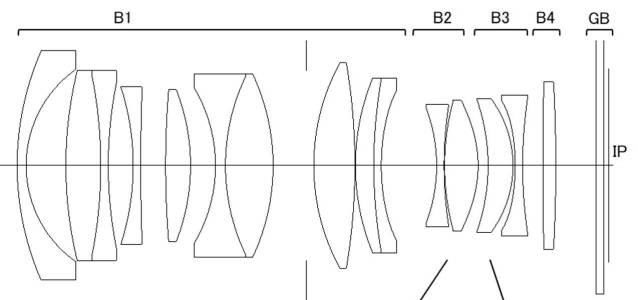
Here is one more Canon patent for RF mount lenses, another one in an already long list: 35mm f/1.4 and 28mm f/1.4 lenses for full frame mirrorless cameras, i.e. the EOS R.
Canon patent application 2021-063966 (Japan) discusses optical formulas for a 35mm f/1.4 lens and a 28mm f/1.4 lens, both for the RF mount. The patent application was spotted by Canon News.
28mm f/1.4:
Focus distance 28.00
F number 1.42
Half angle (degree) 37.69
Image height 21.64
Lens total length 140.62
BF 21.99
35mm f/1.4:
Focus distance 34.98
F number 1.42
Half angle (degree) 31.73
Image height 21.64
Lens total length 154.45
BF 16.17
More Canon patents are listed here. Some particularly interesting patent applications we think might get into production are these:
Eventually Canon reacted to the ongoing rumor suggesting the company is gradually retiring EF lenses in favor of an RF-mount-only future. However, the answer is somewhat ambiguous.
As Inside Imaging reports, Canon is not so much discontinuing EF lenses but putting some order in the line-up. In other words: Canon is removing redundancy, not discontinuing EF lenses. Sounds weird? Here is Canon Australia’s statement on the issue (emphasis mine):
Canon has around 80 lens options for creators to choose from – only 22 of which are RF at this time. Over the past two years, we’ve been focused on building out our range of RF lenses to expand the creative possibilities of our R-System consumers, however our commitment to supporting our EF lens range is unwavering. It’s true, Canon has recently discontinued select EF lenses in our range, however this is a process of series optimisation, not an indication of us abandoning EF lenses. Lenses that have been recently discontinued are lenses that have multiple versions available; comprise technology that’s been superseded by other available options; or, are low volume lenses. There are still many options for creators to choose from in our EF range, while our RF range continues to expand.
Sounds neither like a clear yes nor like a clear no. Also, keep in mind that for sure Canon has large stocks for most of the lenses rumored to get discontinued, and especially that it does not mean those EF lenses are no longer going to be maintained and serviced by Canon.
Here is the list of the allegedly discontinued EF lenses (release year in parenthesis):
Canon EF-S 10-22 f/3.5-4.5 USM (2007)
Canon EF 14mm f/2.8L USM II (2007)
Canon EF-S 15-85mm f/3.5-5.6 IS USM (2009)
Canon EF-S 17-55mm f/2.8 IS USM (2006)
Canon EF-S 18-200mm f/3.5-5.6 IS USM (2008)
Canon EF 24-70mm f/4L IS USM (2012)
Canon EF 24mm f/2.8 IS USM (2012)
Canon EF-S 35mm f/2.8 IS STM Macro (2012)
Canon EF 40mm f/2.8 STM (2012)
Canon EF-S 55-250 f/4-5.6 IS STM (2013)
Canon EF-S 60mm f/2.8 Macro USM (2005)
Canon EF 70-200mm f/2.8L USM (1995)
Canon EF 70-200mm f/4L IS USM II (2018)
Canon EF 70-300mm f/4-5.6L IS USM (2010)
Canon EF 85mm f/1.2L USM II (2006)
Canon EF 85mm f/1.8 USM (1992)
Canon EF 100mm f/2 USM (1991)
Canon EF 135mm f/2L USM (1996)
Canon EF 180mm f/3.5L USM (1996)
Canon EF 200mm f/2L IS USM (2008)
Canon EF 300mm f/4L IS USM (2010)
Canon EF 800mm f/5.6L IS USM (2008)
And these lenses are rumored to get retired some time in 2021:
Canon EF 35mm f/2 IS USM (2012)
Canon EF 300mm f/2.8L IS USM II (2010)
Canon EF 400mm f/4 DO IS USM II (2014)
Canon EF 500mm f/4L IS USM II (2011)
The future is RF mount, no doubts about that. But EF mount will still be around for a long time, no doubts on that either.
This website or its third-party tools use cookies, which are necessary to its functioning and required to achieve the purposes illustrated in the cookie policy. If you want to know more or withdraw your consent to all or some of the cookies, please refer to the cookie policy. By closing this banner you agree to the use of cookies.