Are There Even Enough EOS 7D Users To Justify An EOS R With APS-C Sensor?
eos r model with aps-c

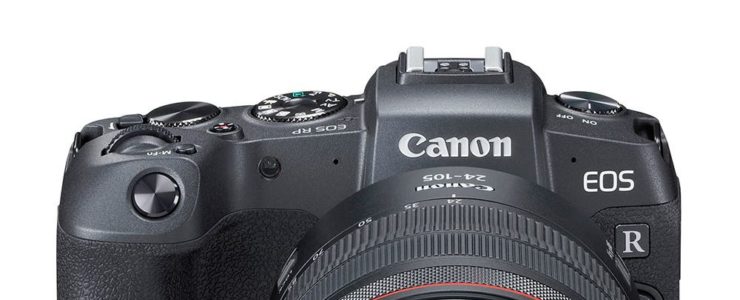
We got a curios mail from a source we dealt with in the past. But instead of “never seen features” or “truly innovative sensor”, we got a somewhat different rumor. Well, it’s again about an EOS R with APS-C sensor.

Our source states, I quote, “do not believe the EOS R with APS-C bs [sic]”. Well, we never were sold out on this. However, the source, who claims to have some insights in Canon’s strategies, has a rather interesting argumentation for what he or she claims is Canon’s motivation to not release an EOS R body with APS-C sensor. Simply speaking, Canon doesn’t think there are enough EOS 7D users, or photographers with such needs, to justify the launch of an EOS R model with crop sensor.

To be honest, I never wondered how large the EOS 7D user base was. I know it’s a community with many happy with Canon for having made the two 7Ds. WIld-life photographers and all those on a budget yet needing more reach with their telephoto lenses made a thankful and reliable user base for the EOS 7D lineup. The question is: are they large enough in numbers to motivate Canon to design and build and EOS R with APS-C?

We had some discussion among us and involved some 7D shooters. While there was no clear consensus, we were able to agree (well, at least to a large degree) to the following points:

  • Full frame sensor equipped cameras are becoming more and more inexpensive. The EOS RP sells for less than $1000, and an upcoming new entry-level EOS R is rumored to be even less expensive than the RP. It’s no longer a financial hurdle as it used to be. Hence the motivation or need to safe a few bucks with an APS-C sensor might be decreasing.
  • Th same applies to telephoto lenses, for instance see the rather unexpected telephoto lenses Canon made with f/11 and sells at a reasonable price
  • RF mount lens offering is increasing quickly. No doubt about that, just look at sheer number of patent application.
  • For everything amateur level or below an EOS 7D, there is the hugely popular EOS M lineup, which I assure is not going to die anytime soon.
  • APS-C technology doesn’t seem to have a great future in the industry, besides on consumer cameras or where space issues and form factor are a critical issue.
  • And finally, Canon released the EOS 90D, an APS-C DSLR already far superior to the EOS 7D Mark II and seen by many as the last favor done to hard core professional APS-C shooter before taking them to Canon’s new shiny full frame mirrorless universe.

We are not saying APS-C will disappear in the next few years. The technology still has great potential and given how much crop sensors have evolved with respect to high ISO/noise performance, I am sure we are going to see some very interesting application in the future. Also, keep in mind that if full frame imaging sensor are going to cost less, this is even more true for APS-C sensors.

Curious to learn what you think.

Canon Patent For A Bunch Of Fast Primes For The RF Mount (70mm, 80mm, 85mm, 100mm)

canon patent

A new Canon patent application for a bunch of fast prime lenses for the Canon EOS R full frame mirrorless system.

Canon patent application P2021-39304A (Japan) discusses optical formulas for various prime lenses for the RF mount: 70mm f/2, 80mm f/1.8, 80mm f/2, 85mm f/2, 100mm f/22.

Embodiment 1 – 80mm f/2

  • FOCAL LENGTH: 82.45 mm
  • F NUMBER: 2.06
  • HALF ANGLE OF VIEW: 14.70
  • IMAGE HEIGHT: 21.64 mm
  • LENS LENGTH: 104.87 mm
  • BF: 17.60 mm

Embodiment 2 – 80mm f/1.8

  • FOCAL LENGTH: 82.48 mm
  • F NUMBER: 1.86
  • HALF ANGLE OF VIEW: 14.70
  • IMAGE HEIGHT: 21.64 mm
  • LENS LENGTH: 98.50 mm
  • BF: 16.84 mm

Embodiment 3 – 82mm f/2

  • FOCAL LENGTH: 82.50 mm
  • F NUMBER: 2.06
  • HALF ANGLE OF VIEW:14.69
  • IMAGE HEIGHT: 21.64 mm
  • LENS LENGTH: 102.08 mm
  • BF: 14.92 mm

Embodiment 4 – 100mm f/2

  • FOCAL LENGTH: 99.80 mm
  • F NUMBER: 2.06
  • HALF ANGLE OF VIEW: 12.23
  • IMAGE HEIGHT: 21.64 mm
  • LENS LENGTH: 118.38 mm
  • BF: 21.99 mm

Embodiment 5 – 70mm f/2

  • FOCAL LENGTH: 70.50 mm
  • F NUMBER: 2.06
  • HALF ANGLE OF VIEW: 17.06
  • IMAGE HEIGHT: 21.64 mm
  • LENS LENGTH: 94.86 mm
  • BF: 17.89 mm

Embodiment 6 – 85mm f/2

  • FOCAL LENGTH: 85.00 mm
  • F NUMBER: 2.06
  • HALF ANGLE OF VIEW: 14.28
  • IMAGE HEIGHT: 21.64 mm
  • LENS LENGTH: 100.82 mm
  • BF: 16.76 mm

We think the technology discussed in the patent might get into production within the next years. More Canon patents are listed here. Some particularly interesting patent applications we think might get into production are these:

[via Hi Lows Note]

Canon RF 70-200mm f/4L IS Review (the lens is a winner, D. Abbott)

RF 70-200mm f/4L IS review

Here is a new Canon RF 70-200mm f/4L IS review. The Canon RF 70-200mm f/4L IS is getting quite popular with people on budget, or simply trying to safe some bucks.

At a glance:

  • RF-Mount Lens/Full-Frame Format
  • Aperture Range: f/4 to f/32
  • Four Ultra-Low Dispersion Elements
  • Air Sphere and Fluorine Coatings
  • Dual Nano USM AF System
  • Optical Image Stabilizer
  • Customizable Control Ring
  • Weather-Sealed Construction

Dustin Abbott posted his exhaustive Canon RF 70-200mm f/4L IS review. From his conclusion:

The Canon RF 70-200mm F4L IS USM is a winner.  It is incredibly compact, which opens up a whole new way to use the lens and a whole new market of those who wouldn’t mind the premium optics, build, and autofocus of an L series telephoto, but who were unwilling to deal with the bulk and weight of such a lens.  But Canon also has not compromised on the autofocus or image quality performance of this lens […]

The only area to criticize in this new design is that you have to give up the use of teleconverters, which is unfortunate when one considers that the amazing focus systems of the EOS R bodies (particularly the R5 and R6 at the moment) theoretically should make using TCs more seamless than ever before. This is a lens that must be used solely as the bare lens, though one could enable the 1.6x crop on a camera like the EOS R5 if you wanted more crop in camera.

[…] Autofocus performance is excellent. I really like Canon’s Nano USM tech, as it delivers fast, quiet, smooth, and accurate autofocus results. The image stabilizer is also effective even with a higher megapixel body like my EOS R5. I appreciate the solid image quality as well. But what really sets the RF 70-200 F4L apart is the incredibly compact, lightweight nature of the lens that will allow you to treat it like a 24-105mm F4 lens for transport and storage.

Read Dustin Abbott’s review here…

As usual Dustin’s reviews come with a huge set of sample pictures, comparison charts, and all the information you might want to know. Dustin’s reviews are what I look for when I am about to purchase new gear. And for those who prefer to watch their reviews, Dustin Abbott provides a comprehensive video-review.

For those in a hurry there is also a shorter version of the video review:

More Canon RF 70-200mm f/4L IS review stuff is listed here.

Canon RF 70-200mm f/4L IS: [shoplist 64340]

Canon RF 70-200mm f/4L IS description after the break.

Click here to open the rest of the article

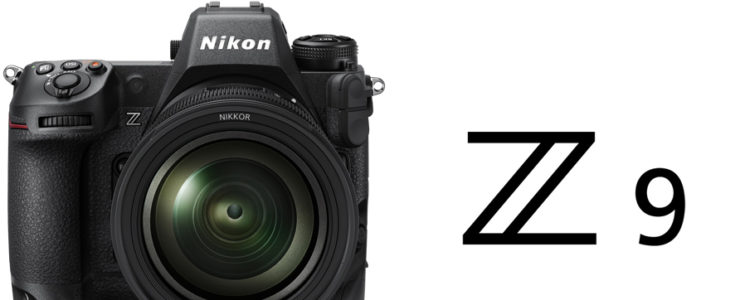
Industry News: Nikon Announces Development Of Nikon Z 9 Full Frame Flagship MILC

eos r3 vs nikon z9

Nikon announced the development of their flagship full frame mirrorless camera, the Nikon Z 9.

Nikon press release:

Nikon is developing the Nikon Z 9 full-frame flagship mirrorless camera

TOKYO – Nikon Corporation (Nikon) is pleased to announce the development of the first flagship model for which the Nikon Z mount has been adopted: The Nikon Z 9. The full-frame (Nikon FX-format) mirrorless camera is scheduled for release in 2021, and represents a significant leap in technology and performance.

The Z 9 brings together Nikon’s groundbreaking technologies to deliver the best still and video performance in Nikon history, meeting the advanced needs of professionals across a wide range of genres. It utilizes a newly developed FX-format stacked CMOS sensor and new image-processing engine. In response to the growing needs of professionals, advanced enthusiasts and cinematographers, it includes support for 8K video recording as well as various other video specifications that fulfill diverse needs and workflows. The Z 9 embodies ultimate usability as a tool offering users an unprecedented imaging experience, from capture to workflow, exceeding that of previous digital-SLR and mirrorless cameras.

  • *Information regarding the release of this product will be announced at a later date.

Canon Kills Its “Imaging Division”, Creates “Optical Industry” With Additional Products Instead

canon

Some radical changes undergoing Canon as a whole have been reported at the latest Company Strategy Conference. Thanks to EdinaMN for the tip.

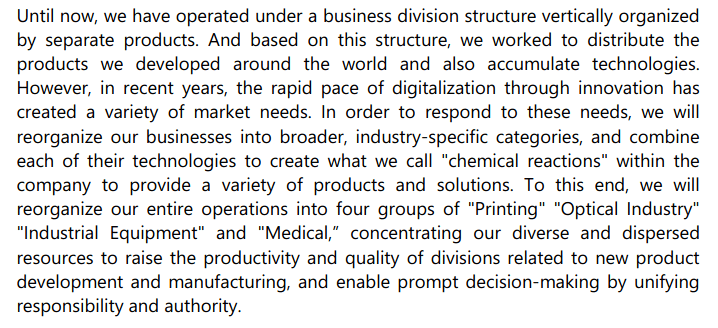
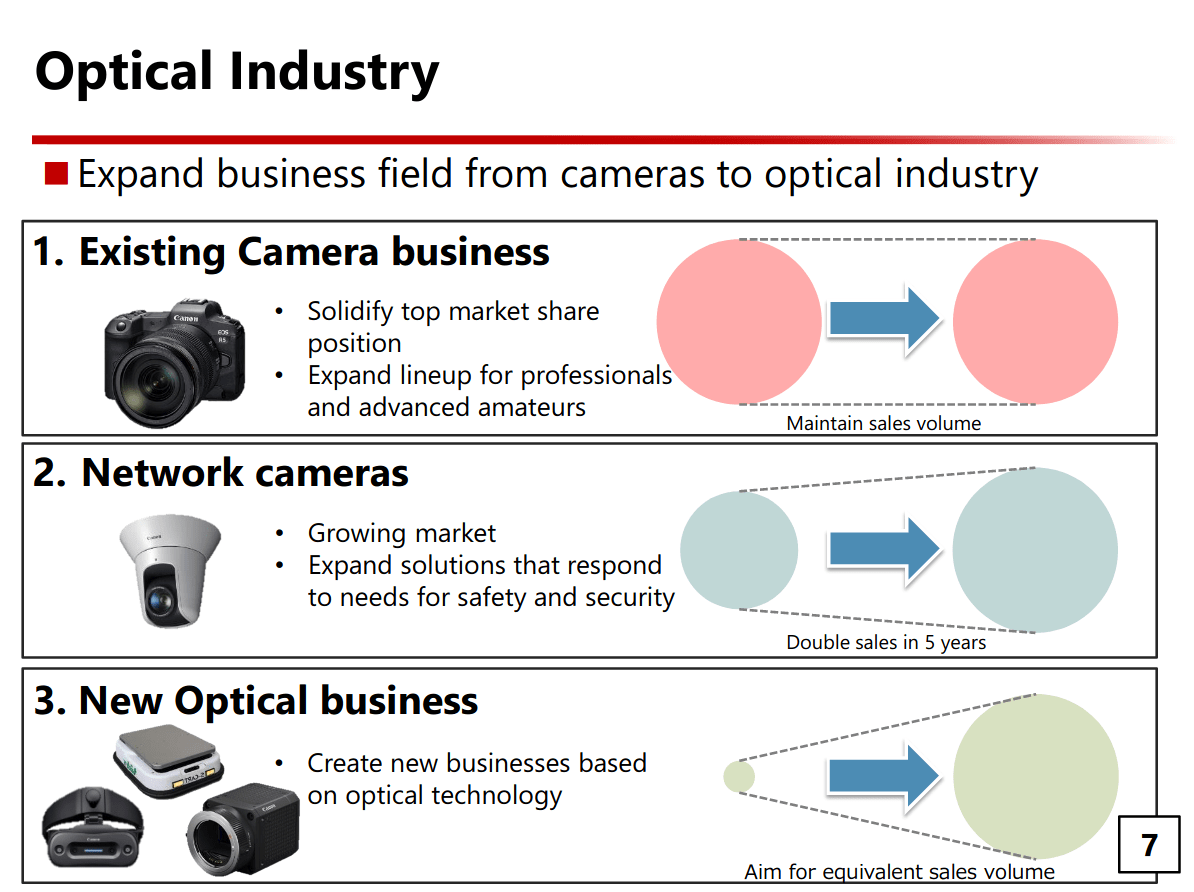
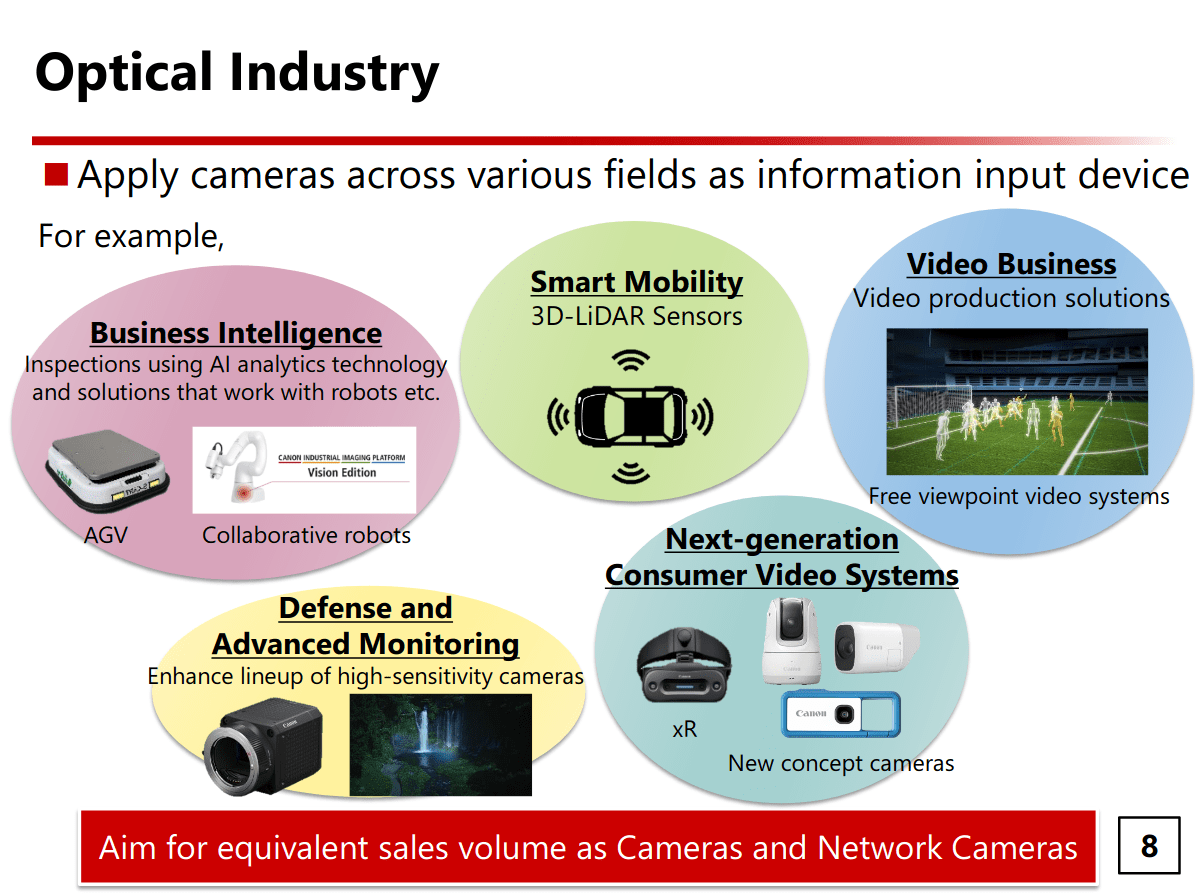
Mr. Fujio Mitarai’s speech at the conference highlights the difficulties Canon has to face as a global company. What Mr. Mitarai outlines is a corporate reorganization plan which defines four new business domains where Canon is going to be active: printing, industrial equipment, medical, and optical industry. Canon calls this process changing from a product group to a industry group business structure (see image on top). In Mr. Mitarai’s words:

The newborn “Optical Industry” involves three main areas, the existing camera business, network cameras, and other optical devices like Canon’s specialized cameras for scientific applications or mixed reality technology.

It’s the third business area in the image above that seems to hold most of Canon’s hopes for the future:

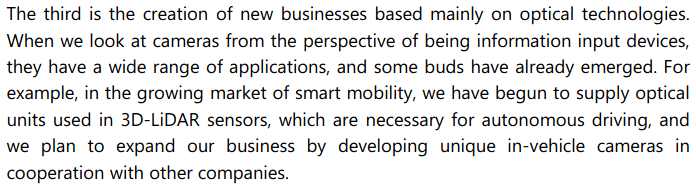
Canon clearly states that the “camera market has contracted significantly due to advances made in smartphone image capture functions” and that the “broader optical industry is a promising growth area for imaging devices that comprise mainly lenses and sensors“. The image below gives ore insights.

canon

All in all, Canon seems to be optimistic about the future. All material related to Canon’s Company Strategic Conference, including Mr. Fujio Mitarai’s speech, can be found here and are available for download.

Industry News: Sony Set To Release a 128MP Imaging Sensor With Global Shutter

global shutter

Sony is set to release another innovative imaging sensor, with 128MP resolution and global shutter.

Canon is also rumored to work on an entirely new sensor. Sony, so it seems, will release its imaging sensor before Canon..

Sony press release:

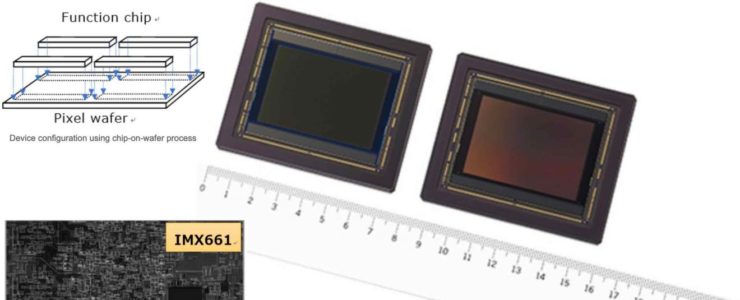
Sony to Release Large Format CMOS Image Sensor with Global Shutter Function and Industry’s Highest Effective Pixel Count of 127.68 Megapixels

Delivering Increased Pixel Count, High-Speed Imaging Performance, and Contributing to Solutions in the Field of Advanced, Diversified Industrial Equipment

Tokyo, Japan — Sony Corporation announced today the upcoming release of a large format 56.73mm diagonal CMOS image sensor “IMX661” for industrial equipment with a global shutter function and the industry’s highest*1 effective pixel count of 127.68 megapixels.*2

This product features an increased pixel count that yields an optical size nearly 10 times larger than the common 1.1-type image sensor corresponded to the C mount*3 for industrial equipment. It also features Sony’s original global shutter pixel technology “Pregius™”, which enables capture of motion distortion-free images. Furthermore, the Sony’s original device configuration and interface technology employed enable high-speed image readout at a data rate nearly four times faster*4 than conventional products.

Sony expects that the new sensor, when used in industrial equipment cameras for a wide variety of applications, will help to solve a variety of complex challenges, thereby contributing to the development of industry.

  • *1Among CMOS image sensors equipped with a global shutter. According to Sony research (as of announcement on March 9, 2021).
  • *2Based on image sensor effective pixel specification method.
  • *3The joining mechanism between lens and the camera body.
  • *4Compared to Sony’s “IMX253” 1.1 type, 12.37 effective megapixels CMOS image sensor equipped with a global shutter function.

Model name Sample: IMX661 3.6 type (56.73 mm diagonal) 127.68-effective-megapixel CMOS image sensor
Shipment date (planned)*5: April 2021(*5 The dates given for sample shipment date (planned) are for the color model. Black and white model samples will be available for shipment approximately one month later.”

Needs for automation, labor-saving and other benefits of digital transformation continue to grow in recent years in various fields of industrial equipment. This has accelerated the adoption of cameras for a wide variety of applications, driving demand for CMOS image sensors with higher imaging performance.

The new product couples Sony’s Pregius technology with the 3.6-type (56.73mm diagonal) large optical size, delivering an increased pixel count and motion distortion-free imaging. The original device configuration, which employs a chip-on-wafer process, together with Sony’s original interface technology, enables high-speed readout nearly four times faster than conventional products*4 in full-pixel readout mode. This design delivers highly efficient imaging that captures a wide viewing angle with no motion distortion in a single imaging operation. It also improves recognition precision thanks to the high-resolution imaging and delivers a high level of processing performance. It can contribute to solutions for a variety of industrial equipment applications, for example, inspection processes for production of displays and electronic substrates, wide-area monitoring, and aerial photography, where its improved precision and quicker readout will help meet the need for a high level of productivity.

Click here to open the rest of the article